Rina Sato
CS2 Premier Rating Colors Explained | What Each Color Means
CS2 Premier rating colors explained: learn what every color means, from Grey and Light Blue to Red and Gold, and where each rating tier starts.
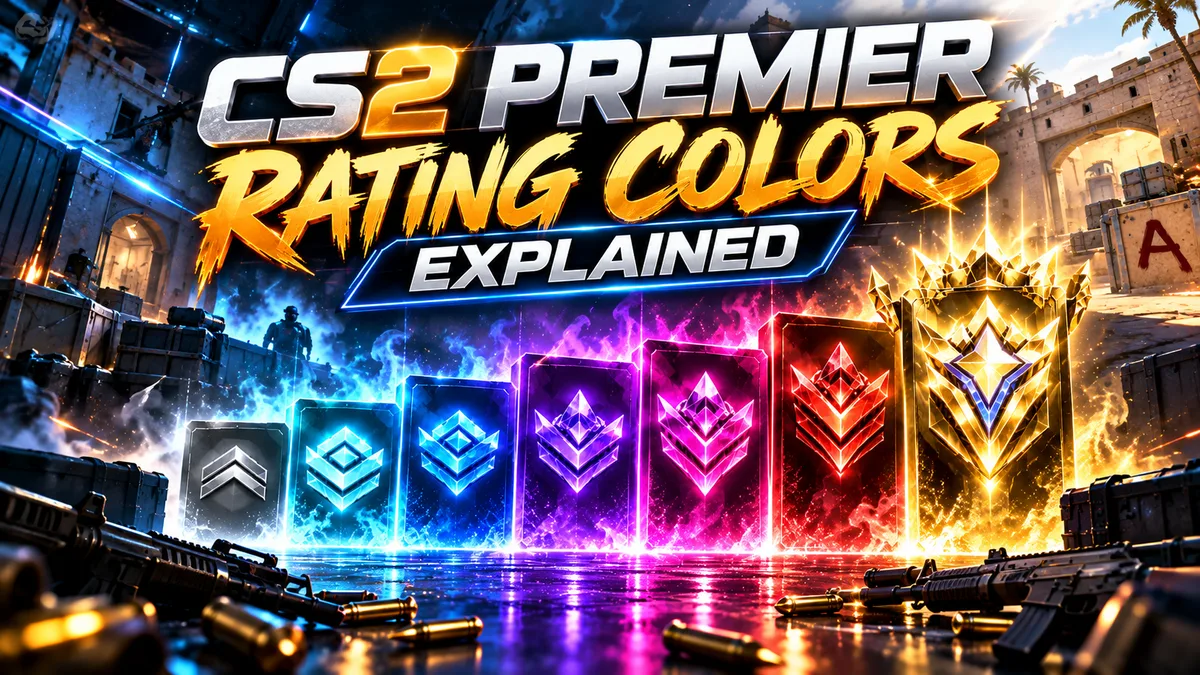
CS2 Premier Rating Colors Explained
CS2 Premier uses a visible CS Rating instead of the traditional rank badges used in Competitive mode. Your rating is displayed with a color that represents a specific rating range, making it easy to understand roughly where you sit on the Premier ladder.
Valve describes CS Rating as a visible measurement of Counter-Strike performance that determines your position on regional and global leaderboards. It is earned through Premier matches. :chatgpt-content-reference{index="1"}
But what does each color actually mean?
CS2 Premier Rating Colors at a Glance
The current Premier system is commonly divided into seven color bands:
| Color | CS Rating |
|---|---:|
| Grey | 0–4,999 |
| Light Blue | 5,000–9,999 |
| Blue | 10,000–14,999 |
| Purple | 15,000–19,999 |
| Pink | 20,000–24,999 |
| Red | 25,000–29,999 |
| Gold | 30,000+ |
These color bands are widely used to describe the current Premier rating structure. Valve's official CS2 information confirms the CS Rating system itself, but does not publish a detailed official color-threshold table on its main CS2 page. :chatgpt-content-reference{index="2"}
Grey — 0 to 4,999 CS Rating
Grey is the lowest Premier color band.
Players in this range are generally still developing their fundamentals, learning the Premier map pool, or returning to CS2 after a period away from competitive play.
If you are currently below 5,000, focus on the basics before worrying about advanced strategies:
- Crosshair placement
- Counter-strafing
- Recoil control
- Basic utility usage
- Economy management
- Trading teammates
- Playing common angles
Getting these fundamentals consistent can have a much bigger impact than trying to learn complicated executes.
Light Blue — 5,000 to 9,999
Light Blue is the second Premier color band.
Players around this range are usually becoming more comfortable with the core mechanics of CS2. The biggest improvements often come from reducing unnecessary deaths and making better decisions rather than simply trying to get more kills.
At this stage, work on:
- Better positioning
- More disciplined peeking
- Trading kills
- Playing with your team
- Using grenades with a purpose
- Understanding when to save
- Improving your economy decisions
If you are repeatedly getting stuck around the same rating, consistency is usually more important than attempting flashy plays.
Blue — 10,000 to 14,999
Blue represents the next major Premier rating band.
Once you reach 10,000 CS Rating, opponents generally become more consistent and mistakes are punished more frequently.
Players trying to move through this range should start thinking more about round structure rather than individual duels.
For example, instead of asking:
"Can I win this fight?"
Ask:
"What happens to our round if I lose this fight?"
This mindset helps reduce unnecessary aggressive plays and improves overall round consistency.
Map knowledge also becomes increasingly important. Knowing common rotations, timings, grenade lineups, and default positions can give you advantages without requiring perfect aim.
Purple — 15,000 to 19,999
Purple marks another significant step up the Premier ladder.
At this rating, mechanical fundamentals are usually no longer enough by themselves. Players need to combine aim with better decision-making and stronger understanding of how rounds develop.
Important areas to improve include:
- Mid-round decision-making
- Utility coordination
- Trading
- Reading enemy rotations
- Managing advantages
- Playing the clock
- Understanding opponent tendencies
Communication also becomes increasingly valuable.
A simple call such as an enemy position, missing utility, or rotation can give your teammates information that changes the entire round.
Pink — 20,000 to 24,999
Pink is one of the higher Premier rating bands.
Once you reach 20,000 CS Rating, maintaining consistency becomes increasingly important. A single bad round can be recovered from, but repeatedly making the same mistakes can quickly turn into a losing streak.
Players at this level should pay particular attention to:
- Advanced positioning
- Utility timing
- Team coordination
- Trading efficiency
- Counter-strategies
- Opponent tendencies
- Clutch decision-making
At this point, reviewing your own matches can be extremely useful.
Instead of only looking at your kills and deaths, examine why you died. Were you isolated? Did you peek without support? Did you use utility too early? Did you fail to anticipate a rotation?
These questions can reveal problems that a simple scoreboard cannot.
Red — 25,000 to 29,999
Red is one of the highest Premier color bands.
Players reaching 25,000 CS Rating are operating near the top end of the rating ladder compared with the broader Premier population. Third-party tracking datasets show that the player population becomes much smaller in the higher rating bands, although Valve does not publish an official Premier rating distribution. :chatgpt-content-reference{index="3"}
At this level, small advantages matter.
Players need to consistently:
- Convert man advantages
- Avoid unnecessary deaths
- Coordinate utility
- Trade effectively
- Adapt to opponents
- Understand timing windows
- Maintain concentration throughout the match
The difference between winning and losing can come down to a handful of decisions across an entire game.
Gold — 30,000+ CS Rating
Gold is the highest commonly recognized Premier color band.
It begins at 30,000 CS Rating and represents the extreme upper end of the Premier ladder.
Gold does not mean that there is a hard maximum of exactly 30,000. The rating can continue above that threshold, with top players appearing significantly higher on leaderboards.
Valve's CS2 system uses CS Rating to determine global and regional leaderboard positions, making very high ratings particularly relevant for players competing at the top end of Premier. :chatgpt-content-reference{index="4"}
If your goal is to reach 30,000+, simply playing more matches is unlikely to be enough. You need consistent performance, strong mechanics, excellent decision-making, and the ability to perform against other highly skilled players.
Does the Color Matter More Than the Exact Rating?
Not really.
The color gives you a quick visual indication of your rating range, but the actual number provides much more information.
For example:
- 10,100 and 14,900 are both Blue
- 15,100 and 19,900 are both Purple
- 20,100 and 24,900 are both Pink
The players at opposite ends of the same color can therefore have very different ratings.
If you want to compare your progression accurately, pay attention to your exact CS Rating, not just the color displayed next to it.
How Does CS2 Premier Rating Increase?
Your CS Rating changes through Premier matches.
Winning increases your rating while losing decreases it. The amount shown before a match can vary, so the impact of a result is not necessarily identical from one game to another.
The most important thing is therefore to focus on consistently winning matches rather than trying to maximize the rating gained from an individual game.
For a broader explanation of the rating system, see our CS2 Premier Rating Explained.
How to Climb to the Next CS2 Rating Color
If you are trying to move from one color band into the next, focus on fundamentals that consistently influence rounds.
1. Improve Your Aim
Better crosshair placement reduces the amount of adjustment required when an opponent appears.
Practice your most-used weapons rather than constantly changing your setup.
2. Stop Taking Unnecessary Fights
Not every duel needs to be taken.
If your team already has the advantage, preserving that advantage can be more valuable than searching for another kill.
3. Use Utility With a Purpose
Smoke, flash, molotov, and HE grenade usage should have a reason behind it.
A flash that helps your teammate take an angle is usually more valuable than a flash thrown without coordination.
4. Play for Trades
If your teammate enters a site, try to be close enough to trade the kill.
Trading converts individual fights into team advantages and makes aggressive plays much more reliable.
5. Learn the Maps
Knowing common angles, rotations and timings allows you to make better decisions before the fight even begins.
6. Review Your Losses
Losing a match does not automatically mean you played badly.
Look for repeated mistakes instead:
- Dying first too often
- Giving away man advantages
- Poor utility usage
- Predictable positioning
- Late rotations
- Weak communication
Fixing one recurring mistake can have a larger impact than learning another advanced mechanic.
How Long Does It Take to Reach the Next Color?
There is no fixed number of matches required.
Your progression depends on your current rating, match results, the rating changes shown for your games, and your ability to maintain a positive win rate.
Someone with a strong and consistent win rate can progress considerably faster than a player alternating between winning and losing streaks.
The best approach is to treat each color as a progression milestone rather than trying to reach a specific rating in a single session.
CS2 Premier Colors vs. Competitive Ranks
Do not confuse Premier colors with the traditional Competitive ranks.
Premier uses a single numerical CS Rating.
Competitive uses separate skill groups for individual maps.
For example, a player can have different Competitive ranks on different maps while having one Premier CS Rating.
If you mainly want to improve your Premier rating, focus on the Premier system rather than trying to convert your rating directly into an old CS:GO rank.
Want to Rank Up Faster in CS2?
If your goal is to improve your Premier rating, our How to Rank Up Fast in CS2 guide covers practical strategies for improving your results.
For players looking for direct Premier progression, RankForge also offers CS2 Premier Rank Boosting.
Whether you are trying to reach 10,000, 15,000, 20,000, or push toward the 30,000+ Gold tier, understanding the rating system is the first step toward setting a realistic target.
Final Takeaway
CS2 Premier uses seven commonly recognized color bands:
- Grey: 0–4,999
- Light Blue: 5,000–9,999
- Blue: 10,000–14,999
- Purple: 15,000–19,999
- Pink: 20,000–24,999
- Red: 25,000–29,999
- Gold: 30,000+
The color provides a quick overview of your position on the Premier ladder, but your exact CS Rating is more useful when tracking progress.
If you want to climb, focus on consistent round impact, better decision-making, strong mechanics, and reducing repeat mistakes rather than simply playing more games.