 Rina Sato
CS2 Retake Guide: Utility, Positioning & Teamwork
Learn how to win more CS2 retake rounds with better positioning, utility usage, teamwork, and bomb-timer management.
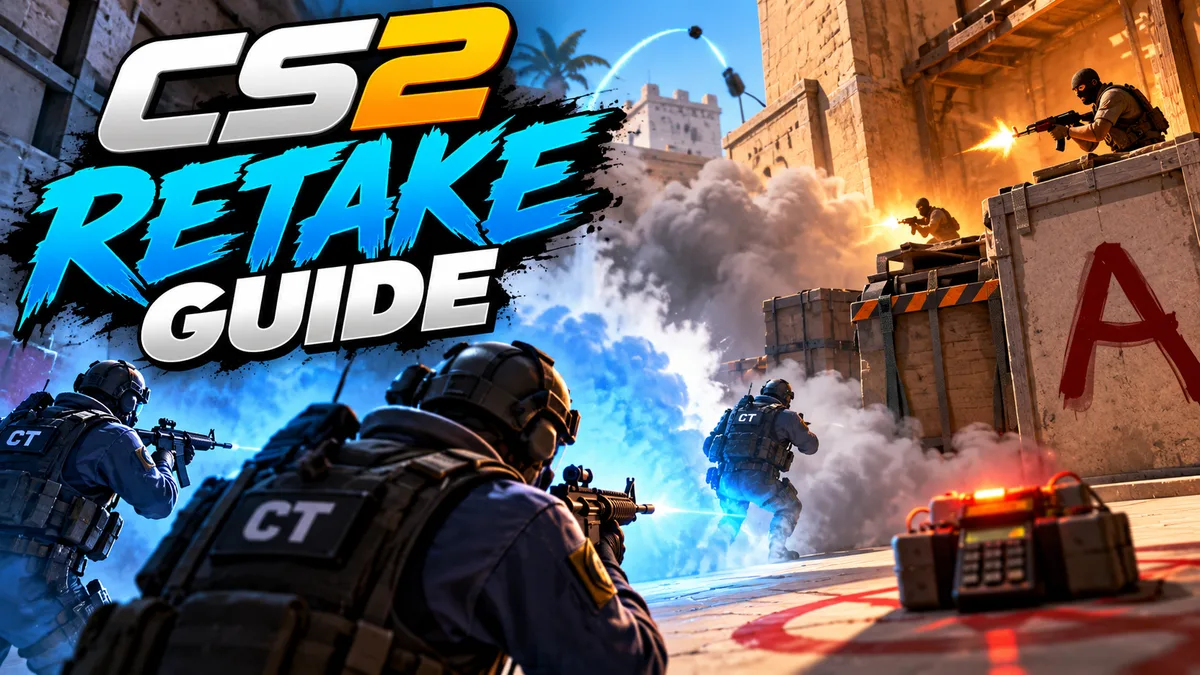
CS2 Retake Guide: How to Win More Rounds with Utility, Positioning & Teamwork
Winning a round in Counter-Strike 2 doesn't always mean preventing the bomb from being planted. Sometimes, the Terrorists take control of a bombsite, your teammates fall back, and your team must coordinate a retake before the bomb explodes.
Retaking a bombsite is one of the most demanding situations in CS2. You have limited time, fewer opportunities to make mistakes, and opponents who can use the planted bomb to their advantage.
The difference between a successful retake and a lost round often comes down to three things: timing, utility, and teamwork.
In this CS2 retake guide, you'll learn how to approach retakes more intelligently, coordinate with teammates, use grenades effectively, and avoid the mistakes that cost Counter-Terrorists valuable rounds.
What Is a Retake in CS2?
A retake happens when the Counter-Terrorists lose control of a bombsite after the bomb has been planted and must eliminate the defending Terrorists before the bomb explodes.
Unlike a normal site defense, a retake forces your team to fight against opponents who already have favorable positions. Terrorists can hold common entry points, play off angles, and use the ticking bomb to force the Counter-Terrorists into predictable approaches.
A successful retake requires more than winning individual duels. Players must coordinate their movement, clear dangerous positions, and manage the remaining time.
Before committing to a retake, consider:
- How many teammates are alive?
- How many enemies are likely defending the site?
- How much time remains before the bomb explodes?
- Which grenades and defuse kits are available?
- Can your team attack together, or are players too far apart?
These questions help you decide whether a retake is realistic or whether saving your weapons is the better option.
1. Decide Whether the Retake Is Worth Attempting
One of the most common mistakes in CS2 is attempting every retake regardless of the situation.
A 3v2 retake with several grenades and sufficient time can be favorable. A 1v4 retake with no utility and only a few seconds remaining is usually a poor investment.
Before committing, evaluate the round.
Count the Players
The number of living players matters, but so does their positioning. A 3v3 retake may be manageable if your team can approach together. The same situation becomes much harder when one teammate is isolated on the opposite side of the map.
Check the Equipment
Smokes can block enemy vision, flashbangs can create entry opportunities, and HE grenades can damage opponents holding predictable positions.
A defuse kit can also change your options by reducing the time required to defuse the bomb.
Consider the Economy
If your team is on a low-buy or an eco round, saving an expensive rifle may be more valuable than attempting an unlikely retake.
However, saving should not become an automatic habit. If the round is winnable and the economic situation supports an attempt, committing together can be the correct decision.
Rule of thumb: Retake when your team has a realistic path to clearing the site and defusing the bomb. Save when the odds are poor and preserving equipment offers more value in the next round.
2. Retake Together Instead of Taking Isolated Fights
Timing is one of the most important elements of a successful retake.
Imagine three Counter-Terrorists approaching a planted bomb. The first player enters the site alone and dies. The second arrives several seconds later and loses another duel. The final player is now forced into an unfavorable situation.
The problem was not necessarily individual aim. The team never created a coordinated fight.
Establish a Regroup Point
Whenever possible, regroup before entering the bombsite. This doesn't mean waiting indefinitely or allowing the bomb timer to expire. It means avoiding unnecessary staggered engagements.
Use voice communication or quick callouts to establish when your team will move.
Trade Kills
Players should approach in a way that gives teammates an opportunity to trade a kill. If the first player is eliminated, the second should be positioned to challenge the opponent without exposing themselves to several angles at once.
Trading does not require every player to enter through the same doorway. Coordinated pressure from multiple directions can make it difficult for defenders to focus on one target.
Avoid Unnecessary Solo Pushes
If you are separated from the team, communicate your position and move toward a useful regroup point when time allows.
An isolated player can sometimes make a high-impact play, but repeatedly taking solo fights gives defenders opportunities to eliminate your team one player at a time.
3. Use Utility Before Entering the Bombsite
Grenades are especially valuable during retakes because defenders often know where attackers must enter.
Good utility disrupts those defensive positions and gives your team opportunities to take space.
Smoke Grenades
Smokes can block sightlines from common defensive positions and make dangerous crossings more manageable.
Use them to:
- Block a long angle while teammates cross.
- Separate defenders from supporting positions.
- Reduce the number of angles your team must fight simultaneously.
- Create safer movement toward the bomb.
Smoke placement should reflect the map, bombsite, and remaining time. A poorly placed smoke can block your own team's vision or leave a critical angle exposed.
Flashbangs
A well-timed flashbang can force defenders to turn away or temporarily lose their ability to fight effectively.
Coordinate flashes with your team's entry. A flash that detonates too early may have little impact by the time your teammates arrive.
Avoid throwing flashes directly in front of teammates without warning them.
HE Grenades and Molotovs
HE grenades can punish opponents holding predictable positions, while Molotovs can force defenders out of cover or deny access to important areas.
Use these grenades to create space rather than throwing every piece of utility immediately.
The objective is to make the retake easier for your team, not simply to use every grenade before the round ends.
4. Clear Angles Methodically
During a retake, defenders often have the advantage of choosing where to position themselves. Rushing onto the site without clearing dangerous angles can turn a winnable round into a series of unfavorable duels.
Think about the most likely defensive positions based on the bomb plant, the map, and the information available.
Prioritize Dangerous Positions
You cannot safely inspect every corner at the same time. Focus first on angles that can stop your team's entry or prevent access to the bomb.
Use utility and teammate positioning to reduce the number of places an opponent can attack from.
Avoid Exposing Yourself to Multiple Angles
Whenever possible, move in a way that limits how many opponents can see you at once.
This is one reason coordinated entry is so effective. If teammates apply pressure from different directions, defenders may have to choose which threat to address.
Communicate What You Clear
Call out confirmed enemy positions and areas you have checked. Clear communication prevents teammates from wasting time repeating the same checks while another angle remains dangerous.
Do not assume an area is empty simply because you did not see an opponent there.
5. Understand the Bomb Timer
A retake can fail even when the Counter-Terrorists win every duel because they leave themselves insufficient time to defuse.
You must account for the time needed to reach the bomb, eliminate defenders, and complete the defuse.
In CS2, the standard bomb timer is 40 seconds. A defuse takes 10 seconds without a kit and 5 seconds with a defuse kit.
That means reaching the bomb just before detonation is not enough. Your team needs to control the area and begin the defuse with sufficient time remaining.
Assign Responsibility for the Defuse
If your team has a kit, communicate who has it. This avoids confusion when multiple players reach the bomb simultaneously.
A teammate should cover the defuser whenever possible, while the remaining players focus on likely enemy positions.
Don't Chase Unnecessary Kills
Once the bomb is accessible, additional fights may be unnecessary if the defuse can be secured safely.
Prioritize the objective. Winning a duel is useful only if it helps your team complete the round.
6. Adapt Your Retake Strategy to the Map
The basic principles of retaking remain the same, but the execution depends on the map.
Different bombsites have different entry points, sightlines, elevation changes, and defensive positions.
Learn Common Defensive Setups
Pay attention to where opponents repeatedly position themselves after planting the bomb. Review your own matches to identify angles that consistently cause problems.
Over time, you will recognize patterns and anticipate where defenders are likely to hold.
Understand Alternate Approaches
A predictable retake route allows defenders to prepare crossfires. When the timer permits, consider whether a different approach could create pressure from another direction.
However, taking a long rotation is not automatically better. The alternative route must provide enough time to reach the bomb and complete the defuse.
Practice Utility for Your Most-Played Maps
Learn a small number of reliable smoke and flash lineups for the sites you encounter most often.
You do not need to memorize every lineup in the game. Start with utility that solves recurring problems in your own matches, then expand your repertoire.
7. Know When to Save Your Weapons
Saving is part of good Counter-Strike decision-making, not an admission that you are a bad player.
There are situations where the chance of winning the retake is so low that preserving a rifle, armor, or valuable utility is the better strategic choice.
Consider saving when:
- You are the last player alive against several opponents.
- The bomb timer leaves insufficient time to defuse.
- Your team has no realistic way to clear the site.
- Saving expensive weapons will significantly improve your next-round buy.
On the other hand, do not save automatically just because the bomb has been planted. A coordinated retake can still be the best option when your team has the numbers, equipment, and time to make it work.
The goal is to make decisions that improve your team's chances across the match, not to maximize the number of weapons you personally save.
8. Improve Your Communication
A retake becomes much harder when everyone makes independent decisions.
You do not need complicated strategies or lengthy explanations. Short, actionable callouts are usually enough.
Useful information includes:
- Enemy positions.
- Number of opponents seen.
- Available utility.
- Whether the bomb is accessible.
- Who has the defuse kit.
- When your team is ready to enter.
Avoid flooding voice communication with guesses or repeating information that everyone already knows.
If you are unsure about an enemy's position, make that uncertainty clear. Accurate information is more valuable than a confident but incorrect callout.
9. Review Your Failed Retakes
Improvement comes from understanding why a round failed, not simply playing more matches.
After a failed retake, ask yourself what actually caused the loss.
Did your team enter separately? Did you use utility too early? Did you ignore a dangerous angle? Did you spend too much time rotating? Did nobody know who had the defuse kit?
Reviewing these mistakes helps you identify patterns.
A Simple Practice Routine
Try this routine during your next CS2 sessions:
1. Identify one retake mistake after each relevant round.
2. Choose one improvement to focus on, such as trading or utility timing.
3. Practice useful grenade lineups on your most-played maps.
4. Review a replay to understand where your team lost control.
5. Check whether the same mistake happens repeatedly.
Focus on one or two improvements at a time. Trying to change every aspect of your play simultaneously makes progress harder to measure.
Common CS2 Retake Mistakes to Avoid
Before your next match, watch out for these recurring problems:
- Entering one at a time: Gives defenders isolated fights instead of forcing them to handle coordinated pressure.
- Ignoring utility: Allows opponents to hold comfortable positions without being challenged.
- Forgetting the timer: Leaves too little time to complete the defuse.
- Repeating predictable approaches: Makes it easier for defenders to prepare crossfires.
- Over-rotating: Wastes valuable time before the actual retake begins.
- Saving too early: Gives up rounds that could still be won.
- Refusing to save: Risks expensive equipment in situations with little chance of success.
Fixing these habits can improve your decision-making even before your aim or mechanical skill changes.
Final Thoughts: Win More Retakes Through Better Decisions
Winning more retakes in CS2 is not just about having better aim. It requires your team to make sensible decisions under pressure, use utility effectively, clear angles together, and respect the bomb timer.
Start with the fundamentals: evaluate whether a retake is realistic, regroup when possible, communicate clearly, and make every grenade serve a purpose.
Most importantly, review your mistakes. A failed retake can reveal exactly what you need to practice for the next match.
If you want to improve your overall Counter-Strike performance, combine these habits with consistent aim practice, map knowledge, and better team coordination.
Looking to improve your CS2 rank? Explore RankForge CS2 Boosting to learn about the available boosting service options.


