Diego Alvarez
Deadlock Best Items for Ranked | Item Guide & Builds 2026
Learn the best Deadlock items for Ranked, when to buy them, how itemization works and how to adapt your build to the enemy team in 2026.
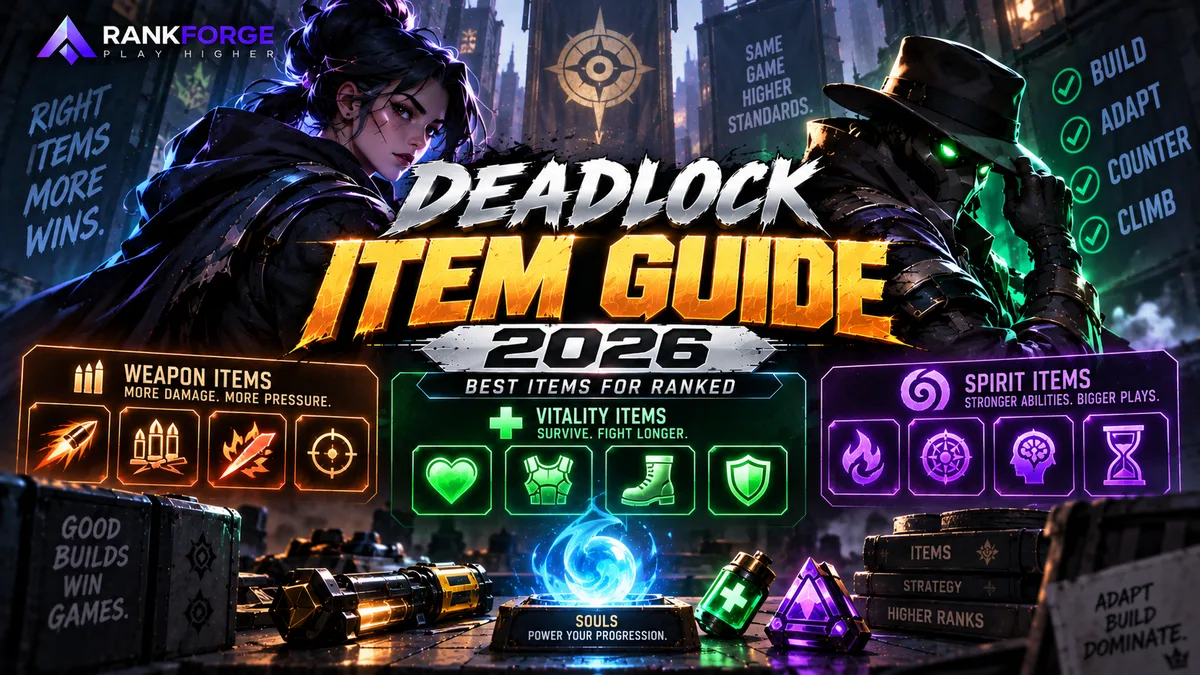
Deadlock Best Items for Ranked | Item Guide & Builds 2026
Deadlock's item system can be overwhelming when you're first trying to build a hero.
There are hundreds of possible item combinations, four item tiers, multiple upgrade paths and three major item categories.
And unlike a traditional hero shooter, your item choices can completely change how your hero performs.
A good build can turn a weak lane into a stable one.
A bad build can leave you with expensive items that do not solve the problems you're actually facing.
This guide explains the best Deadlock items for Ranked in 2026, how the item system works, which purchases are useful in different situations, and how to adapt your build instead of blindly following a fixed item order.
Patch note: This guide reflects the September 16, 2026 balance environment. Deadlock is actively updated, so individual item values and build priorities can change between patches.
---
How the Deadlock Item System Works
Deadlock currently has 156 items across the main item system.
Items are divided into three major categories:
- Weapon
- Vitality
- Spirit
Items are also separated into four price tiers:
| Tier | Cost |
|---|---:|
| Tier 1 | 800 Souls |
| Tier 2 | 1,600 Souls |
| Tier 3 | 3,200 Souls |
| Tier 4 | 6,400 Souls |
Some higher-tier items are upgrades of lower-tier components.
This means you don't always have to save the full price of an expensive item.
You can purchase a component first and upgrade it later.
The current item system therefore rewards players who understand both the final item and the path used to reach it.
---
Weapon Items
Weapon items primarily improve your gun and basic attack performance.
They can provide things such as:
- Bullet damage
- Fire rate
- Magazine size
- Bullet resistance reduction
- Reload improvements
- Weapon range
- Critical-hit effects
- Attack-related utility
Weapon items are particularly important on heroes whose primary damage comes from sustained gunfire.
---
Vitality Items
Vitality items improve your ability to survive.
Depending on the item, they can provide:
- Maximum health
- Health regeneration
- Movement speed
- Stamina
- Resistances
- Healing
- Defensive actives
Vitality items are not simply "tank items."
Even aggressive heroes can benefit from defensive purchases.
Surviving an additional few seconds in a team fight can allow you to deal significantly more damage than buying another offensive item would have.
---
Spirit Items
Spirit items improve abilities and other non-weapon aspects of a hero.
They can affect:
- Spirit Power
- Ability damage
- Cooldowns
- Ability range
- Ability duration
- Charges
- Utility effects
Spirit-heavy builds are particularly effective on heroes whose abilities provide most of their damage or utility.
---
The Best Deadlock Items Are Situation Dependent
There is no single six-item build that is optimal in every Deadlock match.
Your purchases should depend on:
- Your hero
- Your lane
- Enemy heroes
- Enemy items
- Your current Soul income
- Whether you're ahead or behind
- Your team's win condition
This is one of the biggest differences between a beginner and an experienced player.
A beginner asks:
"What is the best build?"
An experienced player asks:
"What does this game require from my build?"
---
Best Early-Game Deadlock Items
Early purchases should solve immediate problems.
You usually want to improve one or more of:
- Farming
- Lane survivability
- Movement
- Stamina
- Weapon consistency
- Ability pressure
Some common early components include:
Sprint Boots
Sprint Boots provide early movement utility and are also used as a component in several upgrade paths.
Movement is extremely valuable in Deadlock because it affects:
- Rotations
- Escapes
- Chasing
- Lane pressure
- Map control
Do not underestimate movement speed simply because it does not directly increase your damage.
---
Extra Regen
Extra Regen is useful when your lane is forcing you to repeatedly spend resources recovering from poke.
It can help you stay on the map longer rather than constantly returning to base.
This is especially useful when your priority is maintaining farm.
---
Extra Stamina
Extra Stamina is valuable for heroes that rely heavily on movement.
More stamina can improve:
- Dodging
- Escaping
- Chasing
- Mobility combos
- Positioning
It can also make certain matchups considerably easier.
---
Monster Rounds
Monster Rounds is one of the early Weapon options that can improve your efficiency against NPC targets.
This can be useful when your immediate objective is improving farming rather than fighting the enemy hero.
---
High-Velocity Rounds
High-Velocity Rounds is another early Weapon option.
It can be useful when you want to improve the consistency of your weapon during the early stages of the game.
---
Extra Spirit
Extra Spirit provides an early route into Spirit-focused builds.
It can be useful for heroes that rely heavily on ability damage or Spirit scaling.
---
Mystic Burst
Mystic Burst provides an early Spirit-oriented option for heroes looking to increase ability pressure.
The important thing is not simply buying a Spirit item because it is statistically strong.
Your hero needs to actually benefit from the stats and effect.
---
Best Mid-Game Deadlock Items
The mid game is where itemization becomes much more important.
You now have enough Souls to make larger investments, and enemy builds start revealing how the rest of the match will develop.
At this point, start asking:
What is stopping me from winning fights?
If the answer is:
"I can't survive."
Buy defense.
If the answer is:
"I can't kill them."
Look for offensive penetration or damage.
If the answer is:
"I can't catch them."
Look for mobility or control.
If the answer is:
"I'm getting disabled."
Consider defensive utility.
This approach is much better than blindly following a predetermined item order.
---
Toxic Bullets
Toxic Bullets is one of the items affected by the September 16, 2026 patch.
Its Spirit scaling was increased from 0.005% to 0.006%.
Toxic Bullets applies a damage-over-time effect through its buildup mechanic.
It can be particularly interesting for heroes that:
- Attack frequently
- Maintain pressure on targets
- Can consistently apply bullet hits
- Benefit from sustained damage
Because Toxic Bullets uses buildup, understanding the mechanic is important.
Buildup accumulates toward a 100% trigger and decays when the target is not receiving new buildup.
---
Hollow Point
Hollow Point also received a September 16 adjustment.
Its Bullet Resist Reduction increased from:
9% → 10%
That makes it a relevant item to consider when your build needs additional pressure against targets with significant Bullet Resistance.
As always, item value depends on your actual matchup.
Do not buy it simply because the number increased.
Buy it when the effect solves a problem in your game.
---
Weakening Headshot
Weakening Headshot was adjusted in the September 16 update.
Its Bullet Resist Reduction was reduced from:
-13% → -12%
This is a good example of why old build guides can become unreliable.
A build that was optimal several months ago may no longer have exactly the same value after multiple balance changes.
---
Shadow Weave
Shadow Weave received several important changes in the September 16 patch.
It now builds from Sprint Boots.
Its Sprint Speed increased from:
1.5 → 2
Its cooldown was reduced from:
45 seconds → 37 seconds
This makes Shadow Weave particularly interesting for heroes that value mobility, stealth and repositioning.
It also demonstrates why component paths matter.
If you already purchased Sprint Boots, the path toward Shadow Weave can fit naturally into your build.
---
Spiritual Overflow
Spiritual Overflow was changed significantly in the September 16 patch.
Its buildup is now 35% slower.
Its Spirit Power on proc was reduced from:
40 → 30
Its Fire Rate was reduced from:
30% → 25%
This means players should reconsider older Spiritual Overflow builds rather than automatically treating the item as a default purchase.
The item still has a specific role, but its value needs to be judged against the current patch.
---
Restorative Locket
Restorative Locket was also adjusted.
Its heal per boon was reduced from:
0.5 → 0.45
Its stack range was reduced from:
35m → 32m
This makes positioning more important when using the item.
If you're relying on its utility, you need to remain within the effective range rather than assuming it will work from anywhere nearby.
---
Trophy Collector
Trophy Collector received a reduction to its Souls-per-minute value:
18 → 16
This is another example of an item whose value should be evaluated in the context of your actual game.
Economy-focused items can be powerful when you have the time and safety to extract value from them.
But if your team needs immediate combat strength, delaying a critical fighting item for additional economy may not be correct.
---
Veil Walker
Veil Walker also changed in the September 16 patch.
It no longer builds from Sprint Boots.
It also lost the Sprint and Out-of-Combat Regen benefits that came from that component.
Its Spirit Power was reduced from:
10 → 6
Its movement-speed bonus is now removed when the invisibility ends.
These changes make older Veil Walker build guides particularly worth checking before copying them.
---
Best Items When You're Ahead
When you're ahead, your itemization should help you convert that advantage.
Good goals include:
- More damage
- Better mobility
- Stronger pressure
- Faster farming
- Better objective control
- Tools that prevent the enemy from stabilizing
However, being ahead does not mean you should buy pure damage every time.
Sometimes a defensive item protects your lead better than another offensive item.
For example:
If you are extremely fed but repeatedly dying to one enemy's crowd control, solving that problem can be more valuable than adding another damage item.
---
Best Items When You're Behind
Being behind requires a different approach.
The biggest mistake is trying to copy the build you would use while ahead.
Instead, ask:
What can keep me relevant?
That may mean buying:
- Defensive items
- Sustain
- Mobility
- Utility
- Efficient components
- Items that directly counter the enemy's strongest threat
The objective is not necessarily to become stronger than the enemy immediately.
The objective is to stop the game from getting further out of control.
---
Itemization Against Bullet Damage
If the enemy team is heavily focused on Bullet damage, prioritize ways to survive their primary damage source.
Look at:
- Bullet Resistance
- Health
- Healing
- Mobility
- Defensive actives
You don't always need to build a pure defensive item.
Sometimes mobility is the better defense because it allows you to avoid the enemy's damage entirely.
---
Itemization Against Spirit Damage
Against Spirit-heavy opponents, defensive itemization becomes important.
Consider:
- Spirit Resistance
- Health
- Defensive utility
- Mobility
- Interrupts
The exact choice depends on which enemy hero is creating the problem.
Don't counter "Spirit" as a concept.
Counter the actual threat.
---
Itemization Against Crowd Control
Crowd control can be more dangerous than raw damage.
If you're repeatedly dying before you can use your abilities, additional damage may not solve the problem.
Look for ways to:
- Avoid the ability
- Survive the initial burst
- Escape
- Interrupt the enemy
- Reposition
- Reduce the enemy's opportunity to engage
A dead hero deals zero damage regardless of how expensive their build is.
---
Don't Build Six Expensive Items
Another common mistake is focusing entirely on final-item builds.
Deadlock's component system allows you to become stronger before completing your final items.
For example:
800 Souls → useful component → 1,600 Souls → upgrade → 3,200 Souls
can often provide more immediate value than saving everything for a 6,400-Soul purchase.
The strongest build is not necessarily the build with the most expensive items.
It is the build that provides the most useful power at the moment you need it.
---
Build Components With a Plan
Before buying a component, ask:
What does this become later?
If you buy Sprint Boots, for example, you should know whether you're:
- Keeping the movement
- Upgrading it
- Using it as part of a larger build path
The same principle applies to other components.
Avoid filling your inventory with random items that do not contribute to a coherent final build.
---
When Should You Buy a Defensive Item?
Buy defense when it solves a real problem.
Good reasons include:
You die before using your abilities
You need more survivability.
You cannot escape
Mobility may be more valuable than raw damage.
One enemy is carrying the game
Build specifically against that threat.
Your team already has enough damage
Your additional utility may provide more value.
You're protecting a lead
A defensive purchase can prevent the enemy from getting shutdown kills.
---
When Should You Buy More Damage?
Damage makes sense when:
- You are consistently surviving fights
- You can safely attack
- Your team needs more kill pressure
- The enemy's defenses are becoming a problem
- Your hero scales strongly from offensive stats
But don't confuse damage with impact.
An item that gives slightly less theoretical DPS but allows you to consistently stay in fights can produce more real damage over the course of a match.
---
How to Build Items Based on Your Hero
Start with the hero's main source of value.
Gun-Focused Heroes
Prioritize items that improve:
- Weapon damage
- Fire rate
- Magazine efficiency
- Bullet pressure
- Sustained combat
Ability-Focused Heroes
Look toward:
- Spirit Power
- Cooldown-related effects
- Ability range
- Ability duration
- Charges
Frontline Heroes
Consider:
- Health
- Resistances
- Sustain
- Mobility
- Fight initiation
Assassins
Prioritize:
- Mobility
- Burst
- Target access
- Survivability during engagement
- Escape options
These categories are starting points, not strict rules.
Many heroes can use hybrid builds.
---
Don't Follow Build Guides Blindly
Build guides are useful.
But a build is not a substitute for understanding the game.
A published build might assume:
- A particular hero
- A particular patch
- A particular playstyle
- A particular enemy composition
- A particular level of farm
Your game may be completely different.
Use builds as a foundation.
Then adapt.
---
The 30-Second Itemization Check
Before buying your next major item, ask yourself five questions:
1. What is killing me?
Identify the actual threat.
2. What is preventing me from dealing damage?
Maybe it's range, crowd control, mobility or positioning.
3. Am I ahead or behind?
Your build should reflect the current game state.
4. What is my next power spike?
Don't buy random items simply because you have enough Souls.
5. What does my team need?
Your personal build still affects the entire team's win condition.
---
Common Deadlock Itemization Mistakes
1. Copying a Build Without Understanding It
You may buy the right item at the wrong time.
---
2. Building Pure Damage
Damage doesn't matter if you're constantly dead.
---
3. Building Pure Defense
Surviving forever doesn't win a game if you cannot threaten the enemy.
---
4. Ignoring Enemy Items
The enemy's build tells you how the game is developing.
Adapt accordingly.
---
5. Saving for Too Long
A 3,200-Soul item is not useful if you lose three fights while saving for it.
---
6. Buying Random Components
Every purchase should contribute toward a purpose.
---
7. Never Changing Your Build
If the game changes, your build should change too.
---
How to Learn Deadlock Itemization
The fastest way to improve is not memorizing 156 items.
Start with your main heroes.
For each hero, learn:
1. Two or three common starting purchases
2. Your main offensive path
3. Your main defensive path
4. One anti-Bullet option
5. One anti-Spirit option
6. One mobility option
7. One utility option
8. Your major late-game power spike
Once you understand these, you can adapt rather than memorize.
---
Deadlock Item Build Example
Imagine you are playing a gun-focused hero.
Your first goal is consistent farming.
You might prioritize an early Weapon component.
Then you notice the enemy is repeatedly diving you.
Instead of immediately completing another damage item, you purchase a defensive or mobility option.
Later, the enemy begins stacking Bullet Resistance.
Your next offensive purchase should account for that.
The final build may therefore look very different from the build you planned before the match.
That is good itemization.
---
Current Deadlock Item Meta
The September 16 patch shows exactly why itemization needs to be reviewed regularly.
Among the notable recent changes:
| Item | September 16 Change |
|---|---|
| Hollow Point | Bullet Resist Reduction 9% → 10% |
| Toxic Bullets | Spirit scaling 0.005% → 0.006% |
| Shadow Weave | New Sprint Boots component, more Sprint Speed, lower cooldown |
| Spiritual Overflow | Slower buildup, lower Spirit Power and Fire Rate |
| Restorative Locket | Lower heal per boon and smaller stack range |
| Trophy Collector | Souls/minute 18 → 16 |
| Veil Walker | No longer builds from Sprint Boots, lower Spirit Power |
| Weakening Headshot | Bullet Resist Reduction -13% → -12% |
This is why an old "best Deadlock items" list can quickly become outdated.
Always check the current patch before committing to a build.
---
Deadlock Items: Quick Reference
| Situation | What to Think About |
|---|---|
| Need better farming | Weapon efficiency / NPC damage |
| Losing lane | Sustain / defense |
| Getting chased | Mobility |
| Dying instantly | Health / resistance / positioning |
| Can't kill targets | Damage / penetration |
| Enemy stacks Bullet Resistance | Bullet-resistance counterplay |
| Enemy relies on Spirit | Spirit defenses |
| Enemy has heavy CC | Defensive utility / mobility |
| You're far ahead | Convert lead into pressure |
| You're far behind | Stabilize and buy efficient power |
| Full late-game build | Adapt to enemy composition |
---
Final Thoughts
Deadlock's item system rewards adaptation.
There is no universal six-item build that is perfect for every Ranked game.
The best players understand what their hero needs, what the enemy team is doing, and how the game state is changing.
Start with a coherent build path.
Then adapt.
If you're dying too quickly, solve survivability.
If you're unable to threaten targets, improve your offensive tools.
If you're ahead, turn your advantage into map pressure.
If you're behind, buy enough power to stabilize the game.
Most importantly, don't blindly copy a build because a website says it is the "best."
Understand why the item is being purchased.
That is what turns itemization from a shopping list into an actual competitive skill.
For more Deadlock climbing advice, check our Deadlock Best Heroes for Ranked guide, Deadlock MMR Explained guide, and Deadlock Rank Distribution guide.
If you'd rather not grind it out yourself, our Deadlock rank boost puts an experienced high-rank booster on the climb for you.