Diego Alvarez
Deadlock Duo Queue Guide | Party Rules, Rank Limits & Climbing 2026
Learn Deadlock's current duo queue rules, rank restrictions, party limits, calibration rules and how to climb Ranked with a friend in 2026.
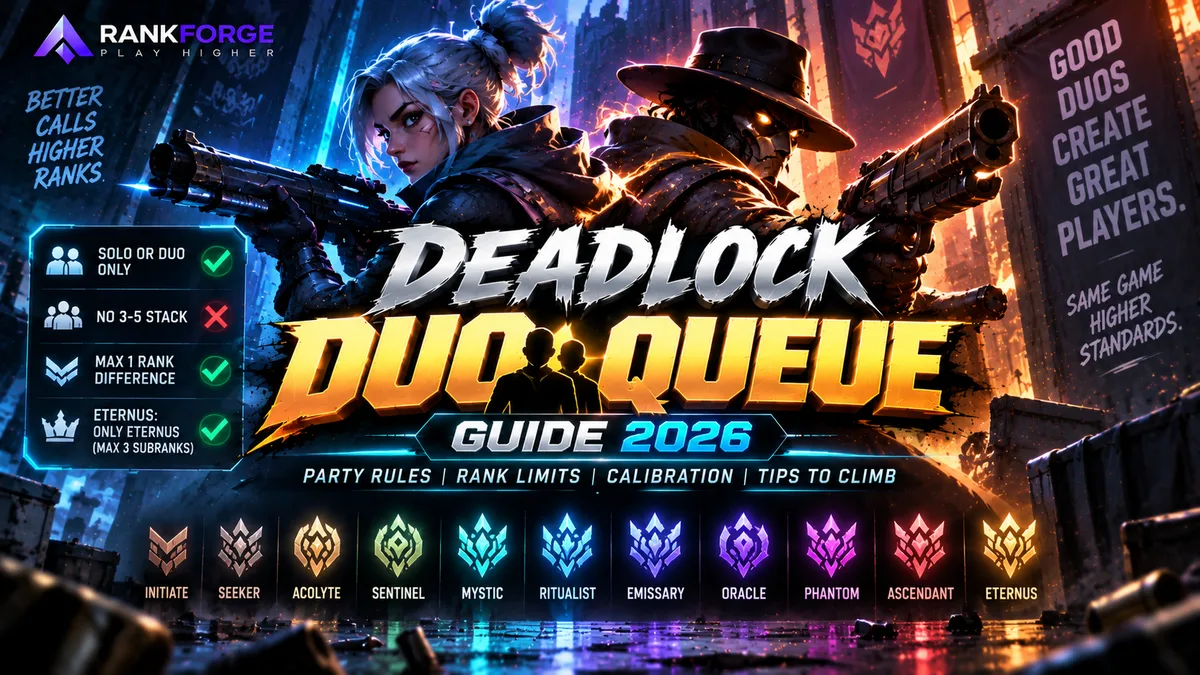
Deadlock Duo Queue Guide | Party Rules, Rank Limits & Climbing 2026
Want to play Deadlock Ranked with a friend?
You can — but the current Ranked system has strict restrictions on party size and rank differences.
Unlike Standard Mode, where party size and skill spread are much more flexible, Deadlock Ranked currently allows only solo or duo parties.
There are also specific requirements for how far apart two players can be in rank.
This guide explains the current Deadlock duo queue rules, rank restrictions, calibration limitations, matchmaking system and practical strategies for climbing with a duo partner.
Current system: These rules are based on the Ranked system introduced on July 30, 2026. Deadlock is actively updated, so party restrictions can change in future updates.
---
Can You Duo Queue in Deadlock Ranked?
Yes.
Deadlock Ranked currently allows players to queue:
- Solo
- As a duo
Parties larger than two players cannot currently enter Ranked matchmaking.
This is one of the biggest differences between Ranked and Standard Mode.
Standard Mode is designed as a lower-stakes environment where players can play with friends without the same Ranked restrictions.
Ranked is much more restrictive because the matchmaking system is designed around competitive games with a narrower skill spread.
---
Deadlock Ranked Party Size
The current Ranked party-size rules are simple:
| Party | Ranked |
|---|---|
| Solo | ✅ Allowed |
| Duo | ✅ Allowed |
| 3 players | ❌ Not allowed |
| 4 players | ❌ Not allowed |
| 5 players | ❌ Not allowed |
| 6 players | ❌ Not allowed |
If you have a group of three or more friends, you currently need to use Standard Mode instead.
This is an intentional part of the current Ranked design.
Valve has indicated that the party-size and rank-spread restrictions may be adjusted in the future based on how the system performs.
---
How Far Apart Can Two Deadlock Players Be in Rank?
For a normal duo, both players must be no more than one full rank apart.
For example:
Mystic + Ritualist
is allowed because these ranks are directly adjacent.
Another example:
Emissary + Oracle
is also within the normal one-rank difference.
However:
Mystic + Emissary
would be too large a gap because there is another full rank between them.
The important point is that the restriction is based on the named rank rather than simply looking at the numerical value of the subrank.
---
Deadlock Duo Rank Difference Examples
Here are some simple examples.
| Player 1 | Player 2 | Duo Queue |
|---|---|---|
| Sentinel | Sentinel | ✅ |
| Sentinel | Mystic | ✅ |
| Mystic | Ritualist | ✅ |
| Ritualist | Emissary | ✅ |
| Emissary | Oracle | ✅ |
| Oracle | Phantom | ✅ |
| Sentinel | Ritualist | ❌ |
| Mystic | Emissary | ❌ |
| Ritualist | Oracle | ❌ |
| Emissary | Phantom | ❌ |
The normal rule is:
Maximum difference = 1 named rank
There is a special exception for Eternus.
---
What Are the Eternus Duo Rules?
Eternus works differently.
Eternus players can only queue with another Eternus player.
However, they can be up to three subranks apart.
For example:
Eternus II + Eternus V
can fit within the special Eternus restriction.
The players must still both be Eternus.
An Eternus player cannot simply queue with an Ascendant player because Ascendant and Eternus are adjacent ranks.
The special rule specifically restricts the party to Eternus players.
---
Can Eternus Queue With Ascendant?
No.
The normal one-rank rule does not allow an Eternus player to simply queue with Ascendant.
The special Eternus rule is:
Eternus + Eternus
with a maximum difference of three subranks.
So an Eternus player cannot use duo queue to bring a lower-ranked player into an Eternus match.
---
Can You Duo During Deadlock Calibration?
No.
Calibration matches must currently be played solo.
When a new Ranked season begins, players enter an eight-game calibration phase.
You cannot bring a friend into those calibration games.
This is important if you are planning to start Ranked together at the beginning of a season.
Both players need to complete their calibration independently.
After calibration, duo restrictions apply normally.
---
How Does Deadlock Duo Queue Matchmaking Work?
The exact hidden matchmaking formula is not publicly exposed.
However, the Ranked system uses matchmaking information in addition to your visible Rank Points.
Your visible rank therefore should not be treated as a complete representation of the matchmaking calculation.
When you queue as a duo, the system has to account for both players while creating the match.
The goal is to create a competitive game while respecting the party's skill range.
This is one reason the rank-difference restrictions exist.
For a deeper explanation of matchmaking, see our Deadlock MMR Explained guide.
---
Does Duo Queue Give You Easier Matches?
There is no reliable reason to assume that duo queue automatically produces easier opponents.
A duo gives you something else:
communication and coordination.
That can be extremely valuable.
Two players who communicate well can:
- Coordinate ganks
- Call rotations
- Track enemy positions
- Set up objectives
- Share information
- Coordinate item timing
- Protect each other
- Recognize enemy mistakes faster
But the opposing team can also contain a duo.
The matchmaking system is still attempting to create a competitive match.
---
Why Duo Queue Can Be Strong
The biggest advantage of duo queue is not simply having another player.
It is having someone whose decisions you can predict.
When playing with a consistent teammate, you can develop patterns.
For example:
Player A pushes the lane → Player B rotates → Enemy is forced back → Team takes objective
This is much harder to execute with five random players.
You can also establish simple communication rules.
For example:
- "I'm rotating."
- "Don't fight yet."
- "Two missing."
- "Objective in 30."
- "I'm ready."
- "Back out."
- "We can punish this."
Short communication is often more useful than constant voice chat.
---
Best Duo Roles in Deadlock
There is no single mandatory duo combination.
Instead, think about what your two heroes can accomplish together.
Damage + Utility
One player provides damage while the other creates opportunities.
This can work well because the utility player can create space for the damage dealer.
---
Frontline + Ranged Damage
A durable frontline hero can create room for a ranged teammate.
The frontline player can:
- Start fights
- Absorb pressure
- Create space
- Force enemy movement
The ranged player can then capitalize on the resulting openings.
---
Assassin + Follow-Up Damage
A mobile assassin can create a pick while the second player provides immediate follow-up.
This requires good communication.
The assassin should not engage before the second player is in position.
---
Two Independent Carries
Two mechanically strong players can also choose heroes that are capable of generating their own advantages.
This gives the duo more independence.
However, there is a downside:
If both players require significant farm, the team can become inefficient if resources are not distributed properly.
---
Should Both Duo Players Play Carry Heroes?
Not necessarily.
A common mistake is choosing two heroes that both want the same resources and play the same role.
For example, if both players constantly want to farm the same areas, your duo can actually reduce the team's overall efficiency.
Instead, think about complementary strengths.
A good duo can divide responsibilities:
Farm + Pressure
Frontline + Damage
Initiation + Follow-up
Map pressure + Objective control
The goal is not simply to pick two strong heroes.
The goal is to create a combination that works together.
---
Best Communication Tips for Deadlock Duo Queue
You do not need constant communication.
You need useful communication.
Call Enemy Movement
Instead of saying:
"Where is everyone?"
Try:
"Two left side."
Short information is easier to process during a fight.
---
Call Your Intentions
Tell your teammate what you are about to do.
Examples:
- "I'm going in."
- "I'm backing."
- "I'm rotating."
- "Wait for me."
- "I'm pushing."
- "Let's take objective."
This prevents situations where one player engages while the other is still farming.
---
Use Countdown Calls
For important actions:
"Three, two, one."
This can synchronize:
- Ganks
- Initiations
- Escapes
- Objective attempts
- Ability combinations
---
How to Avoid the Biggest Duo Queue Mistake
The biggest problem with duo queue is often overconfidence.
Having a friend in the game can make players take fights they would normally avoid.
For example:
You see one enemy.
You assume:
"We are two, let's go."
But the enemy team has three players nearby.
The result is an unnecessary death.
Always consider the full map before committing.
Your duo partner being nearby does not automatically mean the fight is favorable.
---
Duo Queue and Lane Assignments
The current Ranked system includes a pre-game phase where players can adjust their heroes and starting lanes.
This makes communication between duo partners particularly useful.
Before the game starts, decide:
- Who wants which lane
- Who needs farm
- Who wants to rotate
- Which hero combination you are playing
- Whether you want to play aggressively
- Which player should prioritize objectives
Do this before the match begins rather than trying to figure everything out after the first fight.
---
Can You Change Your Hero After Matchmaking?
Yes.
The current Ranked system includes a pre-game waiting area.
Players can change their assigned hero to another eligible hero that has not already been selected.
Each player can make one such swap.
The system is primarily designed to improve team composition rather than provide traditional live counter-picking.
The enemy team's initial composition is visible, but their subsequent hero swaps are not continuously revealed.
This gives duo players an opportunity to make a quick adjustment if their initial composition does not make sense.
---
Deadlock Ranked Hero Requirements for Duo Queue
Both players need to independently meet the Ranked eligibility requirements.
Currently, Ranked requires:
- At least 60 Standard wins
- At least 3 heroes unlocked for Ranked
- Each Ranked-eligible hero must have at least 15 Standard wins
So if your friend has just started Deadlock, they cannot immediately join you in Ranked simply because your account is already eligible.
They need to complete their own requirements.
---
Why Does Deadlock Require 15 Wins Per Hero?
The Ranked system is designed around players already understanding the heroes they select.
A hero becomes available for Ranked after you have achieved at least 15 Standard wins with that hero.
This means you cannot simply unlock a hero and immediately take it into Ranked.
The requirement encourages players to develop familiarity before using the character in competitive matches.
---
Can You Practice a Duo in Standard?
Yes.
Standard Mode is the best place to practice your duo strategy.
Standard has much fewer party restrictions and is specifically intended as a lower-stakes environment.
You can use it to practice:
- Hero combinations
- Lane assignments
- Rotations
- Communication
- Objective timing
- Item builds
- Team-fight setups
This is especially useful before pushing Ranked.
---
Duo Queue vs Solo Queue
| Feature | Solo Queue | Duo Queue |
|---|---|---|
| Party size | 1 | 2 |
| Communication | Limited | Direct |
| Coordination | Variable | Higher |
| Rank restriction | Individual | Max 1 rank apart |
| Calibration | Allowed | Not allowed |
| Standard practice | Yes | Yes |
| Requires Ranked eligibility | Yes | Both players |
Duo queue gives you more direct coordination, while solo queue gives you complete independence.
Neither removes the need to understand the game.
---
Is Duo Queue Better for Climbing?
Duo queue changes the way you approach Ranked, but it does not guarantee faster progression.
Its biggest advantage is consistency.
If you and your teammate:
- Communicate well
- Understand each other's playstyles
- Avoid unnecessary fights
- Use complementary heroes
- Share useful information
- Review mistakes
then your duo can become much more coordinated over time.
However, duo queue also creates additional responsibility.
If both players constantly make the same mistakes, those mistakes become coordinated mistakes.
---
How Rank Points Work With a Duo
Your Rank Points are still based on your individual Ranked progression.
The current system awards around 300 Rank Points per match, with the amount adjusted based on matchmaking quality and win streaks.
An August 2026 update increased the base amount from 250 to 300 and increased the maximum five-win-streak bonus from +75 to +90.
Your duo partner does not simply give you their Rank Points.
Each account progresses independently.
That means:
Win together → both can progress
but your individual Rank Points remain tied to your own Ranked account.
---
Can One Duo Player Rank Up Faster?
Yes.
Even if two players queue together for the same games, their progression does not have to remain identical.
You may notice that your Rank Points or rank progression differs from your teammate.
This can happen because Ranked progression is not simply a shared party rating.
Your visible rank represents your own progression.
---
What If One Player Ranks Too High?
Eventually, you may reach the point where the normal one-rank restriction prevents you from continuing to queue together.
For example:
Player A: Oracle
Player B: Mystic
would exceed the normal one-rank difference.
At that point, you would need to play separately until the rank gap becomes valid again.
This can happen naturally when one player climbs faster than the other.
---
How to Climb With a Deadlock Duo
If you are serious about climbing together, establish a simple system.
Step 1: Choose a Small Hero Pool
Each player should have approximately 3–5 heroes they understand.
You don't need identical pools.
Instead, make sure your combined heroes provide different types of value.
---
Step 2: Assign Responsibilities
Decide who is responsible for:
- Starting fights
- Calling rotations
- Watching objectives
- Creating pressure
- Following up on engagements
This avoids both players trying to make the same play.
---
Step 3: Communicate Enemy Information
Don't only call kills.
Call:
- Missing heroes
- Cooldowns
- Rotations
- Objective timings
- Low-health enemies
- Important items
Information can be more valuable than a kill call.
---
Step 4: Don't Chase Every Fight
Your duo does not need to participate in every fight.
Sometimes the best play is:
Farm → gain power → take objective
instead of:
Fight → chase → die → lose farm
---
Step 5: Convert Kills
After a successful duo play, ask:
"What do we get from this?"
Possible answers:
- Lane pressure
- Objective
- Souls
- Map control
- Enemy cooldowns
- Defensive positioning
A kill should ideally create another advantage.
---
Common Deadlock Duo Queue Mistakes
Playing Too Aggressively
Two coordinated players can become overconfident.
Don't assume every 2v2 is favorable.
---
Sharing Too Much Farm
Two players farming the same area can hurt your team's overall economy.
Know when one player should rotate elsewhere.
---
Ignoring the Other Three Players
You are still part of a five-player team.
Your duo should support the team's overall win condition rather than creating its own separate game.
---
Fighting Without Information
If three enemies are missing, be careful about aggressive plays.
The enemy team may be setting up a collapse.
---
Playing Only for Your Duo
The objective is to win the match, not to make your duo look good.
Sometimes the correct play is helping another teammate instead of protecting your duo partner's farm.
---
Deadlock Duo Queue Checklist
Before entering Ranked:
- [ ] Both players meet the Ranked requirements
- [ ] Both players have at least 3 Ranked-eligible heroes
- [ ] Both players are within the allowed rank difference
- [ ] Neither player is in calibration
- [ ] You have agreed on your hero pools
- [ ] You know your preferred lane assignments
- [ ] You have voice communication available
- [ ] You understand your duo's main win condition
Before a fight:
- [ ] Where are the missing enemies?
- [ ] Are our important abilities ready?
- [ ] Is our third teammate nearby?
- [ ] What happens if we win?
- [ ] What happens if we lose?
This simple checklist can prevent a surprising number of unnecessary deaths.
---
Deadlock Duo Queue FAQ
Can you play Ranked Deadlock with a friend?
Yes. Ranked currently allows solo and duo parties.
Can three players queue Ranked together?
No. Ranked currently restricts parties to a maximum of two players.
How far apart can Deadlock duo players be?
Normal duo partners can be no more than one named rank apart.
Can Eternus players duo together?
Yes. Eternus players can queue with another Eternus player if they are within three subranks of each other.
Can you duo during calibration?
No. The eight calibration games must currently be played solo.
Can a Mystic queue with Ritualist?
Yes. Mystic and Ritualist are one named rank apart.
Can a Mystic queue with Emissary?
No. That exceeds the normal one-rank restriction.
Does duo queue give more Rank Points?
No. Duo queue does not provide a special Rank Point bonus simply because you are playing with a friend.
Can you practice duo strategies in Standard?
Yes. Standard Mode is the ideal place to practice duo communication, lane assignments, hero combinations and rotations before playing Ranked.
---
Final Thoughts
Deadlock's current Ranked system is intentionally restrictive when it comes to parties.
You can play:
Solo
or
Duo
but larger groups are currently restricted to Standard Mode.
For normal duos, the two players must be within one named rank of each other. Eternus has its own special rule, allowing two Eternus players to queue together when they are within three subranks.
Calibration is also strictly solo.
These restrictions can make Ranked feel less flexible than Standard, but they also make duo coordination more meaningful.
If you are playing with a friend, focus on complementary heroes, clear communication and converting small advantages into objectives rather than simply looking for fights.
A coordinated duo can create opportunities, but you still need to play around the other three players and the overall state of the map.
For more information about how Deadlock matchmaking works, read our Deadlock MMR Explained guide.
You can also check the Deadlock Rank Distribution guide to see where your current rank sits relative to the wider Ranked population.