 Diego Alvarez
Deadlock Hero Pool Guide: Choose Your Best Ranked Heroes
Learn how to build a strong Deadlock hero pool for Ranked. Choose complementary heroes, master key matchups, and adapt your picks to the team.
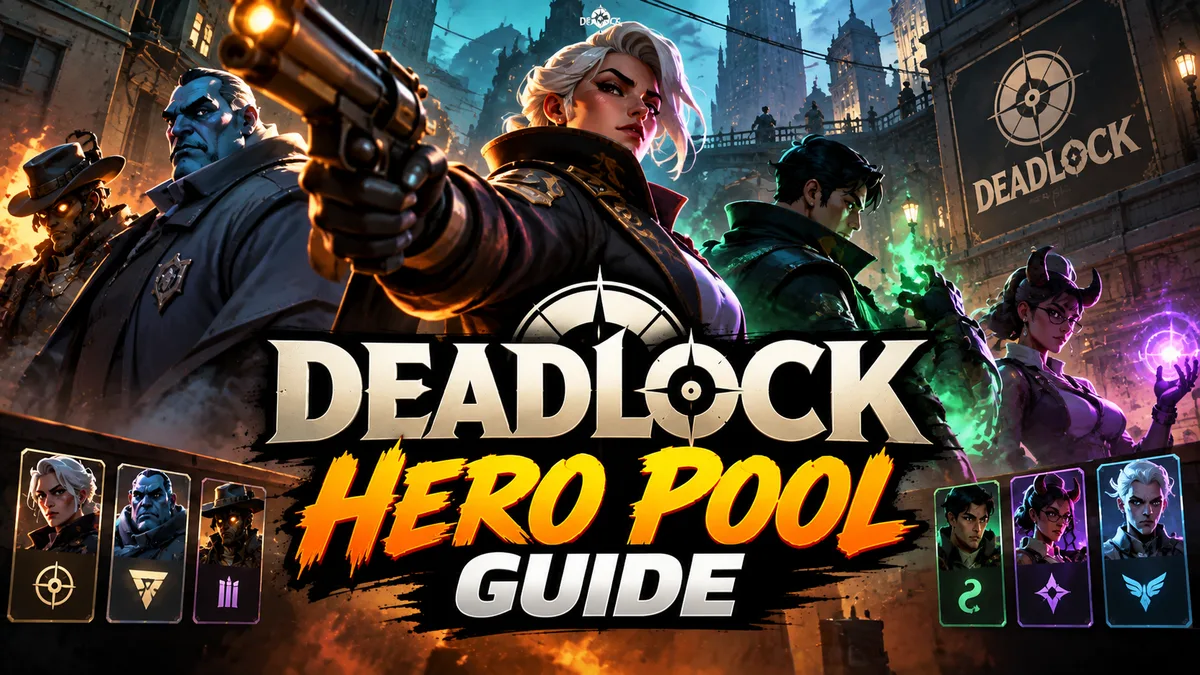
Deadlock Hero Pool Guide: How to Choose Your Best Ranked Heroes
Choosing the right heroes in Deadlock can make Ranked matches easier to understand, but playing a different hero every game makes it harder to develop consistent mechanics, item knowledge, and matchup experience.
The goal is not to master the entire roster. It is to build a small, flexible hero pool that lets you play comfortably in different team compositions and adapt when your first choice is unavailable.
In this Deadlock hero pool guide, you'll learn how many heroes to practice, how to choose complementary picks, how to prepare for difficult matchups, and how to improve your decision-making in Ranked.
What Is a Hero Pool in Deadlock?
A hero pool is the group of heroes you regularly practice and feel comfortable playing. Instead of choosing a different hero every match, you focus on a manageable selection and develop a deeper understanding of each pick.
A well-built hero pool helps you learn:
- Which abilities to use in different situations.
- Which items support your playstyle and counter specific threats.
- How to approach different lane matchups.
- When to farm, fight, rotate, or help teammates.
- How your hero contributes to the team's overall composition.
Knowing a few heroes well can be more valuable than having a superficial understanding of the entire roster.
How Many Heroes Should You Main?
For most players trying to improve in Ranked, a practical starting point is three core heroes.
This is a recommendation, not a fixed rule. Your ideal number depends on how much time you play, how often your preferred heroes are unavailable, and how comfortable you are learning new mechanics.
Your Main Hero
Choose one hero you genuinely enjoy and want to master.
Your main should be a character whose abilities, movement, and combat style feel natural to you. Repeatedly playing the same hero helps you recognize favorable fights, understand power spikes, and make decisions without having to think about every basic mechanic.
Your Secondary Hero
Choose a second hero with a meaningfully different playstyle.
For example, if your main relies on sustained damage and careful positioning, your secondary might offer stronger initiation, mobility, or disruption. The objective is to give yourself another option when your usual approach does not fit the match.
Your Backup Hero
Your third choice should be a hero you can play reliably when your first two options are unavailable or unsuitable.
You do not need to master every advanced mechanic immediately. Focus on understanding the core abilities, a reliable item plan, and your main responsibilities in team fights.
How to Choose the Right Deadlock Heroes
A strong hero pool starts with your own strengths and preferences rather than a tier list alone.
1. Match Your Playstyle
Think about which parts of Deadlock you enjoy most.
Do you prefer taking direct fights, applying pressure across the map, supporting teammates, controlling space, or dealing damage from favorable positions?
Choose heroes whose core gameplay rewards those preferences. You are more likely to practice consistently when you enjoy the mechanics you are learning.
2. Consider Mechanical Difficulty
Some heroes require more precise ability usage, movement, or timing than others.
If you are still learning the fundamentals of Deadlock, consider starting with a hero whose basic game plan is easy for you to understand. You can then spend more attention on farming, positioning, map awareness, and objective control.
Mechanical difficulty is not the only factor, but a hero that overwhelms you with decisions can slow down your overall improvement.
3. Learn the Hero's Strengths and Weaknesses
Every hero has situations where they perform well and situations where they struggle.
Study how your chosen hero handles lane pressure, extended fights, enemy initiation, and different team compositions. Learn which abilities are most important to preserve and which opponents can punish predictable positioning.
Understanding weaknesses is just as important as knowing how to execute your strongest combination.
4. Check Current Game Changes
Deadlock is an evolving game, so hero balance, items, and gameplay systems can change.
Use current in-game information and recent patch notes when evaluating builds or deciding which heroes to practice. Do not assume that an old tier list or item guide remains accurate after a significant update.
A hero does not need to be the strongest pick in the current patch to be a useful main. Familiarity and consistent execution still matter.
Build a Flexible Hero Pool
Your three heroes should give you options rather than forcing you into the same strategy every match.
Consider the following questions when reviewing your selections:
- Can I play at least one hero comfortably in my preferred role or lane?
- Do my picks rely on exactly the same strengths and weaknesses?
- Can I contribute when the enemy team has strong initiation or sustained pressure?
- Do I understand how to farm and scale on each hero?
- Can I execute each hero's basic game plan without constantly checking a guide?
You do not need a perfect answer to every question. The purpose is to identify gaps and avoid building a pool that struggles whenever one particular matchup appears.
Also remember that team composition matters. A hero that works well in isolation may be less suitable if your team already lacks important capabilities.
Learn One Reliable Build Before Experimenting
Changing your build every match can make it difficult to understand what is working.
Start with a reasonable, current build for each hero. Learn the purpose of its main items and identify the situations in which you might need to adapt.
Understand Your Core Items
For every hero in your pool, learn which items support its primary strengths and which help address common threats.
Do not buy items simply because a guide lists them in a particular order. Consider the match state, your opponent's damage, your own economy, and the timing of upcoming fights.
Adapt to the Enemy Team
A default build is a starting point, not an instruction to ignore the match.
If you repeatedly lose to a particular type of threat, investigate whether positioning, ability usage, team coordination, or an appropriate defensive item could help. Avoid blaming every defeat on itemization alone.
Practice Your Heroes With a Purpose
Playing more matches is useful only when you pay attention to what each game teaches you.
Instead of trying to improve everything at once, set one clear objective for your next few matches.
Examples include:
- Improving last hits and resource collection.
- Avoiding unnecessary deaths during the laning phase.
- Using important abilities more deliberately.
- Checking the map before committing to a fight.
- Recognizing when to rotate or contest an objective.
- Buying appropriate items for the current match.
After each match, identify one decision you would change. Over time, these small adjustments help you build repeatable habits.
Keep Track of Your Results
Record the hero you played, the main challenge you faced, and one lesson from the match.
Do not judge a hero entirely by a short win streak or losing streak. Match quality, team composition, opponents, and your own decision-making all affect the result.
Look for repeated patterns across multiple games instead.
When Should You Change Your Hero Pool?
You do not need to abandon your main because of a few difficult matches.
Consider changing your pool when:
- You consistently struggle to understand your hero's role.
- Your preferred playstyle no longer suits your goals.
- A significant patch changes a hero's mechanics or effectiveness.
- Your current selections leave you without a comfortable alternative.
- You no longer enjoy playing one of your core heroes.
Before dropping a hero, distinguish between a genuine mismatch and a skill gap that you can improve with practice.
If you decide to replace a hero, introduce the new pick gradually. Learn the basics in a lower-pressure environment before relying on it in important Ranked matches.
Common Hero Pool Mistakes
Avoid these habits when building your Deadlock hero pool:
- Playing a new hero every match: Prevents you from developing consistent mechanics and matchup knowledge.
- Following tier lists blindly: A highly rated hero is not automatically the best choice for your experience or playstyle.
- Learning too many builds at once: Makes it harder to understand which decisions improve your performance.
- Ignoring team composition: Your personal favorite may not always fit the team's needs.
- Changing mains after every loss: Makes it difficult to distinguish temporary setbacks from real problems.
- Never adapting: Sticking to one build or strategy regardless of the opponent can make your play predictable.
A good hero pool balances familiarity with enough flexibility to handle different matches.
Final Thoughts
Building a strong Deadlock hero pool is about consistency, not collecting the largest possible roster.
Start with one main, add a secondary with a different playstyle, and keep a reliable backup. Learn their core abilities, practice a sensible item approach, and review your decisions after each match.
As your understanding improves, you can expand your pool when there is a clear reason to do so.
Working toward a higher Deadlock rank? Consistent practice and better decision-making can help you improve over time. If you are also exploring service options for your ranked progression, visit RankForge Deadlock Rank Boost to review the available service details.
Frequently Asked Questions
How many heroes should I main in Deadlock?
Three is a useful starting point for many players: one main, one secondary, and one backup. Adjust the number to suit your available practice time and experience.
Should I always pick the highest-tier hero in Deadlock?
No. Tier lists can provide context, but your familiarity, mechanics, team composition, and the current patch all matter. A hero you understand well can be a more reliable choice than an unfamiliar high-tier pick.
How do I learn a new Deadlock hero faster?
Learn the core abilities, understand the hero's main role, use a current build as a starting point, and focus on one improvement per match. Review your mistakes rather than changing everything after each loss.
When should I change my Deadlock main?
Consider changing when your preferred playstyle no longer suits your goals, a major update changes the hero significantly, or you consistently struggle to perform the role you want to play. A few losses alone are not enough reason to switch.


