Diego Alvarez
Deadlock Laning Guide 2026 | Souls, Denies, Wave Control & Lane Strategy
Master Deadlock laning with our 2026 guide to Souls, denies, last hits, wave control, trading, farming and winning your lane.
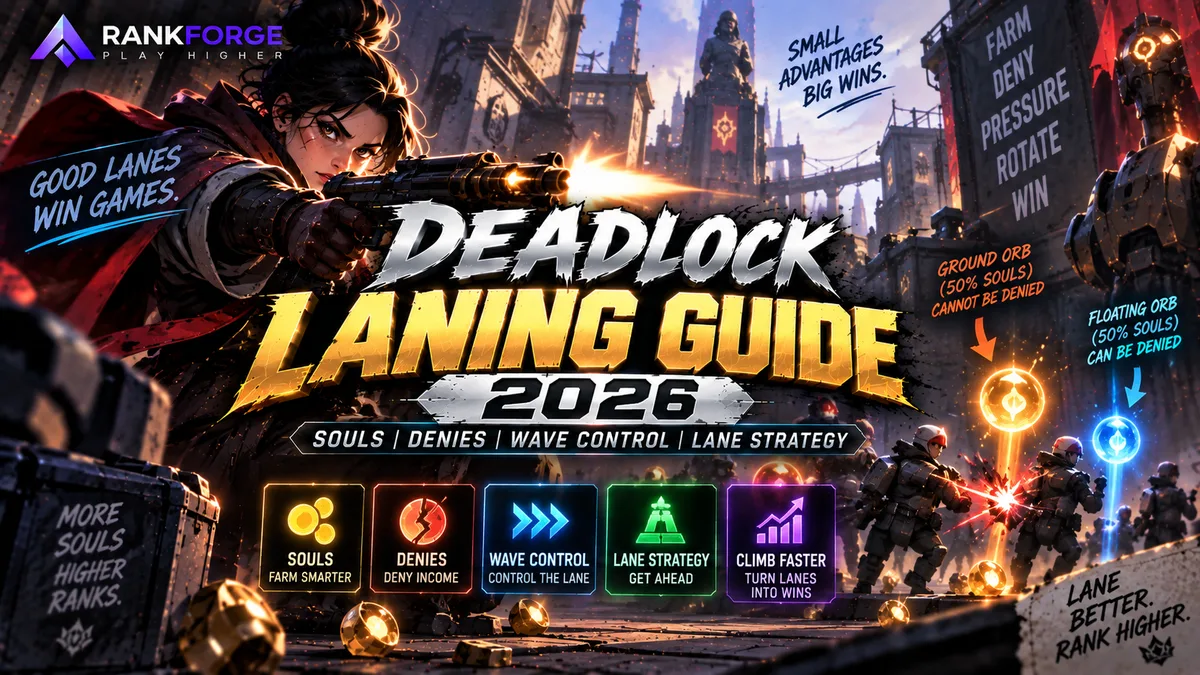
Deadlock Laning Guide 2026 | Souls, Denies, Wave Control & Lane Strategy
The laning phase is where many Deadlock games begin to separate.
You don't need to get three kills in the first few minutes to win your lane.
In fact, some of the strongest laners are simply better at collecting Souls, denying enemy income, controlling the wave and choosing when to trade.
A small Soul advantage can turn into an item advantage.
An item advantage can turn into lane pressure.
Lane pressure can create rotations, objectives and more farm.
That is the basic Deadlock snowball.
This guide explains how to win your lane in Deadlock, including last hitting, Soul Orbs, denies, wave control, trading, farming, positioning and knowing when to leave the lane.
Current for September 2026: Deadlock's current trooper and Soul systems include a 50/50 split between the ground and floating Soul Orbs. The September 16 update also changed objective bounties and comeback Soul mechanics. :contentReference[oaicite:1]{index=1}
---
What Is the Goal of the Laning Phase?
The goal of laning is not simply to kill your opponent.
Your primary objectives are:
1. Collect Souls
2. Deny enemy Souls
3. Stay alive
4. Maintain useful lane positioning
5. Build toward your first important items
6. Create pressure
7. Prepare for the next map objective
A player who goes 0/0 but finishes lane with a large Soul advantage can be in a much better position than a player who gets one kill but loses several waves.
Think about the lane as an economic battle.
Every wave gives you an opportunity to gain resources.
Every missed Soul is an opportunity for the enemy to catch up.
---
How Souls Work During Laning
Troopers are one of the most reliable sources of Souls during the early game.
When a trooper dies, its Soul bounty is divided between two Soul Orbs:
- One ground orb
- One floating orb
The current system gives each orb 50% of the trooper's Soul value. :contentReference[oaicite:2]{index=2}
The ground orb cannot be denied.
The floating orb can be confirmed by your team or denied by the enemy.
This creates two separate decisions every time a trooper dies:
Can I secure the kill?
and then:
Can I secure or deny the floating Soul Orb?
That second interaction is one of the most important mechanics in the lane.
---
Last Hitting in Deadlock
Last hitting means dealing the final damage to an enemy trooper.
It sounds simple.
But good last hitting requires you to watch:
- Trooper health
- Your weapon damage
- Your attack timing
- Enemy positioning
- Your ammunition
- The floating Soul Orb
- Incoming enemy pressure
You should not tunnel vision on the trooper.
The enemy player is watching the same health bar.
If you repeatedly walk forward to last hit without considering the opponent, you can become predictable.
---
Secure the Soul Orb
After securing a trooper, immediately pay attention to the floating Soul Orb.
Your opponent can attempt to deny it.
A clean lane routine looks like:
Last hit → confirm orb → reposition
Don't treat the orb as an optional bonus.
It is part of the value of the kill.
If you secure the trooper but allow the enemy to deny the floating orb, you have given away half of that trooper's Soul bounty.
---
Denying Souls
Denying is one of the most powerful laning mechanics in Deadlock.
When an enemy trooper dies, their floating Soul Orb can be contested.
If you destroy the enemy's orb, you deny those Souls from your opponent and receive the value yourself.
That creates a double effect:
You gain Souls
while
the enemy loses Souls
This makes a successful deny more valuable than simply gaining an equivalent amount of uncontested farm.
---
Why Denies Matter So Much
Imagine two players each getting the same number of trooper kills.
If one player consistently denies the other's floating orbs, the two players can still end the lane with very different economies.
This is because the deny doesn't merely increase your income.
It also removes income from the opponent.
Over multiple waves, these small differences compound.
A few successful denies can become:
Soul advantage → item timing → stronger trades → more lane control
That is why experienced players pay close attention to the Soul Orb phase after every last hit.
---
Don't Die for a Deny
There is an important exception.
You should not blindly risk your life to deny one orb.
If walking into the enemy's attack range gives you a 100-Soul opportunity but also exposes you to a likely death, the trade may be terrible.
Always ask:
Can I deny this without losing the lane?
A good deny is valuable.
A deny followed by your death can give the enemy much more value.
---
Ground Orbs Are Still Important
Players sometimes focus so much on denies that they forget their own guaranteed Souls.
The ground orb represents half of the current trooper bounty and cannot be denied by the enemy. :contentReference[oaicite:3]{index=3}
You still need to collect it.
If you leave the lane after a kill without collecting your Souls, you are throwing away part of your own economy.
Your positioning should therefore consider both:
Where the enemy is
and
where your Soul Orbs are going to land.
---
Soul Sharing and Lane Positioning
Deadlock's Soul system also means positioning relative to allied heroes matters.
When Souls are shared, multiple nearby heroes can receive a portion of the value.
The current system uses proximity checks around the Soul Orb and the hero that killed the trooper. :contentReference[oaicite:4]{index=4}
This is one reason you should understand whether you're actually supposed to be sharing a wave with another teammate.
More heroes standing around the same farm can change how much individual income each player receives.
---
Don't Stand on Top of Your Teammate
If you're sharing a lane or temporarily farming together, don't automatically assume that more players means more efficient farming.
The Soul-sharing system can divide income between nearby allied players. :contentReference[oaicite:5]{index=5}
Instead, coordinate your farming.
One player may:
- Hold the lane
- Pressure the enemy
- Clear the wave
while the other:
- Rotates
- Farms elsewhere
- Prepares an objective
- Recovers resources
Good map economy is about distributing farm efficiently.
---
How to Trade in Lane
Winning lane does not mean attacking constantly.
A good trade usually happens when you have an advantage.
Look for:
- Enemy ability on cooldown
- Enemy reload
- Enemy low health
- Enemy out of position
- Enemy trying to secure a Soul
- Your own ability ready
- Your own ammunition available
- Nearby allied pressure
The best time to attack is often when your opponent is forced to choose between:
fighting you
and
collecting their Souls.
---
Punish the Last Hit
One of the simplest laning techniques is to attack when the enemy has to commit to farm.
When an enemy moves forward to secure a trooper:
1. Watch their movement
2. Predict their last-hit timing
3. Apply pressure
4. Force them away
5. Return to farming
You don't necessarily need to kill them.
If they lose health every time they farm, eventually they are forced to leave the lane.
That gives you control without needing a risky all-in.
---
Don't Fight While Your Wave Is Bad
Your own wave position matters.
If your troopers are far away from your defensive structure and you take a losing fight, the enemy can potentially convert the advantage into pressure.
Before committing, look at:
- Your trooper count
- Enemy trooper count
- Your health
- Enemy health
- Escape routes
- Nearby teammates
- Objective timing
A fight is never just a fight.
It happens inside a specific wave state.
---
Wave Control in Deadlock
Wave control means influencing where the trooper wave is positioned.
You generally have three broad choices:
Push
Kill enemy troopers quickly and move the wave forward.
Hold
Keep the wave in a useful position without aggressively clearing it.
Freeze
Control the wave so that it remains close to a favorable defensive position.
Wave control can make the lane dramatically safer or more dangerous.
---
When Should You Push the Wave?
Push when you want to create pressure.
Common reasons include:
- Enemy is forced to return
- You want to rotate
- You want to shop
- You want to pressure the Guardian
- You want to create space
- You want to prepare for an objective
A pushed wave can also force the enemy to spend time clearing instead of moving around the map.
---
When Should You Freeze?
Freezing can be useful when you want the enemy to walk into a dangerous position to farm.
You can control the wave by limiting unnecessary damage to enemy troopers.
The goal is to keep the wave in a favorable location rather than automatically killing everything as quickly as possible.
This can be especially effective when:
- You're stronger than the opponent
- Your enemy has poor escape options
- Your Guardian provides a safe fallback
- You want to deny farm
- You are waiting for your teammate to rotate
Wave freezing is not about doing nothing.
It is about deliberately controlling how quickly the wave moves.
---
Why Wave Position Matters
A lane near your defensive structure is generally safer than a lane deep in enemy territory.
If your opponent must walk farther forward to collect Souls, you gain more opportunities to pressure them.
If the wave is constantly under the enemy's structure, you may have more difficulty denying their farm.
This creates an important principle:
Don't automatically push just because you can.
Sometimes keeping the wave closer to your side gives you more control.
---
Use the Medic Trooper Carefully
Medic Troopers can affect the health of your wave.
Their healing can change the balance between the two waves and influence where the lane moves.
If you're deliberately trying to control a wave, don't ignore the Medic Trooper.
A small change in wave health can eventually turn a controlled lane into a pushing lane.
---
Farming Under Pressure
You will eventually play against a hero who makes last hitting difficult.
Don't panic.
Your priority should become:
Secure safe Souls → avoid unnecessary damage → wait for opportunities
You don't need every Soul.
You need enough of them to remain competitive.
Walking into danger for one trooper can cost you:
- Health
- Position
- A Soul Orb
- A death
- Multiple future waves
Sometimes giving up one last hit is the correct play.
---
What to Do When You Lose Lane
Losing lane does not mean losing the game.
The biggest mistake is trying to recover by taking increasingly risky fights.
Instead:
Step 1: Stabilize
Stop dying.
Step 2: Collect Safe Farm
Take the Souls that you can collect without excessive risk.
Step 3: Adjust Your Build
Buy items that solve the problem you're facing.
Step 4: Use Safer Wave Positions
Keep farm closer to areas where you can escape.
Step 5: Look for Team Opportunities
A rotation from another teammate can change the lane.
Step 6: Recover Your Economy
Use available neutral or map farm when appropriate.
A losing lane can become a winning mid game if you stop the bleeding.
---
What to Do When You Win Lane
Winning lane creates a different problem:
How do you convert the advantage?
Don't just sit in lane and repeatedly shoot the enemy.
Look for:
- Guardian pressure
- Enemy rotations
- Safer farm
- Shop timings
- Objective opportunities
- Rotations into another lane
A strong lane should give your team more map control.
---
Pushing the Guardian
The Guardian is an important early objective.
The September 16, 2026 update increased the Guardian bounty by 10%, making successful objective pressure even more economically relevant. :contentReference[oaicite:6]{index=6}
However, don't attack the Guardian simply because the enemy hero left the lane.
Ask:
- Where are the other enemies?
- How much health do we have?
- Can we escape?
- Do we have enough wave pressure?
- What happens if they rotate back?
Objective pressure should be calculated, not automatic.
---
When Should You Leave Lane?
Leaving lane is valuable when your time away creates more value than staying.
Good reasons include:
- Important objective
- Enemy is forced out
- Your lane is safely pushed
- You need to shop
- A teammate needs help
- You can secure a high-value rotation
- The enemy has overextended
Bad rotations often look like:
Leave full wave → walk across map → find nobody → return → lose farm
Always ask:
What am I gaining by leaving?
---
The Push → Shop → Rotate Pattern
One of the most useful early-game patterns is:
Push the wave → create time → spend Souls → make a play
If you push the wave before leaving, the enemy is forced to spend time dealing with it.
That gives you a window.
Use that window efficiently.
---
Don't Hoard Souls
If you have enough Souls to purchase an important component, consider spending them.
Unused Souls don't provide combat power.
An item in your inventory does.
The important exception is when you are deliberately saving for a specific power spike.
Otherwise, sitting on a large amount of unspent currency can leave you weaker than necessary.
---
Track Your Power Spikes
Every hero has moments where their effectiveness changes.
This can happen because of:
- New ability level
- Major item
- Additional Spirit Power
- Weapon upgrade
- Defensive purchase
- Ultimate availability
If you know your next power spike, you can play around it.
For example:
"I need 300 more Souls for my next major component."
That changes how aggressively you should play.
You may decide to avoid a risky fight and farm one more wave.
---
How to Win a Losing Matchup
Some matchups are naturally difficult.
Don't try to prove that you can win every trade.
Instead:
Farm efficiently
Get what is safe.
Avoid predictable movement
Don't always approach the same trooper from the same angle.
Use cover
Make it harder for the enemy to punish your last hits.
Wait for cooldowns
If the enemy's main poke ability is down, your farming window may improve.
Ask for help
A well-timed rotation can completely change a difficult matchup.
---
Common Laning Mistakes
1. Chasing Kills Instead of Farm
A kill is exciting.
A large Soul lead is more reliable.
---
2. Ignoring Soul Orbs
Getting the last hit but losing the floating orb wastes part of the reward.
---
3. Trying to Deny Everything
Not every deny is worth taking damage for.
---
4. Pushing Every Wave
Permanent pushing can put you in dangerous positions.
---
5. Fighting Without Ammunition
Running out of ammo during a trade can turn a winning situation into a death.
---
6. Forgetting the Minimap
Your lane opponent is not the only threat.
---
7. Staying Too Long
If your health is low and the enemy is stronger, another wave may not be worth dying for.
---
8. Spending Souls Too Late
A completed component can change your next fight.
---
Deadlock Laning Routine
Use this routine every wave.
Step 1
Position yourself where you can see the enemy and the wave.
Step 2
Prepare for the last hit.
Step 3
Secure the trooper.
Step 4
Immediately confirm your floating Soul Orb.
Step 5
Look for an enemy deny.
Step 6
Reposition.
Step 7
Check the minimap.
Step 8
Decide whether to push, hold or trade.
Step 9
Repeat.
This simple routine removes a lot of unnecessary decision-making.
---
The 10-Minute Laning Checklist
During the opening phase, ask yourself:
- [ ] Am I securing most of my safe last hits?
- [ ] Am I confirming my floating Soul Orbs?
- [ ] Am I attempting useful denies?
- [ ] Am I taking unnecessary damage?
- [ ] Where is the wave?
- [ ] Where are the enemy heroes?
- [ ] Where are my teammates?
- [ ] What is my next item?
- [ ] Should I push or freeze?
- [ ] Is there a reason to rotate?
If you can answer these questions consistently, your lane quality will improve dramatically.
---
How to Measure Whether You Actually Won Lane
Don't only look at kills.
Compare:
Souls
Who has more?
Items
Who reached important components first?
Health
Who can stay on the map?
Wave Position
Who controls where the fight happens?
Objective Pressure
Who can threaten the Guardian?
Map Freedom
Who can rotate first?
These factors tell you much more about lane performance than kills alone.
---
Deadlock Laning Guide: Quick Reference
| Situation | Recommended Approach |
|---|---|
| Enemy is weak | Pressure while farming |
| Enemy is stronger | Farm safely |
| Wave near your Guardian | Consider holding |
| Enemy leaves lane | Push if safe |
| You need to shop | Push first |
| Enemy is low | Pressure their farm |
| You are low | Stabilize and recover |
| Enemy ability is down | Look for a trade |
| You have a big Soul lead | Convert into item/map pressure |
| You are behind | Stop unnecessary deaths |
| You win a fight | Look for an objective or farm advantage |
---
Final Thoughts
Winning lane in Deadlock is not about constantly fighting.
It is about consistently making better decisions around Souls, positioning, wave control and pressure.
Secure your farm.
Confirm your Soul Orbs.
Deny the enemy when it is safe.
Control where the wave sits.
Trade when you have an advantage.
Push when you have a reason.
And most importantly, convert a lane advantage into something bigger.
A good lane gives you more than kills.
It gives you:
Souls → Items → Map Control → Objectives → Win Conditions
The September 2026 balance environment also makes objective economy more relevant: Guardian bounty was increased by 10%, Walker bounty by 5%, while comeback Soul mechanics were adjusted to redistribute more value toward the lowest-net-worth players. :contentReference[oaicite:7]{index=7}
If you're using this guide to climb Ranked, combine these fundamentals with our Deadlock Best Heroes for Ranked guide, Deadlock Best Items guide, and How to Rank Up in Deadlock guide.
For matchmaking fundamentals, see our Deadlock MMR Explained guide.