Diego Alvarez
Deadlock Rank Distribution 2026 | Average Rank & Percentiles
See the Deadlock rank distribution for 2026, including average rank, player percentages, top 10% and where each rank sits on the ladder.
Deadlock Rank Distribution 2026 | Average Rank & Percentiles
Ever wondered how your Deadlock rank compares with the rest of the Ranked player base?
The Deadlock ranked ladder has changed significantly with the 2026 Ranked system. The current ladder contains 11 named ranks, from Initiate through Eternus, with six subranks inside each tier.
But knowing the rank names is only part of the picture.
The more interesting question is:
What percentage of Deadlock players are actually at each rank?
This guide breaks down the current Deadlock rank distribution, explains the average rank, shows where the major percentile thresholds sit, and explains what your rank means compared with the wider Ranked population.
Important: Valve does not publish an official account-level rank distribution. The percentages in this guide are based on current third-party Ranked tracking datasets. Different trackers use different collection methods, so exact percentages can vary.
---
Deadlock Rank Distribution 2026
Current September 2026 tracking data shows a broad concentration through the middle of the ladder.
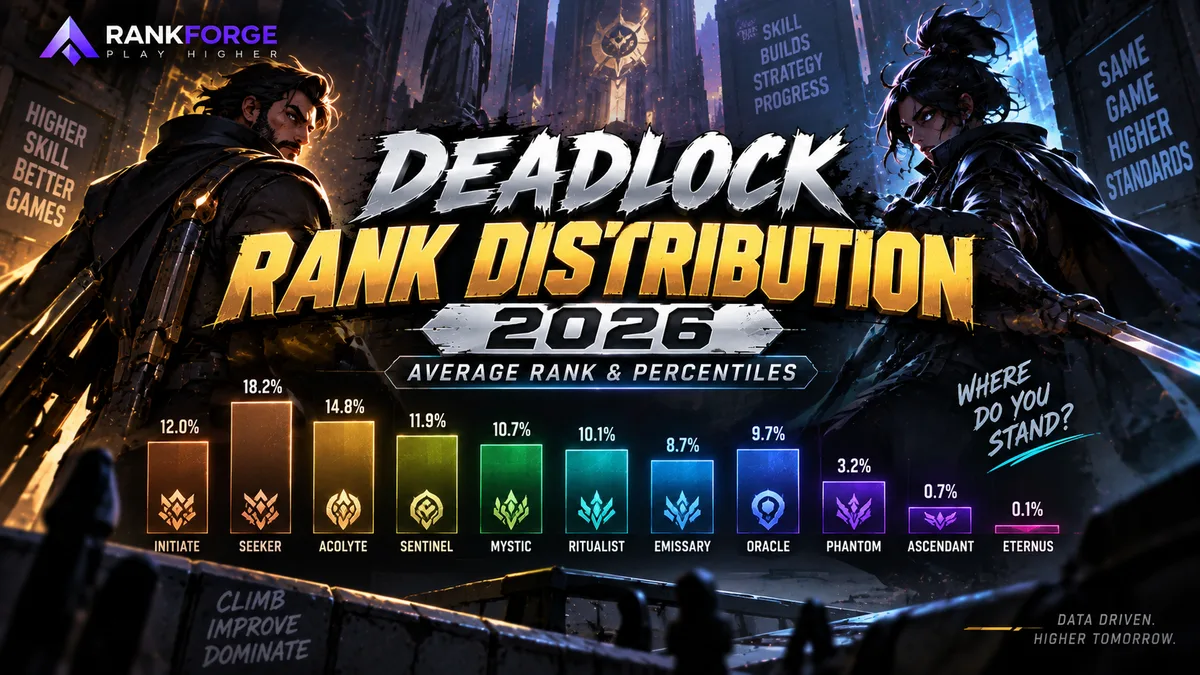
One current player-based dataset covering approximately 259,000 unique ranked players reports the following distribution:
| Rank | Approx. Player Share |
|---|---:|
| Initiate | 12.0% |
| Seeker | 18.2% |
| Acolyte | 14.8% |
| Sentinel | 11.9% |
| Mystic | 10.7% |
| Ritualist | 10.1% |
| Emissary | 8.7% |
| Oracle | 9.7% |
| Phantom | 3.2% |
| Ascendant | 0.7% |
| Eternus | 0.1% |
These numbers are a snapshot of tracked ranked players rather than an official Valve census.
Another large dataset reports a somewhat different distribution, particularly around Oracle and the upper ranks. This is normal because different services collect different samples and use different counting methods.
The important pattern is consistent:
The majority of ranked players are concentrated in the lower and middle tiers, while the population becomes much smaller in Phantom, Ascendant and Eternus.
---
What Is the Average Deadlock Rank?
There is no single permanently fixed "average rank" because the Ranked population changes over time.
Current trackers place the center of the population around the Sentinel-to-Mystic area, depending on the dataset and measurement method.
For example, one current tracker reports Sentinel III as the median ranked player, while another player-based dataset places the median around the Mystic/Sentinel boundary.
This means that being around Sentinel or Mystic generally puts you close to the middle of the currently tracked Ranked population.
It is important to distinguish:
- Average — the mathematical mean
- Median — the player sitting in the middle of the distribution
- Most common rank — the tier containing the largest share of players
These are not necessarily the same thing.
---
Deadlock Ranks in Order
The current Deadlock Ranked ladder contains 11 ranks.
From lowest to highest:
1. Initiate
2. Seeker
3. Acolyte
4. Sentinel
5. Mystic
6. Ritualist
7. Emissary
8. Oracle
9. Phantom
10. Ascendant
11. Eternus
Every named rank has six subranks:
I → II → III → IV → V → VI
VI is the highest subrank within a tier.
Below the visible ladder is Obscurus, which represents the unranked/provisional state.
The current structure was introduced with the July 2026 Ranked matchmaking overhaul.
---
Deadlock Rank Percentiles
Percentiles are often more useful than the rank name itself.
For example:
If you are in the top 10% of players, you are performing above approximately 90% of the tracked Ranked population.
Current tracking datasets place the upper percentile thresholds roughly around the following areas:
| Approximate Percentile | Rank Area |
|---|---|
| 50th percentile | Sentinel / Mystic |
| Top 25% | Emissary |
| Top 10% | Oracle |
| Top 5% | High Oracle / Phantom |
| Top 1% | Phantom / above |
| Top 0.1% | Eternus |
These should be treated as approximate rather than official fixed cutoffs.
Rank distributions move as the Ranked population changes.
---
What Rank Is Top 50% in Deadlock?
The middle of the current Ranked population is around Sentinel/Mystic.
That means players around this part of the ladder are approximately around the median of the tracked population.
However, your exact percentile depends on your subrank.
For example, Sentinel I and Sentinel VI represent very different positions within the ladder.
Moving from one tier to another can therefore represent a meaningful change in your position relative to other players.
---
What Rank Is Top 25% in Deadlock?
Current tracking data places the top-25% area around Emissary.
This means reaching the Emissary area generally places a player well above the middle of the Ranked population.
Again, this is an approximate percentile rather than an official Valve threshold.
The exact boundary can move as more players enter Ranked and existing players climb or fall.
---
What Rank Is Top 10% in Deadlock?
The current top-10% region is around Oracle.
This is one of the clearest milestones in the current distribution.
Oracle is significantly less populated than the lower and middle ranks, although the exact percentage varies between tracking services.
Players trying to reach the top 10% should therefore think beyond simply gaining individual wins.
At this level, consistency becomes increasingly important.
---
What Rank Is Top 1% in Deadlock?
The top 1% begins around the Phantom region in current tracking data.
This represents a much smaller section of the Ranked population than Oracle.
Above Phantom are:
- Ascendant
- Eternus
The population becomes dramatically smaller as you move toward these tiers.
---
How Rare Is Eternus?
Eternus is the highest named Deadlock rank.
Current player-tracking datasets show Eternus representing only a tiny fraction of the ranked population.
One current dataset places Eternus at approximately 0.1% or less, depending on the measurement period.
Another dataset reports an even smaller share.
This difference illustrates why Eternus percentages should not be treated as an official Valve statistic.
The important takeaway is simple:
Eternus is an extremely small portion of the Ranked population.
---
Deadlock Rank Distribution by Tier
Initiate
Initiate is the entry tier of the visible Ranked ladder.
A significant portion of the tracked population sits here.
Players at this level are generally still developing their fundamentals, including:
- Lane control
- Soul collection
- Denying
- Itemization
- Map awareness
- Objective timing
- Team-fight positioning
---
Seeker
Seeker contains one of the largest portions of the current Ranked population.
Players are generally moving beyond the basic mechanics and beginning to understand how individual decisions affect the entire map.
---
Acolyte
Acolyte sits above Seeker and represents another substantial portion of the Ranked player base.
At this point, improving fundamentals can have a large impact on climbing.
---
Sentinel
Sentinel is close to the center of the current Ranked distribution.
Players around this tier have generally moved beyond the very beginning of the ladder.
Common areas for improvement include:
- Better rotations
- More efficient farming
- Objective timing
- Item adaptation
- Avoiding unnecessary deaths
---
Mystic
Mystic is another major part of the middle of the Ranked ladder.
At this stage, small differences in decision-making can become increasingly important.
Players should start paying closer attention to why fights happen rather than simply whether they were won.
---
Ritualist
Ritualist represents a more advanced portion of the ladder.
Players need to consistently convert advantages into meaningful map pressure.
A kill without follow-up value is often less useful than a kill that creates an objective opportunity.
---
Emissary
Emissary sits in the upper portion of the current player distribution.
At this level, consistency becomes increasingly important.
Players who want to progress further should focus on:
- Efficient farming
- Better rotations
- Item adaptation
- Team-fight positioning
- Objective control
- Punishing enemy mistakes
---
Oracle
Oracle represents a relatively small and higher-skill section of the Ranked population.
Players at this level are competing against opponents who generally make fewer obvious mistakes.
Small advantages therefore become more important.
A single unnecessary death can create a much larger chain reaction than it would in lower ranks.
---
Phantom
Phantom is where the population becomes substantially smaller.
Players reaching Phantom are operating within a much more competitive part of the ladder.
Consistency, mechanics and decision-making all become important.
---
Ascendant
Ascendant is an extremely small section of the player base.
At this level, there are far fewer players compared with the middle ranks.
The difference between simply reaching Ascendant and staying there can come down to consistency over a large number of games.
---
Eternus
Eternus is the highest named rank.
The population is extremely small compared with the rest of the ladder.
Reaching Eternus therefore represents a very high position within the tracked Ranked population.
Eternus also operates differently from the lower parts of the ladder because the highest players are competing within a much smaller population and leaderboard environment.
---
Why Does Deadlock Rank Distribution Change?
Rank distribution is not static.
Several factors can change the shape of the ladder.
New Ranked Players
When new players enter Ranked, they initially increase the population in the lower part of the ladder.
Players Improving
As players become better, they move upward through the tiers.
Seasonal Progression
Ranked seasons can change the population and progression structure.
Balance Updates
Hero and item changes can affect how quickly different players climb.
Player Activity
A tracker measuring active players over the last 30 days will produce a different distribution from one measuring every player who has ever received a rank.
---
Why Do Different Deadlock Rank Distribution Websites Show Different Numbers?
This is an important question.
You may see one website saying the median is Sentinel while another says Mystic.
That does not automatically mean one of them is wrong.
The underlying datasets can be different.
For example, one service may count:
Unique ranked players
while another may count:
Player-games
A player who plays 50 Ranked matches can therefore appear 50 times in a player-game dataset.
Other differences include:
- Collection periods
- Active-player definitions
- Ranked-only filtering
- Calibration players
- Regional coverage
- Account tracking
- Match sampling
For this reason, RankForge uses these statistics as approximate indicators rather than official Valve percentages.
---
Player Count vs Player-Games
This distinction is particularly important when reading Deadlock statistics.
Suppose there are 100 players.
Player A plays one Ranked game.
Player B plays 30 Ranked games.
If a website counts unique players:
- Player A = 1 player
- Player B = 1 player
If a website counts player-games:
- Player A = 1 player-game
- Player B = 30 player-games
The resulting distribution can look very different.
This is why you should always check how a rank distribution website collected its data.
---
Does Your Rank Actually Matter?
Your visible rank is useful because it gives you a simple representation of your current Ranked progression.
But it does not tell the entire story.
Deadlock's matchmaking system contains hidden matchmaking information that is not fully exposed to players.
That means two players with the same visible rank do not necessarily have identical matchmaking values.
Our Deadlock MMR Explained guide covers the difference between visible progression and matchmaking in more detail.
---
How to Improve Your Percentile
If your goal is to move from the middle of the ladder toward the upper ranks, focus on repeatable improvements rather than trying to force every game.
Improve Your Farming
Souls provide the resources required to reach important item and power spikes.
Learn to maximize your income without abandoning important team situations.
Reduce Unnecessary Deaths
Deaths cost more than the death itself.
You can also lose:
- Farming time
- Map pressure
- Objective access
- Positioning
- Momentum
Build a Small Hero Pool
A focused hero pool makes it easier to understand matchups, itemization and power spikes.
Three to five well-practiced heroes is generally easier to manage than trying to master the entire roster.
Improve Your Map Awareness
Check the minimap regularly.
Track missing opponents.
Think about where the enemy team can realistically move before committing to aggressive plays.
Convert Advantages
A kill should ideally create something else.
For example:
Kill → objective → map control → more farm → next advantage
This is much more valuable than repeatedly chasing kills without changing the state of the map.
For a more complete climbing strategy, see our How to Rank Up in Deadlock guide.
---
Deadlock Rank Distribution vs Your Own Progress
Don't become obsessed with your percentile after every game.
Rank distribution is most useful as a long-term reference.
For example:
If you move from Sentinel to Ritualist, that is meaningful progress even if the exact percentile changes slightly from week to week.
Likewise, dropping a few games does not suddenly mean your skill has disappeared.
Focus on your trend across a meaningful number of games.
---
Deadlock Rank Distribution 2026: Quick Reference
| Milestone | Approximate Rank Area |
|---|---|
| Bottom of visible ladder | Initiate |
| Around the middle | Sentinel / Mystic |
| Top 25% | Emissary |
| Top 10% | Oracle |
| Top 5% | High Oracle / Phantom |
| Top 1% | Phantom |
| Top 0.1% | Eternus |
These are approximate current values based on third-party tracking and should not be treated as official Valve rank cutoffs.
---
Final Thoughts
The current Deadlock Ranked population is heavily concentrated in the lower and middle tiers.
The exact distribution changes depending on the dataset, but current tracking consistently shows the biggest population around the middle of the ladder, with the player count falling sharply in the highest tiers.
The most useful way to interpret the distribution is not:
"What rank is considered good?"
Instead, ask:
"What percentage of the current Ranked population am I above?"
That gives you a much clearer picture of your position on the ladder.
If you're currently around Sentinel or Mystic, you're near the middle of the tracked Ranked population. Reaching Emissary moves you into a much smaller upper section, while Oracle and above represent increasingly competitive parts of the ladder.
And if you're aiming for Phantom, Ascendant or Eternus, the population becomes dramatically smaller.
For the next step, combine rank-distribution information with an understanding of matchmaking and your own climbing habits. Our Deadlock MMR Explained guide covers how matchmaking and Rank Points work, while our Deadlock climbing guide focuses on practical ways to improve.