Diego Alvarez
Deadlock Soul Urn Guide 2026 | Timing, Routes & Rewards
Learn the Deadlock Soul Urn spawn times, routes, rewards, runner bonuses, comeback mechanics and strategies for securing it safely in Ranked.
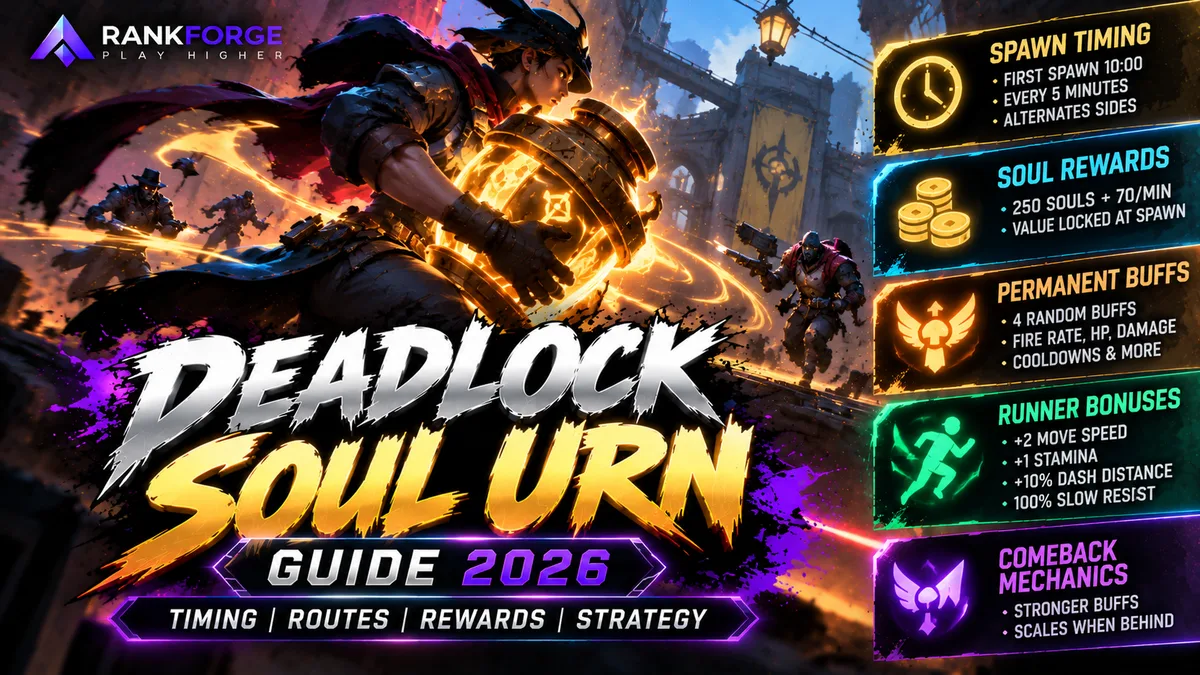
Deadlock Soul Urn Guide 2026 | Timing, Routes & Rewards
The Soul Urn is one of Deadlock's recurring map objectives and can provide a significant resource boost plus permanent stat bonuses to the player who successfully delivers it.
Unlike the Mid Boss, the Soul Urn is a movement-based objective.
One player has to pick it up, carry it across the map and deliver it to the opposite side while the enemy team has a chance to intercept the runner.
That makes the Soul Urn a combination of:
- Map rotation
- Lane pressure
- Objective timing
- Team protection
- Movement
- Vision
- Risk management
Knowing when the Urn spawns is only the beginning.
The important part is understanding when to run it, which route to take, when to contest it and how to convert the reward into an advantage.
---
What Is the Deadlock Soul Urn?
The Soul Urn is a recurring neutral objective that appears on the side lanes of the Deadlock map.
A player can pick it up and carry it to the opposite side of the map.
Successfully delivering the Urn gives the runner:
- Souls
- Four permanent buffs
- Additional value when the team is behind
- A temporary movement and stamina advantage while carrying it
The Urn therefore has two different types of value.
Immediate value
The runner receives Souls when the Urn is delivered.
Permanent value
The successful runner receives four permanent stat buffs.
That makes the Soul Urn useful even when your team doesn't need an immediate team-fight objective.
---
When Does the Deadlock Soul Urn Spawn?
The current Soul Urn spawns at:
10:00
After that, it respawns every:
5 minutes
The normal schedule is therefore:
| Spawn | Time |
|---|---:|
| First Urn | 10:00 |
| Second | 15:00 |
| Third | 20:00 |
| Fourth | 25:00 |
| Fifth | 30:00 |
| Sixth | 35:00 |
The first Urn spawns on the Yellow side.
Later spawns alternate between the Yellow and Green side.
This means you can often predict where the next Urn will appear before it becomes available.
---
Soul Urn Spawn Location
The Soul Urn spawns next to the bridge on one of the side lanes.
The first spawn is on Yellow.
The next is on Green.
The pattern continues to alternate.
This matters because your team can prepare the corresponding side of the map before the Urn appears.
For example:
Next Urn = Green
Your team can begin pushing the Green-side lane before the objective spawns.
That creates a much safer setup than waiting for the Urn to appear and then deciding what to do.
---
Where Does the Soul Urn Need to Go?
The Urn is delivered to the opposite side of the map from where it spawned.
That creates a natural cross-map route.
For example:
Yellow spawn → Green-side delivery
or
Green spawn → Yellow-side delivery
The runner therefore has to cross a meaningful portion of the map.
This creates opportunities for the enemy team to intercept.
---
How Do You Pick Up the Soul Urn?
The Urn can be picked up by hitting it with a:
- Light melee
- Heavy melee
Once picked up, the player becomes the Urn runner.
The runner receives special movement and stamina effects while carrying the objective.
The important difference from older versions is that the current Urn is designed as a dedicated objective that travels from one side of the map to the other.
---
Soul Urn Runner Bonuses
While carrying the Urn, the runner receives several bonuses.
The current bonuses include:
- +2 m/s Move Speed
- +1 Stamina
- +10% Dash Distance
- +25% Stamina Regeneration
- 100% Slow Resistance
The runner's movement speed is capped at 15 m/s.
These bonuses make the runner more mobile, but they don't make the player immune to being stopped.
The enemy can still force the Urn to drop.
---
What Happens If Your Team Is Behind?
The Soul Urn also contains comeback mechanics.
If your team is behind in Souls, the Urn runner receives additional bonuses.
These scale based on how far behind your team is.
At maximum disadvantage, the runner receives additional:
- Bullet Resist
- Spirit Resist
- Debuff Resist
- Sprint Speed
The comeback bonuses scale up to a 15% net-worth difference.
The resistance component also scales with game time and can reach up to 40% later in the game.
This means the Urn can become particularly valuable for a team that is trying to recover from a deficit.
---
Can You Use a Zipline While Carrying the Urn?
No.
The Urn runner cannot use:
- Ziplines
- Teleporters
This is an important part of the route planning.
You can't simply pick up the Urn and use the fastest normal travel option to cross the map.
Your route needs to account for your actual movement options.
---
Can the Soul Urn Be Dropped?
Yes.
The Urn can be dropped when the runner is hit by certain enemy interactions.
For example, enemy:
- Light melee
- Heavy melee
- Melee-damage abilities
- Stuns
can force the Urn to drop.
Several specific abilities can also make the runner drop it.
This means the enemy does not necessarily have to kill the runner.
Sometimes stopping the carrier for even a moment is enough to disrupt the delivery.
---
What Happens When the Urn Is Dropped?
The Urn stays at the location where it was dropped.
It doesn't immediately return to its original spawn location.
This creates a small objective fight around the dropped Urn.
The team that wants the Urn can attempt to recover it while the enemy tries to prevent another pickup.
Because the Urn remains on the ground, a failed delivery attempt doesn't necessarily mean the objective immediately disappears.
---
Can the Urn Be Manually Dropped?
No.
The runner cannot simply choose to drop the Urn whenever they want.
It is dropped through specific game interactions such as:
- Enemy melee
- Stuns
- Death
- Certain abilities
- Specific movement interactions
This makes the runner's positioning especially important.
---
Soul Urn Bounty
The current base Soul Urn bounty is:
250 Souls + 70 Souls per minute
The value is determined when the Urn spawns.
This means holding the Urn for longer does not cause its initial Soul value to increase.
For example, an Urn that spawns at 10:00 has its bounty calculated from that spawn time.
The runner cannot simply hold it until 12:00 and expect the objective's base value to increase.
---
Can Soul Urn Souls Be Denied?
Yes.
After the Urn is successfully deposited, its Souls are released as Soul Orbs.
Those Orbs can be interacted with by players.
If the runner secures the Orbs, they receive the associated value.
If an ally secures one of the Orbs, the reward is shared with the runner.
This means your team should still pay attention after the Urn has been delivered.
Successfully completing the objective is not the end of the resource collection process.
---
The Four Permanent Soul Urn Buffs
One of the most important rewards from the Soul Urn is the permanent buff package.
The runner receives:
4 random permanent buffs
Possible buff categories include:
- Fire Rate
- Maximum Ammo
- Cooldown Reduction
- Weapon Damage
- Maximum Health
- Spirit Power
The strength of the buff depends on the current game stage.
---
Soul Urn Permanent Buff Scaling
The current buff levels scale over the course of the game.
| Buff | Level 1 | Level 2 | Level 3 |
|---|---:|---:|---:|
| Fire Rate | +1.5% | +2% | +2.5% |
| Max Ammo | +3% | +5% | +7% |
| Cooldown Reduction | +0.5% | +0.75% | +1% |
| Weapon Damage | +3% | +4% | +6% |
| Max Health | +15 | +20 | +30 |
| Spirit Power | +2 | +3 | +4 |
Health buffs have a higher individual roll chance than the other buff categories.
The important takeaway is that the Urn provides permanent progression, not just temporary Souls.
---
How Much Is the Soul Urn Worth?
The Soul Urn has two major reward categories:
Souls
The base bounty starts at:
250 + 70 per minute
Permanent buffs
The successful runner receives:
4 random permanent buffs
This makes the Urn valuable even if your team is already ahead.
It isn't purely a comeback objective.
---
Why the Soul Urn Is Important
The Urn creates several strategic advantages.
1. Additional Souls
The immediate Soul reward helps the runner reach item and power spikes.
2. Permanent Stats
Four permanent buffs can improve the runner throughout the rest of the match.
3. Map Pressure
The enemy has to consider where the runner is going.
4. Forced Rotations
The Urn can pull players away from lanes.
5. Comeback Potential
The trailing team receives additional runner bonuses.
6. Information
The Urn creates predictable moments where teams have to think about the same area of the map.
---
The Best Time to Run the Soul Urn
There isn't one universal moment when you should always run the Urn.
The best timing depends on the state of the map.
A good Urn attempt usually happens when:
- Your lane is pushed
- Enemy players are visible
- Your team has control of the route
- You have enough health
- The enemy is occupied elsewhere
- Your team can protect the runner
- You have a clear plan for the delivery
The key concept is:
Don't run the Urn just because it spawned.
Run it because the map gives you a window.
---
Push Before Running the Urn
One of the strongest setups is:
Push → Rotate → Pick Up → Deliver
Suppose the Urn is about to spawn on Green.
Your team pushes the nearby lane.
The enemy has to spend time dealing with the wave.
During that window, your runner can move toward the Urn.
This makes the objective safer.
The same principle applies after pickup.
A pushed lane can make it harder for the enemy to rotate toward the delivery route.
Our Deadlock Laning Guide covers wave control, Souls and lane pressure in more detail.
---
Soul Urn Route Strategy
There isn't one route that is always correct.
Your route should depend on:
- Enemy positions
- Current lane states
- Available movement paths
- Enemy cooldowns
- Team support
- Whether the enemy knows your location
The shortest route is not necessarily the safest route.
Sometimes taking a slightly longer path avoids the enemy's strongest defensive position.
---
Direct Route vs Safe Route
Direct Route
A direct route gets the Urn delivered quickly.
Advantages:
- Less travel time
- Less time for the bounty to decay
- Faster permanent buffs
- Easier to synchronize with another play
Disadvantages:
- More predictable
- Easier to intercept
- Less room to react
Safe Route
A safer route may take longer.
Advantages:
- More opportunities to avoid enemies
- Better use of cover
- Less predictable movement
Disadvantages:
- More travel time
- Greater risk of delaying the delivery
- More time for enemies to rotate
Choose the route based on the information you have.
---
How to Protect the Soul Urn Runner
The runner shouldn't always travel alone.
Your team can protect the route by:
Clearing Vision and Information
Know where enemies are before the runner commits.
Pushing Nearby Lanes
Force enemies to choose between farming and contesting the Urn.
Creating Distractions
Pressure another area of the map so the enemy cannot send everyone toward the runner.
Escorting the Runner
A teammate can follow closely enough to punish an attempted interception.
Controlling Choke Points
If you know where the enemy has to pass, prepare for the fight there.
---
Should You Send Your Best Player With the Urn?
Not necessarily.
The ideal runner is often a hero who can:
- Move quickly
- Escape danger
- Survive crowd control
- Use mobility effectively
- Navigate the map safely
A player with enormous combat power isn't automatically the best carrier.
Think about the role differently:
The runner's job is to deliver.
Other teammates can create the space required for that delivery.
---
Soul Urn and Hero Mobility
Mobility is particularly valuable when carrying the Urn.
The runner already receives:
- Move Speed
- Stamina
- Dash Distance
- Stamina Regeneration
- Slow Resistance
A hero with additional mobility can potentially make better use of those bonuses.
However, mobility doesn't eliminate the risks.
Certain abilities can still force the Urn to drop.
---
The 45-Second Urn Timer
The Urn has an anti-stalling system.
After the runner picks up the Urn, the bounty remains intact for 45 seconds.
After that, the bounty starts to decay.
The value then drains over another 45 seconds.
Eventually, the bounty reaches zero and the Urn expires.
This creates an important rule:
Don't spend forever looking for the perfect route.
Once you pick up the Urn, you should have a plan.
---
What Happens After 3 Minutes?
If the Urn remains at its spawn location for three minutes without being picked up, it starts slowly moving toward the delivery location by itself.
This is useful because the objective doesn't remain completely static forever.
It also creates another strategic situation.
An unattended Urn can begin moving even if neither team has actively committed to it.
---
Can the Enemy Hear the Soul Urn?
Yes.
The Urn produces audio cues.
Its voice lines occur frequently enough that nearby players can use the sound to detect a carrier.
This means stealthy movement isn't completely invisible.
If you are carrying the Urn near enemy territory, assume that nearby opponents may hear you.
---
How to Contest the Soul Urn
You don't always need to fight the runner immediately.
There are several ways to contest.
Stop the Runner
Use crowd control or melee pressure to force the Urn to drop.
Cut Off the Route
Instead of chasing the runner from behind, move to the destination or a major choke point.
Force a Team Fight
If the runner has teammates nearby, fight them away from the safest delivery route.
Force a Detour
Even without killing the runner, forcing them away from the fastest route can create enough time for your team to catch up.
---
Don't Chase the Urn Runner Blindly
A common mistake is having three or four players chase the carrier through the entire map.
That can create another problem.
While your team is chasing:
- Lanes can be lost
- Structures can be pressured
- Farm can disappear
- Another objective can become available
Always consider the opportunity cost.
Stopping the Urn is valuable.
But it isn't automatically worth abandoning the rest of the map.
---
Soul Urn as a Bait
The Urn can also be used to create a fight.
For example:
1. Your team picks up the Urn.
2. The enemy rotates toward the route.
3. Your team expects the contest.
4. The runner slows down or changes position.
5. Your teammates prepare nearby.
6. The enemy commits.
7. Your team takes the fight.
This is especially useful when the enemy believes they have to stop the delivery immediately.
The objective creates pressure because the enemy knows the reward is valuable.
---
Soul Urn When You're Ahead
When you're ahead, the Urn can help you extend the advantage.
A simple pattern is:
Push → Urn → Permanent buffs → Continue pressure
The important thing is not to become careless.
A team that is ahead can still lose the objective and give the enemy a chance to fight.
Protect the lead.
Don't take unnecessary risks simply because the Urn is available.
---
Soul Urn When You're Behind
This is where the comeback mechanics become particularly important.
When your team is behind, the Urn runner receives additional defensive and movement benefits.
This can make an Urn attempt more realistic even when the enemy has a stronger overall map position.
However, the enemy knows this too.
Expect them to contest.
When behind, the Urn can be part of a recovery plan:
Farm → Push → Urn → Permanent buffs → Rebuild map control
Don't treat it as your only comeback mechanism.
---
Soul Urn and Lane Control
The Soul Urn and laning phase are closely connected.
A good Urn attempt usually begins with lane management.
If your side lanes are pushed against you, the enemy can rotate freely.
If you push first, you force them to react.
This creates the classic Deadlock pattern:
Wave Control → Rotation → Objective → Map Pressure
For more on this, see our Deadlock Laning Guide.
---
Soul Urn vs Mid Boss
The Soul Urn and Mid Boss serve different strategic purposes.
| Soul Urn | Mid Boss |
|---|---|
| Recurring movement objective | Major neutral objective |
| Starts at 10:00 | Available from game start |
| Alternates side | Central objective |
| One player carries it | Team fights around boss |
| Permanent buffs | Rejuvenator |
| Soul bounty | Large team-level advantage |
| Route-based objective | Area-control objective |
Our Deadlock Mid Boss Guide covers the other major objective in detail.
The two objectives can also influence each other.
If the enemy commits several players to the Urn, your team may gain space elsewhere.
---
Soul Urn and Item Timing
The Souls from the Urn can help accelerate an important item timing.
This can be particularly valuable when the runner is close to a major power spike.
However, don't force an Urn play solely because you want to finish an item.
The objective itself carries risk.
If your team loses several players trying to secure a relatively small timing advantage, the trade can become negative.
Our Deadlock Best Items for Ranked guide covers how item decisions should adapt to the game state.
---
Soul Urn Mistakes to Avoid
1. Picking It Up Without a Route
Know where you're going before committing.
2. Running Through Enemy Territory Blindly
Check the minimap.
3. Ignoring Lane Pressure
The enemy can rotate freely if your waves are bad.
4. Taking the Urn on the Wrong Hero
Mobility and survivability can matter more than raw damage.
5. Forgetting the Decay Timer
The bounty begins decaying after 45 seconds.
6. Chasing Enemies Instead of Delivering
The objective is to deliver the Urn.
7. Fighting Everyone
Sometimes avoiding the enemy is the correct play.
8. Sending the Runner Alone
If the enemy has easy access to the route, an escort can be valuable.
9. Forgetting the Permanent Buffs
The Urn isn't only about Souls.
10. Overcommitting When Ahead
Protect your existing advantage.
---
Soul Urn Strategy Checklist
Before picking up:
- [ ] Where are the enemy players?
- [ ] Which lane needs to be pushed?
- [ ] Which route will we use?
- [ ] Who is carrying?
- [ ] Who is protecting?
- [ ] Can the enemy reach the route?
- [ ] Is another objective more important?
After picking up:
- [ ] Watch the minimap
- [ ] Avoid unnecessary fights
- [ ] Track the 45-second timer
- [ ] Use mobility efficiently
- [ ] Don't take predictable routes
- [ ] Stay near teammates when necessary
After delivery:
- [ ] Secure the Soul Orbs
- [ ] Check the permanent buffs
- [ ] Convert the advantage
- [ ] Push a lane
- [ ] Take another objective if appropriate
- [ ] Reset before the enemy can punish you
---
Soul Urn Timing Cheat Sheet
| Event | Timing |
|---|---:|
| First spawn | 10:00 |
| Second spawn | 15:00 |
| Third spawn | 20:00 |
| Fourth spawn | 25:00 |
| Fifth spawn | 30:00 |
| Spawn interval | 5 minutes |
| Bounty decay starts | 45 seconds after pickup |
| Bounty decay duration | 45 seconds |
| Urn begins walking if untouched | 3 minutes |
| Base bounty | 250 Souls |
| Soul scaling | +70 Souls/minute |
| Permanent buffs | 4 random buffs |
---
How to Get More Value From Every Soul Urn
The biggest mistake is viewing the Soul Urn as:
"Free Souls."
It is better to think of it as:
A map-control objective with Souls and permanent progression attached to it.
The complete sequence should look something like:
Prepare the lane
↓
Track enemies
↓
Choose the runner
↓
Pick up the Urn
↓
Take the safest useful route
↓
Protect the runner
↓
Deliver
↓
Collect Souls
↓
Receive permanent buffs
↓
Convert the advantage
That final step matters.
If you deliver the Urn and then immediately return to farming without using the additional advantage, you may be leaving value on the map.
---
Soul Urn Strategy for Ranked
In Ranked games, communication makes the Urn much easier to use.
Before picking it up, establish a simple plan:
"Push Green, then Urn."
or:
"Urn is up, play for the cross-map route."
Then assign roles:
Runner
Carries the Urn.
Escort
Protects the runner.
Pressure Player
Pushes another lane or threatens an enemy rotation.
Information Player
Tracks missing enemies and warns about incoming contests.
You don't need complicated voice communication.
A simple plan is often enough.
---
Final Thoughts
The Deadlock Soul Urn is one of the most useful recurring objectives for teams that understand map movement.
The current system is straightforward to learn:
10:00 spawn → every 5 minutes → alternating side → carry across the map → deliver → Souls + 4 permanent buffs
But the strategic layer is much deeper.
The strongest Urn plays usually begin before the Urn is even picked up.
Push your lane.
Track enemy positions.
Choose the right runner.
Plan the route.
Protect the carrier.
Deliver before the bounty starts decaying.
Then immediately convert the reward into something useful.
The Soul Urn isn't simply another way to farm Souls.
It's a tool for creating map pressure, permanent progression and controlled opportunities to take the next fight or objective.
For more Deadlock strategy, continue with our Deadlock Laning Guide, Deadlock Mid Boss Guide, and Deadlock MMR Explained.