Diego Alvarez
Deadlock Unstable Rift Guide 2026 | Spawn Timing, Rewards & Comeback Strategy
Learn Deadlock Unstable Rift spawn timing, capture rules, rewards, Rift Troopers, comeback mechanics and strategies for winning the objective.
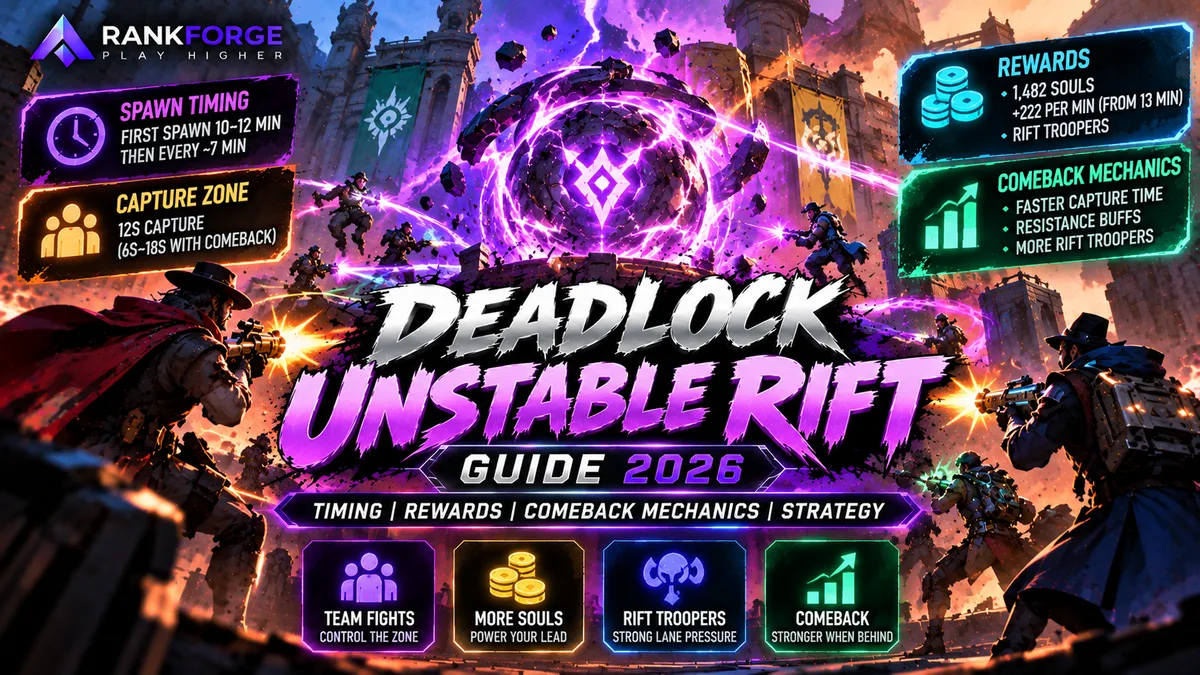
Deadlock Unstable Rift Guide 2026 | Spawn Timing, Rewards & Comeback Strategy
The Unstable Rift is one of Deadlock's most important recurring map objectives.
Unlike the Soul Urn, the Unstable Rift is not a delivery objective. Instead, both teams fight for control of a capture zone that appears on a random side-lane bridge.
The team that secures the Rift receives:
- A large Soul reward
- A wave of Rift Troopers
- Additional comeback value when behind
The objective also has special comeback mechanics that change depending on the difference in team net worth.
This makes the Unstable Rift particularly important in games where one team is trying to extend a lead or recover from a deficit.
This guide covers the current September 2026 Unstable Rift system, including spawn timing, capture rules, rewards, Rift Troopers, comeback mechanics and the best ways to approach the objective in Ranked.
Current for September 2026: The latest September 16 update changed Unstable Rift comeback resistance so that its maximum scales with game time instead of using a fixed maximum. The current formula reaches up to 40% at 30 minutes. :contentReference[oaicite:1]{index=1}
---
What Is the Unstable Rift?
The Unstable Rift is a recurring neutral objective that appears on a random side-lane bridge.
When it becomes active, it creates a capture zone.
Both teams can contest the zone.
The objective can only be secured once one team has exclusive control of the capture point.
This creates a different type of fight from the Mid Boss.
The Mid Boss is primarily a damage and area-control objective.
The Unstable Rift is primarily a positioning and capture-control objective.
That means the winning team often isn't the team that deals the most damage.
It is the team that can control the area long enough to complete the capture.
---
When Does the Deadlock Unstable Rift Spawn?
The first Unstable Rift appears around:
11:00
However, the spawn time is variable.
The first Rift can appear between approximately:
10:00 and 12:00
The Rift then appears again approximately every seven minutes, but subsequent spawns also have timing variation.
The current system therefore shouldn't be treated as an exact:
11:00 → 18:00 → 25:00
timer.
Instead, think of the Rift as a roughly seven-minute recurring objective with variable timing.
The current mechanics allow subsequent Rifts to appear roughly 6–8 minutes after the previous Rift. :contentReference[oaicite:2]{index=2}
---
Unstable Rift Spawn Warning
The Rift gives teams advance information before it opens.
Approximately 60 seconds before the global announcement, an in-world visual effect appears on a random side-lane bridge.
This gives players information about where the next Rift will appear.
Then:
20 seconds before the Rift opens
a global announcement is made.
After the announcement, the Rift becomes visible on the map.
This creates an important preparation window.
You don't have to wait until the Rift actually opens before rotating.
---
Unstable Rift Timing Cheat Sheet
| Event | Current Timing |
|---|---:|
| First Rift | Around 11:00 |
| First spawn range | 10:00–12:00 |
| Early visual warning | 60s before announcement |
| Global announcement | 20s before Rift opens |
| Capture point opens | 20s after announcement |
| Later Rift interval | Approximately 7 minutes |
| Later spawn variation | Approximately 6–8 minutes |
| Base capture time | 12 seconds |
| Maximum trailing capture time | 6 seconds |
| Maximum leading capture time | 18 seconds |
The variable timing means you should use the game's warnings rather than relying exclusively on a fixed timer. :contentReference[oaicite:3]{index=3}
---
Where Does the Unstable Rift Spawn?
The Rift randomly chooses a side lane bridge.
The exact lane isn't fixed.
That means your team has to react to the warning rather than memorizing one permanent location.
Approximately one minute before the global announcement, the game provides an in-world visual indication of the selected location.
Use that information immediately.
If the Rift is going to appear on a lane where your team already has pressure, you can potentially prepare the wave before the objective becomes active.
---
How Does the Unstable Rift Capture Work?
When the Rift opens, it creates a capture zone with approximately a:
20-meter radius
Both teams can enter the zone.
The capture progress works differently from a normal damage objective.
If both teams are present, the Rift remains contested.
The capture only progresses once one team has exclusive control of the zone.
The base capture time is:
12 seconds
The important detail is that adding more players from the same team does not make the capture progress faster.
The capture rate remains the same.
This means five players standing inside the zone aren't necessarily five times as effective as one player.
The value comes from denying the enemy access to the zone.
---
How Many Players Should Enter the Rift?
There is no universal number.
You need enough players to:
- Contest the enemy
- Protect the capture player
- Prevent enemy access
- Survive incoming abilities
- Maintain control of the area
But putting your entire team inside the capture zone can also be dangerous.
If every player stands in one small area, enemy area damage can become extremely effective.
A better setup is often:
Capture player + frontline inside
while:
Damage and utility players control the approaches
This creates more space around the objective.
---
Unstable Rift Players Are Revealed
Players inside the Unstable Rift zone are revealed on the minimap.
This makes the objective more information-heavy than it might initially appear.
You cannot simply sit inside the capture zone and expect to remain hidden.
If your team enters the Rift, assume the enemy knows exactly where the contest is happening.
That makes positioning outside the zone particularly important.
---
Unstable Rift Comeback Mechanics
One of the defining features of the Unstable Rift is its comeback system.
The team that is behind in total net worth receives additional benefits while contesting the objective.
These bonuses scale based on how far behind the team is.
The maximum scaling is reached at approximately:
15% net-worth deficit
The bonuses are dynamic.
If the trailing team catches up during the fight, its bonuses can decrease.
If the team falls further behind, the bonuses can increase.
This means the Rift's comeback mechanics aren't simply locked when the event begins.
They can change during the contest.
---
Unstable Rift Capture-Time Comeback Bonus
The trailing team can receive a faster capture time.
At maximum comeback scaling:
Trailing team: 6 seconds
Leading team: 18 seconds
The normal capture time is:
12 seconds
So the comeback system can significantly change how long a team needs to control the Rift.
This is one of the reasons a team that is ahead should not casually abandon the objective.
The trailing team can have a substantial capture-time advantage if it reaches maximum comeback scaling. :contentReference[oaicite:4]{index=4}
---
Unstable Rift Resistance Bonus
The trailing team also receives Bullet, Spirit and Debuff Resistance while inside the Rift area.
The current maximum resist scaling is no longer a fixed 35%.
The September 16, 2026 update changed the system to:
10% + 1% per minute
with a maximum of:
40% at 30 minutes
The resistance applies within approximately:
35 meters
of the Rift.
This is one of the most important changes to understand when playing around the objective. :contentReference[oaicite:5]{index=5}
---
Why the September 2026 Change Matters
Previously, the Rift's comeback resistance used a fixed maximum value.
The current system scales with game time.
That means a late-game Rift can provide a much larger maximum resistance bonus than an early Rift.
For example:
- Early game → lower maximum
- Mid game → higher maximum
- 30 minutes → maximum 40%
This makes later Unstable Rifts increasingly important for teams attempting to recover.
---
Unstable Rift Soul Reward
The current base Unstable Rift bounty is:
1,482 Souls
The bounty scales by:
+222 Souls per minute
However, the scaling doesn't begin immediately.
The Rift's bounty starts scaling from:
13 minutes
The Souls are distributed equally among the team that secures the Rift. :contentReference[oaicite:6]{index=6}
This makes the Rift a substantial team-wide resource objective.
Unlike the Soul Urn, the main Soul reward isn't concentrated on one runner.
---
Unstable Rift Comeback Bounty
The trailing team can also receive additional comeback value when it captures the Rift.
The amount scales based on:
- Team net-worth deficit
- Game time
The current September 16 update removed a fixed amount of extra bonus Souls that previously applied even when a team was only slightly behind.
Comeback bounties were also slightly reduced in the same update. :contentReference[oaicite:7]{index=7}
The result is a more gradual comeback system rather than giving a large bonus simply for being marginally behind.
---
What Are Rift Troopers?
The winning team receives a special wave of Rift Troopers from the location of the Unstable Rift.
These are stronger than normal lane troopers.
They are visually distinct and don't drop Souls when killed.
The initial Rift produces at least:
5 Rift Troopers
If the winning team is behind, the number can increase.
A trailing team can receive up to:
14 total Rift Troopers
The additional troopers scale with the team's net-worth deficit.
---
Rift Trooper Scaling
The first Rift Troopers receive:
- +100% Health
- +100% Damage
- 25% Melee Resistance
- 30% Spirit Resistance
The bonus Health and Damage increase with each successive Rift.
The current maximum bonus Health and Damage can reach:
+160%
Spirit Resistance also increases with successive Rifts, reaching:
45%
The Melee Resistance remains:
25%
These changes were introduced as part of the 2026 Unstable Rift updates. :contentReference[oaicite:8]{index=8}
---
Why Rift Troopers Matter
The Rift isn't just a Soul objective.
The winning team also creates immediate lane pressure.
The Rift Troopers travel down the lane from the Rift location.
That means the objective can directly affect a structure.
A successful Rift therefore gives your team:
Souls + lane pressure
This is why you should consider the location of the Rift before deciding whether to contest it.
If the objective spawns next to a lane where your team can immediately push, the resulting pressure can be particularly useful.
---
Rift Troopers Don't Drop Souls
An important detail:
Rift Troopers do not drop Souls when killed.
Their purpose is pressure rather than additional farming.
Don't treat them like a normal wave.
They exist to help the winning team pressure the corresponding lane.
---
What Happens If the Rift Is Contested for Too Long?
The Rift has a special timeout system.
If the objective remains contested for more than:
50 seconds
a warning appears.
After:
60 seconds
of contesting, the Rift expires.
At that point, the Soul reward is released as:
13 Soul Orbs
These can be claimed by either team.
If the Orbs are not collected, they eventually disappear and the Souls are lost.
This creates an important strategic decision.
If you cannot actually capture the Rift, you may still be able to fight for the resulting Soul Orbs.
---
The 60-Second Contest Scenario
Imagine both teams arrive at the Rift.
Neither team can fully clear the other.
The fight continues.
At 50 seconds, the warning appears.
Your team now knows the Rift is approaching its expiration.
At 60 seconds:
The Rift expires.
The Souls become 13 neutral Soul Orbs.
At this point, the objective changes from:
Capture the Rift
to:
Control the Soul Orbs
This can create a second fight after the original objective has ended.
---
Should You Keep Contesting an Unstable Rift?
Not always.
If your team is losing the fight badly, continuously feeding players into the capture zone may not be worthwhile.
Instead, consider:
- Disengaging
- Preserving health
- Waiting for the Rift to expire
- Preparing to secure the Soul Orbs
- Trading for another objective
The correct decision depends on the map state.
---
How to Prepare for an Unstable Rift
The best Rift plays often begin before the objective opens.
Step 1 — Watch the Warning
When the in-world warning appears, immediately identify the lane.
Step 2 — Push the Nearby Wave
Create pressure around the objective location.
Step 3 — Track Enemy Players
Determine whether the enemy is rotating toward the Rift.
Step 4 — Prepare Your Team
Decide who will enter the capture zone and who will control the surrounding area.
Step 5 — Arrive Before the Enemy
Positioning early can be more valuable than arriving with the entire team after the fight has already started.
---
Push the Lane Before the Rift
Wave control is particularly important for the Unstable Rift.
Suppose the Rift spawns on Green lane.
If your Green wave is already pushed toward the enemy side, the opponent may have to decide between:
Defending the wave
or
Rotating to the Rift
That creates a strategic advantage.
The reverse is also true.
If your own wave is hitting your structures, leaving lane to contest the Rift can be costly.
Our Deadlock Laning Guide covers the relationship between wave control and objective rotations.
---
Unstable Rift Positioning
The capture zone is only part of the objective.
You also need to control the space around it.
A strong setup can look like:
Inside the Rift
- Frontline
- Capture player
- Short-range pressure
Outside the Rift
- Long-range damage
- Flank protection
- Enemy approach control
- Escape route
This prevents the entire team from becoming trapped inside the capture circle.
---
Don't Stack Your Entire Team
One of the easiest ways to lose an Unstable Rift is to place everyone in the same small area.
The enemy can then use:
- Area damage
- Crowd control
- AoE ultimates
- Burst
- Displacement
against multiple players at once.
Instead, spread your team around the objective.
The capture point needs to be controlled.
The entire surrounding area doesn't need to be occupied by five or six players.
---
Unstable Rift When You're Ahead
If your team is ahead, your priority is usually to prevent the enemy from receiving the comeback advantages.
The leading team doesn't receive the same capture-time benefit as the trailing team.
At maximum comeback scaling, the leading team can need up to:
18 seconds
to capture.
That gives the trailing team a major opportunity to interrupt the objective.
When ahead:
- Arrive early
- Push the lane
- Keep the enemy outside
- Don't give them isolated fights
- Track their rotation
- Control the approaches
The goal is to deny the enemy an easy comeback objective.
---
Unstable Rift When You're Behind
The Rift becomes particularly interesting when your team is losing.
Your team can receive:
- Faster capture
- Bullet Resistance
- Spirit Resistance
- Debuff Resistance
- Additional Soul value
- Additional Rift Troopers
The bonuses scale with your deficit.
That doesn't mean you should blindly fight.
Instead, use the objective to create a controlled comeback opportunity.
A strong pattern is:
Farm → Push → Rift → Souls → Rift Troopers → Rebuild map control
---
Unstable Rift as a Comeback Tool
The Rift is designed to make a net-worth deficit less decisive.
However, the comeback mechanics are not unlimited.
The maximum net-worth scaling is approximately:
15% behind
Beyond that point, additional deficit doesn't continue increasing the same Rift bonuses.
This prevents the objective from becoming infinitely stronger for the losing team.
---
The Resistance Aura
The comeback resistance applies around the Rift.
At maximum scaling, the team can receive up to:
40% Bullet Resist
40% Spirit Resist
40% Debuff Resist
The current resistance maximum is based on game time and reaches 40% at approximately 30 minutes.
Because the resistance is local to the Rift area, moving too far away can remove the benefit.
This makes the capture zone itself strategically important.
---
How to Fight Inside the Rift
If you're the trailing team, the Rift can become a temporary defensive zone.
You receive additional resistance while inside the area.
Use that advantage to:
- Hold the capture
- Absorb enemy pressure
- Force the enemy away
- Buy time
- Complete the capture
But remember:
The enemy can still contest the zone.
The resistance doesn't make your team immune to damage.
---
How to Fight Against a Comeback Rift
If you're ahead, don't assume the enemy will be easy to remove.
The trailing team may have:
- Higher resistance
- Faster capture
- Additional bounty
- More Rift Troopers
Instead of forcing the enemy directly inside the capture zone, consider controlling the entrances.
Make the enemy fight outside their strongest position.
Then enter the zone once you have created enough space.
---
Unstable Rift vs Soul Urn
The Soul Urn and Unstable Rift are both recurring side objectives, but their purposes are different.
| Soul Urn | Unstable Rift |
|---|---|
| Movement objective | Capture objective |
| First spawn 10:00 | First Rift around 10–12m |
| Every 5 minutes | Roughly every 7 minutes |
| One runner | Entire team contests |
| Delivered across map | Captured at spawn |
| Permanent buffs | Rift Troopers |
| Runner receives bounty | Souls split across team |
| Runner bonuses | Comeback capture bonuses |
The Soul Urn is primarily about movement and delivery.
The Unstable Rift is primarily about area control and team fighting.
Our Deadlock Soul Urn Guide covers the current Urn system in detail.
---
Unstable Rift vs Mid Boss
The Mid Boss is a central map objective with the Rejuvenator.
The Unstable Rift is a side-lane capture objective.
The two objectives therefore create different strategic situations.
Mid Boss
- Central location
- Large team fight
- Rejuvenator
- Major push potential
Unstable Rift
- Random side lane
- Capture zone
- Rift Troopers
- Comeback mechanics
- Team-wide Soul bounty
Your team should not automatically treat one objective as interchangeable with another.
The current map state determines which objective creates the better opportunity.
---
Can You Trade Unstable Rift for Another Objective?
Yes.
If the enemy commits several players to the Rift, your team may be able to take something elsewhere.
For example:
Enemy → Rift
Your team → lane pressure / Mid Boss / farm
The correct trade depends on:
- Current Soul difference
- Structures
- Hero positions
- Objective timers
- Team strength
- Respawn timers
Never assume every objective must be contested.
Sometimes the best play is to trade.
---
Unstable Rift and Map Rotations
The Rift is especially useful for creating rotations.
Because the spawn location is random, both teams must react.
A team that rotates first can often establish better positioning.
This creates a simple macro sequence:
Rift warning → Push wave → Rotate → Establish control → Capture
That is much more reliable than:
Rift opens → Everyone runs there
The second approach often arrives too late.
---
Unstable Rift Mistakes to Avoid
1. Ignoring the Early Warning
The visual warning gives you valuable preparation time.
Use it.
2. Arriving Late
The enemy may already control the area.
3. Stacking the Entire Team
Spread around the objective.
4. Ignoring Lane Pressure
Your structures still matter.
5. Fighting Without a Capture Plan
Someone needs to actually secure the objective.
6. Forgetting the Comeback Mechanics
The trailing team can capture significantly faster.
7. Standing Outside the Resistance Area
If you're relying on comeback resistance, stay close enough to benefit.
8. Overcommitting to a Lost Rift
You may be better off waiting for the Soul Orbs.
9. Ignoring Rift Troopers
The winning team receives additional lane pressure.
10. Forgetting the Expiration Timer
A heavily contested Rift eventually becomes a Soul Orb fight.
---
Unstable Rift Strategy Checklist
Before the Rift opens:
- [ ] Identify the lane
- [ ] Push the nearby wave
- [ ] Track enemy rotations
- [ ] Decide who enters the zone
- [ ] Position damage outside the zone
- [ ] Prepare an escape route
During the capture:
- [ ] Control enemy access
- [ ] Watch the minimap
- [ ] Use the terrain
- [ ] Avoid unnecessary stacking
- [ ] Track capture progress
- [ ] Know whether your team is leading or trailing
If the fight stalls:
- [ ] Watch the 50-second warning
- [ ] Prepare for the 60-second expiration
- [ ] Position around the Soul Orbs
- [ ] Don't feed unnecessary deaths
After winning:
- [ ] Collect the Soul reward
- [ ] Use Rift Trooper pressure
- [ ] Push the affected lane
- [ ] Convert the map advantage
- [ ] Prepare for the next objective
---
Unstable Rift Timing Cheat Sheet
| Mechanic | Current Value |
|---|---:|
| First Rift | Around 11:00 |
| First spawn range | 10:00–12:00 |
| Later interval | ~7 minutes |
| Later variation | ~6–8 minutes |
| Visual warning | ~60s before announcement |
| Global announcement | 20s before opening |
| Capture radius | 20m |
| Base capture time | 12s |
| Maximum trailing capture | 6s |
| Maximum leading capture | 18s |
| Contest warning | 50s |
| Rift expiration | 60s contested |
| Base bounty | 1,482 Souls |
| Soul scaling | +222/min |
| Bounty scaling begins | 13 minutes |
| Rift Troopers | At least 5 |
| Maximum trailing Rift Troopers | 14 |
Current values reflect the September 2026 Unstable Rift system. :contentReference[oaicite:9]{index=9}
---
How to Get More Value From Every Unstable Rift
The biggest mistake is treating the Rift as:
"Another objective we have to fight."
Instead, think of it as:
A timed map event that changes the value of a specific lane.
The complete process should be:
Warning appears
↓
Identify the lane
↓
Push the wave
↓
Track the enemy
↓
Rotate early
↓
Control the area
↓
Capture the Rift
↓
Collect Souls
↓
Send Rift Troopers
↓
Convert lane pressure
The final step is critical.
Winning the Rift isn't the end of the play.
The Rift Troopers give you a chance to convert the objective into actual map pressure.
---
Ranked Strategy for Unstable Rift
In Ranked, simple communication is enough.
Before the Rift opens:
"Rift Green. Push then rotate."
Once your team arrives:
"Front in. DPS outside."
If the enemy is behind:
"Don't leave zone."
If the Rift is heavily contested:
"Play Orbs at 60."
These simple calls can make the objective much easier to coordinate.
---
Final Thoughts
The Unstable Rift is one of Deadlock's most interesting objectives because its value changes depending on the game state.
The basic mechanics are straightforward:
Random side lane → warning → capture zone → team contest → Souls + Rift Troopers
But the comeback system adds another layer.
A trailing team can receive:
- Faster capture
- Defensive resistances
- Additional Soul value
- More Rift Troopers
The September 16, 2026 update also made the resistance system scale with game time, reaching up to 40% at 30 minutes rather than using the previous fixed maximum. :contentReference[oaicite:10]{index=10}
The most important skill is therefore not simply winning the capture.
It's preparing the map before the Rift opens.
Push the lane.
Track the enemy.
Arrive early.
Control the area.
Capture the Rift.
Then use the Rift Troopers to create pressure.
For more Deadlock objective strategy, continue with the Deadlock Soul Urn Guide and Deadlock Mid Boss Guide.