Rina Sato
How to Improve Aim in Valorant | 20-Minute Training Routine 2026
Learn how to improve your Valorant aim with a simple 20-minute daily routine. Train crosshair placement, first shots, flicks, movement and consistency.
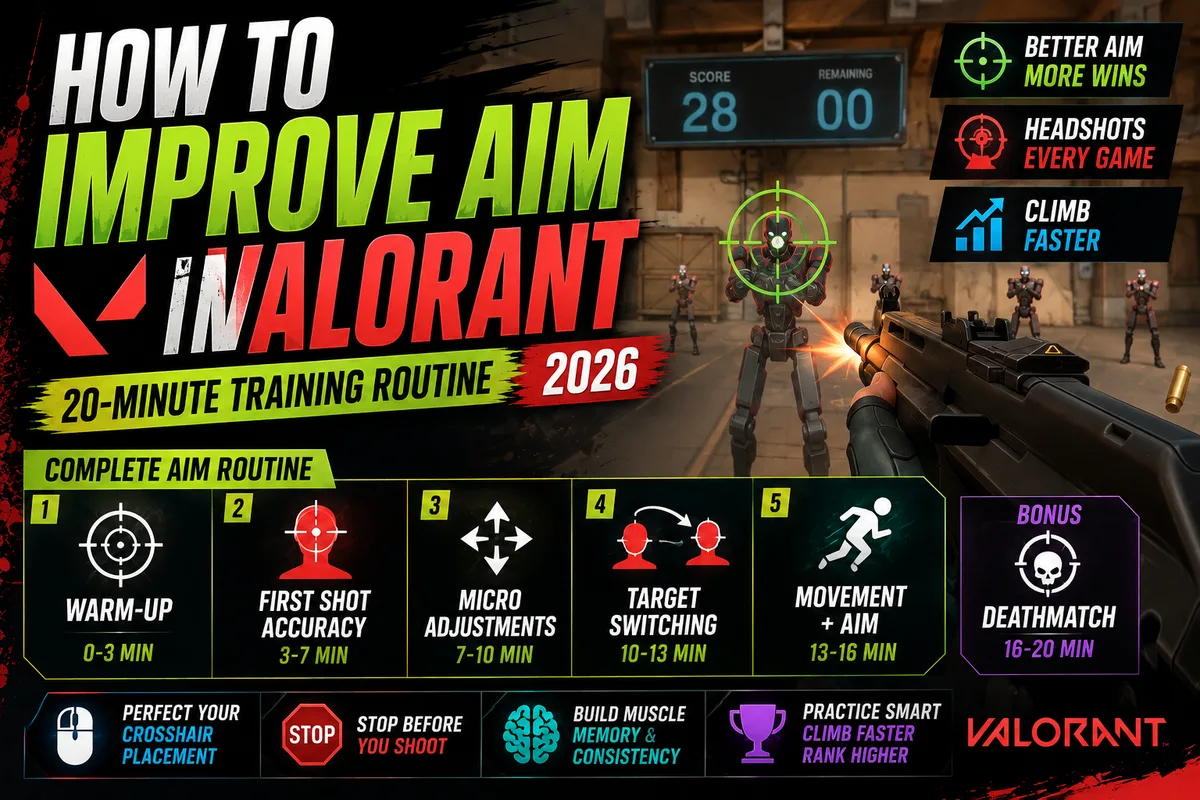
How to Improve Aim in Valorant | 20-Minute Training Routine 2026
Good aim can completely change how Valorant feels.
You win more opening duels.
You feel more confident taking fights.
You don't need to rely on teammates to finish every kill.
And most importantly, you can punish mistakes instead of constantly losing gunfights.
But there is a problem with how many players practice aim.
They simply play more ranked games.
That isn't necessarily training.
If you spend three hours repeating the same bad crosshair placement and movement habits, you're mostly becoming better at repeating those habits.
A better approach is to separate training from playing.
In this guide, we'll build a simple 20-minute Valorant aim routine covering:
- Crosshair placement
- First-shot accuracy
- Micro-adjustments
- Flicking
- Movement
- Deathmatch
- Reviewing mistakes
The goal isn't to spend an hour in an aim trainer every day.
The goal is to create a short routine you can actually repeat.
What Actually Makes Your Aim Better in Valorant?
Aim in Valorant isn't just mouse movement.
Your mechanical performance comes from several different skills working together:
- Crosshair placement
- Mouse control
- First-shot accuracy
- Micro-adjustments
- Flicks
- Movement
- Stopping before shooting
- Spray control
- Target selection
- Positioning
This is why someone can have excellent scores in an aim trainer but still struggle in ranked.
They may have good raw mouse control but poor crosshair placement or movement.
The best training routine should therefore connect practice to actual Valorant fights.
The Most Important Aim Skill: Crosshair Placement
Before worrying about huge flicks, fix your crosshair placement.
If your crosshair is already close to the enemy's head when they appear, you don't need a massive mouse movement.
That makes the duel faster and more consistent.
Think about every corner you approach.
Your crosshair should already be positioned where an enemy's head is likely to appear.
Not at the floor.
Not at chest level.
Not in the middle of the wall.
At head level.
This is one of the easiest mechanical improvements you can make without changing your sensitivity.
Crosshair Placement Is More Important Than Flicking
Flicking looks impressive.
But you shouldn't need a huge flick for every kill.
If your crosshair is correctly positioned before the enemy appears, your first shot may only require a small adjustment.
That means your goal should be:
Predict → Position → Stop → Shoot.
Not:
See enemy → panic → flick across screen → hope.
The better your crosshair placement becomes, the less work your mouse has to do.
Step 1: Lock Your Sensitivity
Before starting an aim routine, stop changing your sensitivity constantly.
You don't need to copy a professional player's sensitivity.
You need a sensitivity that you can control consistently.
Once you find a comfortable setting, give yourself enough time to adapt to it.
Changing sensitivity every few days makes it difficult to build consistent motor habits.
If you're constantly thinking:
"Maybe my sensitivity is wrong."
you're not giving yourself enough time to actually learn it.
For additional setup information, see our Best Valorant Sensitivity and Settings guide.
Step 2: Use the Valorant Range
The Range is one of the most useful places to practice because you're using the exact weapons, movement and visual environment from the real game.
Don't just stand there and shoot bots randomly.
Give every drill a purpose.
Your first goal should be accuracy.
Your second goal should be consistency.
Speed comes later.
The 20-Minute Valorant Aim Routine
Here is a simple routine you can repeat before ranked.
Minutes 0–3: Warm Up Your Mouse
Don't immediately start trying to hit the fastest targets possible.
Spend a few minutes getting comfortable.
Focus on:
- Smooth mouse movement
- Relaxed grip
- Head-level crosshair
- Small adjustments
- Controlled clicks
The objective isn't to set a record.
You're preparing your hands.
Minutes 3–7: First-Shot Accuracy
Use a Vandal or Phantom.
Practice hitting stationary targets with controlled single shots.
Don't spray.
Move your crosshair to the head.
Stop.
Shoot.
Then move to the next target.
Focus on making every shot deliberate.
A good exercise is to reset after a missed shot.
The point isn't to create pressure.
It's to teach yourself not to panic after seeing a target.
Minutes 7–10: Micro-Adjustments
Now work on small corrections.
Place your crosshair slightly beside the target.
Move onto the head with a controlled adjustment.
Shoot.
Repeat.
This trains the small movements that decide many real Valorant gunfights.
Don't exaggerate the movement.
The goal is precision.
Minutes 10–13: Faster Target Switching
Now increase the speed.
Move between targets and shoot them as quickly as you can while maintaining reasonable accuracy.
There is an important rule:
Don't sacrifice all accuracy for speed.
If you hit one target extremely fast but miss the next four, you're not actually improving your ranked aim.
Find the fastest speed at which you can still remain controlled.
Minutes 13–16: Movement + Aim
This is where training starts becoming more realistic.
Practice moving sideways.
Stop.
Shoot.
Move again.
Stop.
Shoot.
The important part is learning the relationship between movement and shooting.
You don't want to shoot while your movement is still ruining your accuracy.
Your rhythm should become:
Move → stop → shoot → move.
Minutes 16–20: Deathmatch
Finish your routine with a real-player environment.
Don't treat Deathmatch like a normal ranked game.
Your goal isn't to win.
Your goal is to practice.
Focus on one thing.
For example:
Today: crosshair placement.
Ignore your score.
If you die, immediately ask:
"Where was my crosshair?"
That question is much more useful than:
"Why is everyone better than me?"
How to Use Deathmatch Correctly
Deathmatch can be extremely useful, but only if you use it intentionally.
Don't turn every Deathmatch into a race for kills.
Instead, choose one mechanical focus.
Crosshair Placement Day
Focus only on keeping the crosshair at head level.
First Shot Day
Focus on controlled taps and short bursts.
Movement Day
Focus on stopping correctly before shooting.
Duel Day
Focus on taking fights without panicking.
This gives every Deathmatch a purpose.
Don't Chase Your Deathmatch Score
A common mistake is changing your behavior because you want to finish first.
You start holding unusual angles.
You start chasing players.
You take fights that you would never take in ranked.
That can make your Deathmatch stats look better while teaching you habits that don't transfer to Competitive.
Your goal is not:
"Win Deathmatch."
Your goal is:
"Improve the skill I'm training today."
Aim Training vs Playing Ranked
Ranked and training serve different purposes.
Training
You isolate one skill.
Deathmatch
You practice mechanics against unpredictable players.
Ranked
You combine mechanics with:
- Utility
- Positioning
- Communication
- Economy
- Timing
- Game sense
You need all three.
Don't expect 20 minutes of Range practice to instantly make you Radiant.
The purpose is to gradually improve the mechanical part of your game.
How Often Should You Train Aim?
Consistency is more important than massive sessions.
A player who practices 20 minutes five days a week can build a much better routine than someone who practices two hours once every two weeks.
A simple schedule is:
Monday: Aim routine
Tuesday: Aim routine
Wednesday: Short warm-up
Thursday: Aim routine
Friday: Aim routine
Weekend: Play and review
You don't have to follow this exact schedule.
The important principle is repetition.
Should You Use Aim Trainers?
You can.
External aim trainers can be useful for specific mechanical skills such as:
- Flicking
- Micro-adjustments
- Target switching
- Precision
- Smoothness
Aimlabs also publishes Valorant-specific training content and routines focused on these mechanics. :contentReference[oaicite:2]{index=2}
But an external aim trainer isn't mandatory.
The Valorant Range and real matches already give you plenty of useful training.
If you do use an aim trainer, make sure your sensitivity is properly matched to Valorant.
More training isn't automatically better.
Better training is better.
Crosshair Placement Practice Outside the Range
You can practice crosshair placement without firing a single shot.
Load into a map.
Walk around.
Pretend enemies are standing behind every corner.
Keep your crosshair at the correct height.
As you move through the map, imagine where an enemy's head would appear.
This is extremely useful because it connects aim training to actual map geometry.
For example, on Summit, your crosshair should account for the height and angle of the positions you're clearing.
You can combine this with our Valorant Summit Map Guide.
Practice Common Angles
Don't only practice random targets.
Think about actual ranked situations.
If you constantly die when clearing a common angle, practice that angle.
For example:
- Clearing a close corner
- Swinging a long angle
- Holding a tight choke
- Fighting an Operator
- Entering a site
- Clearing a vertical position
The closer training is to the fights you actually lose, the more useful it becomes.
Aim Doesn't Fix Bad Positioning
This is one of the most important lessons.
You can have excellent aim and still lose fights because you're standing in a terrible position.
Imagine an enemy has an Operator.
You know exactly where they are.
You peek anyway.
You lose.
That doesn't necessarily mean your aim is bad.
The better solution may have been:
- Use utility
- Swing with a teammate
- Change the angle
- Force the Operator away
- Avoid the fight
Aim is only one part of winning gunfights.
Aim Doesn't Fix Bad Movement
Another common problem is shooting while moving incorrectly.
You see an enemy.
You panic.
You hold A or D.
You shoot.
Your bullets become inaccurate.
Instead, develop the habit of stopping before firing.
This is why movement drills belong in your aim routine.
You don't want your mouse hand and movement hand fighting each other.
They should work together.
Burst vs Spray
Don't automatically spray every time you see someone.
Your firing method should depend on distance.
Close Range
Spraying can be effective.
Medium Range
Short bursts are often more controlled.
Long Range
Controlled taps are generally safer.
The exact situation depends on the weapon and fight, but the principle is simple:
Don't use one firing pattern for every distance.
How to Improve Headshot Percentage
Don't obsess over the number.
Instead, improve the process that creates headshots.
Focus on:
- Head-level crosshair placement
- Stopping before shooting
- Controlled first shots
- Better angle clearing
- Avoiding panic sprays
- Taking favorable fights
If those improve, your headshot percentage will usually become more consistent.
Trying to artificially increase your headshot percentage can actually hurt your gameplay if you refuse to take necessary fights.
What If You Keep Whiffing?
If you're constantly missing easy shots, don't immediately change your sensitivity.
First diagnose the problem.
Your Crosshair Is Too Low
Work on head-level placement.
You're Shooting While Moving
Practice stop-and-shoot timing.
You're Over-Flicking
Slow down and focus on smaller adjustments.
You're Panicking
Practice controlled shots in Deathmatch.
You're Losing Long-Range Fights
Practice precision and first-shot accuracy.
You're Losing Close Fights
Work on reaction speed and movement.
The solution depends on the actual problem.
Review Your Deaths
One of the best aim-training tools is your own gameplay.
After a match, look at several deaths.
Ask:
Was my crosshair already near the enemy's head?
If not, that is a placement problem.
Was I moving when I shot?
If yes, that is a movement problem.
Did I over-flick?
If yes, that is a mouse-control problem.
Did I panic spray?
If yes, that is a discipline problem.
Did I take a terrible fight?
If yes, that may not be an aim problem at all.
This prevents you from wasting hours training the wrong skill.
A Simple Weekly Aim Plan
Monday — Crosshair Placement
Focus on head level and angle clearing.
Tuesday — First Shots
Focus on taps and controlled bursts.
Wednesday — Movement
Practice stopping before shooting.
Thursday — Micro-Adjustments
Practice small corrections.
Friday — Target Switching
Practice moving quickly between targets.
Weekend — Real Games
Focus on applying everything in Ranked.
This is much more useful than doing the same random drill every day.
How Long Does It Take to Improve Aim?
There isn't a guaranteed timeline.
Some players notice changes quickly.
Others need several weeks of consistent practice.
The important thing is measuring improvement correctly.
Don't judge your aim based on one match.
Look for patterns across many games.
Are you:
- Missing fewer easy shots?
- Winning more first duels?
- Keeping your crosshair higher?
- Staying calmer?
- Taking cleaner fights?
- Getting more value from your first bullet?
Those are better indicators than one Deathmatch score.
Don't Change Your Settings Every Day
If you constantly change:
- Sensitivity
- Crosshair
- Resolution
- Mouse settings
you make it difficult to understand what is actually improving.
Pick a setup.
Use it.
Train.
Then make changes only when you have a clear reason.
Our Best Valorant Crosshair Codes and Best Valorant Settings for FPS guides can help you establish a consistent setup.
The Biggest Aim Training Mistakes
1. Training Too Long
More isn't always better.
2. Changing Sensitivity Constantly
Your muscle memory needs consistency.
3. Only Practicing Flicks
Crosshair placement is often more important.
4. Ignoring Movement
Aim and movement work together.
5. Chasing Scores
Training should have a purpose.
6. Never Playing Real Matches
Skills must transfer to real situations.
7. Blaming Sensitivity
Many "aim problems" are actually positioning or crosshair-placement problems.
8. Practicing Without Reviewing
If you don't know what you're doing wrong, you may train the wrong skill.
A 5-Minute Emergency Warm-Up
Don't have 20 minutes?
Use this.
1 minute: smooth mouse movement
2 minutes: controlled headshots in the Range
2 minutes: quick Deathmatch
Then queue.
This is enough to get your hands ready without turning your warm-up into another gaming session.
Should You Warm Up Before Every Ranked Game?
A short warm-up can help if you feel mechanically cold.
But don't turn warming up into a requirement.
If you need an hour of training before you can play properly, there may be a deeper consistency issue.
The goal is to prepare your mechanics, not exhaust yourself.
Aim and Game Sense Work Together
Mechanical skill becomes much more valuable when combined with good decisions.
Imagine you have excellent aim but constantly peek into three enemies.
You're still going to die.
Now imagine you have good game sense but weak mechanics.
You may consistently create favorable fights but fail to convert them.
The strongest players combine both.
That's why you should pair this routine with our How to Improve Game Sense in Valorant guide.
How Aim Helps You Climb
Improved aim can help you:
- Win more opening duels
- Convert advantages
- Secure trades
- Punish mistakes
- Hold important angles
- Enter sites more confidently
- Win clutch situations
But remember:
Aim creates opportunities.
Game sense and decision-making determine how you use them.
If your goal is climbing, also read our How to Rank Up Fast in Valorant guide.
Final Thoughts
Improving your Valorant aim doesn't require spending five hours every day in an aim trainer.
It requires consistency.
Start with a simple 20-minute routine:
3 minutes: warm up
4 minutes: first-shot accuracy
3 minutes: micro-adjustments
3 minutes: target switching
3 minutes: movement
4 minutes: Deathmatch
Then play Ranked and focus on transferring what you practiced.
Most importantly, don't confuse raw aim with good gunfighting.
Crosshair placement, movement, positioning and decision-making all influence whether your shots actually matter.
Keep your sensitivity stable.
Practice deliberately.
Review your deaths.
And focus on one mechanical improvement at a time.
Do that consistently and your aim should become more reliable over time.
If you're also working on your overall competitive performance, check our Valorant Game Sense Guide, Valorant Economy Guide, Valorant Summit Map Guide, and How to Rank Up Fast in Valorant.
If your goal is to reach a specific rank without spending all your time grinding, you can also explore our Valorant Boosting service.