 Marcus Webb
How to Prepare for a LoL VOD Review: A Player's Checklist
Learn how to prepare for a LoL VOD review. Analyze your replays, identify mistakes, and build a practical plan to improve your ranked performance.
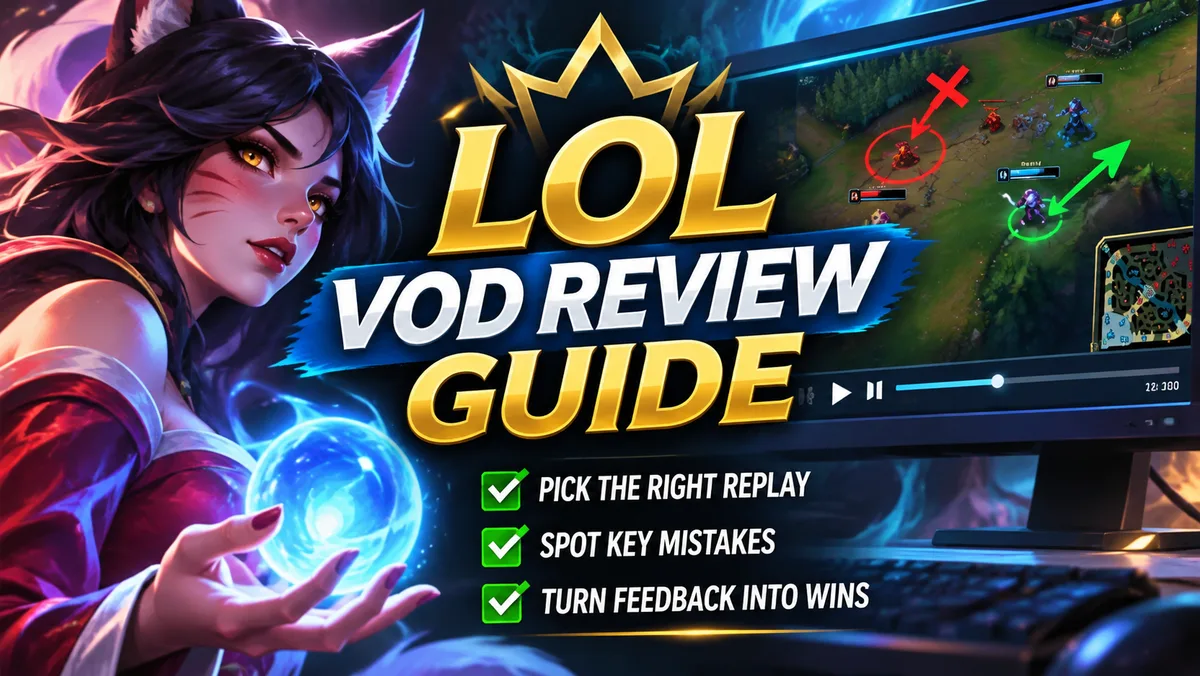
How to Prepare for a LoL VOD Review: A Player's Checklist
Improving at League of Legends is not just about playing more games. It is about understanding why you win, why you lose, and which decisions you need to change.
A LoL VOD review helps you do exactly that. By watching a recording of your own gameplay, you can identify mistakes that are easy to miss during a live match — from poor recalls and missed farm to bad rotations and unnecessary fights.
But a replay is only useful if you know what to look for.
This guide explains how to prepare for a League of Legends VOD review, choose the right game, identify important moments, and turn feedback into improvements you can apply in your next ranked session.
1. Choose the Right Game to Review
Your most recent defeat is not automatically your best replay.
Choose a match that gives you enough information to understand your decisions. Ideally, select a game where you played your main role and a familiar champion.
Good replays to review include:
- A close game where you felt you could have carried.
- A defeat where you were unsure what went wrong.
- A game where you won lane but struggled to close out the match.
- A match where you repeatedly died to the same type of situation.
- A game where you felt lost after the laning phase.
Don't choose a replay simply because you had a bad KDA. A game with several deaths can still contain useful decisions, while a positive KDA does not necessarily mean you played well.
Tip: Start with one replay rather than reviewing five games at once. A focused review is easier to understand and act on.
2. Write Down Your Main Questions Before Watching
Before opening the replay, think about what you want to improve.
Avoid vague goals such as "I want to play better" or "I need to stop losing."
Instead, write down two or three specific questions:
- Am I losing too much CS during the first ten minutes?
- Do I recall at the wrong times?
- Am I trading when my important abilities are unavailable?
- Do I follow my jungler at the right moments?
- Am I rotating too late for Dragon or Baron?
- Do I position too aggressively in team fights?
These questions give your review a clear direction.
You do not need to understand every mistake immediately. The goal is to discover patterns that you can work on.
3. Review the Laning Phase First
The early game often contains decisions that influence the rest of the match.
Start by reviewing the first 10–15 minutes. Pay particular attention to the following areas.
CS and Farming
Check your minion score at different points in the game.
Ask yourself:
- Did I miss minions because of poor last-hitting?
- Did I take unnecessary trades and lose farm?
- Did I leave the lane without managing the wave?
- Did I miss experience by roaming at the wrong time?
Farming is not just about hitting minions. It is also about knowing when you can safely collect a wave and when you should give up farm to avoid a dangerous situation.
Trading and Positioning
Watch your trades again.
Ask yourself:
- Did I trade when my opponent's key ability was unavailable?
- Did I use my abilities effectively?
- Did I take damage without getting anything in return?
- Did I respect the enemy jungler's possible position?
Look for repeated mistakes rather than judging a single trade in isolation.
Jungle Tracking
Review what you knew about the enemy jungler at the time.
Consider whether you had enough vision, whether you respected missing opponents, and whether you continued playing aggressively when a gank was likely.
A death is not always caused by poor mechanics. Sometimes the mistake happened 30 seconds earlier when you ignored information on the map.
4. Identify Your Biggest Mid-Game Mistakes
After the laning phase, the game becomes more dependent on rotations, objectives, and team decisions.
Review the moments when you left your lane and moved around the map.
Focus on:
Objective preparation: Did you arrive early enough to help your team establish vision before Dragon or Baron?
Side-lane management: Did you push a wave before grouping, or did you leave minions and pressure behind?
Map awareness: Did you notice missing opponents and react to information from the minimap?
Team fights: Did you understand your role in the fight? Were you protecting your carry, engaging, or waiting for an important ability?
Overstaying: Did you remain on the map after taking an objective or winning a fight when recalling would have been safer?
Do not try to fix every decision at once. Find the one recurring problem that has the biggest impact on your games.
5. Review Every Important Death
Deaths are among the most valuable moments to study in a replay.
Pause shortly before each death and ask yourself:
1. What information did I have at that moment?
2. Where were the enemy champions?
3. Did I have vision of the area?
4. Was I using an important ability or summoner spell unnecessarily?
5. Was the play worth the risk?
Then look at the moments before the death. Could you have avoided the situation by recalling earlier, changing your position, or respecting missing opponents?
Create a simple list of recurring problems:
| Mistake | Possible improvement |
|---|---|
| Died while pushing without vision | Check the minimap and track missing enemies |
| Lost a trade before an objective | Avoid unnecessary damage and preserve resources |
| Got caught after a won fight | Recall instead of overstaying |
| Entered a fight without teammates | Wait for your team before committing |
The goal is not to eliminate every death. It is to stop repeating avoidable mistakes.
6. Turn Your Findings into an Improvement Plan
Watching a replay without changing your habits will not improve your gameplay.
After reviewing the match, choose a maximum of three improvement goals.
For example:
Goal 1 — Laning: Improve last-hitting and avoid unnecessary trades before the first recall.
Goal 2 — Map awareness: Check the minimap more frequently and respect missing opponents.
Goal 3 — Objectives: Prepare earlier for Dragon and Baron instead of arriving after the fight has started.
Keep your goals specific and measurable.
For your next five ranked games, focus on these areas rather than constantly checking your LP or rank.
After those games, review another replay and check whether the same mistakes are still happening.
7. When Should You Get Professional LoL Coaching?
Self-review is a useful way to improve, but it has limitations.
You might notice that you died several times in lane without understanding the underlying reason. You may also believe that a team fight was lost because of your teammates when an earlier positioning decision made the fight difficult.
An experienced coach can help identify these patterns.
A structured coaching session can include:
- Reviewing your replay and identifying recurring mistakes.
- Analyzing your champion and role fundamentals.
- Improving wave management and recall timing.
- Understanding rotations and objective preparation.
- Creating a personalized improvement plan.
If you want more structured feedback, take a look at RankForge LoL Coaching. You can explore coaching options and get help identifying weaknesses in your gameplay.
8. Your LoL VOD Review Checklist
Use this checklist whenever you review a ranked game.
- [ ] Choose one replay with useful learning opportunities.
- [ ] Write down two or three questions before watching.
- [ ] Review your first 10–15 minutes.
- [ ] Check CS, trading, positioning, and jungle tracking.
- [ ] Analyze your mid-game rotations and objective decisions.
- [ ] Review every important death.
- [ ] Identify your three biggest recurring mistakes.
- [ ] Set no more than three improvement goals.
- [ ] Apply those goals in your next five ranked games.
Consistency matters more than watching hours of replays without a clear plan.
Final Thoughts
A good LoL VOD review is not about proving that you played badly or blaming your teammates. It is about understanding which decisions you can control and making better ones in future games.
Start with one replay, focus on a few important moments, and turn your findings into specific goals. Over time, this process can help you build better habits and become a more consistent ranked player.
If you want an experienced player to analyze your gameplay and help you identify weaknesses, explore RankForge League of Legends Coaching.
Review your decisions. Fix recurring mistakes. Make every ranked game a learning opportunity.


