Rina Sato
Marvel Rivals MMR Explained | How Matchmaking Works (2026)
What is MMR in Marvel Rivals? Learn how matchmaking evaluates player skill, how rank and matchmaking interact, what happens during placements.
Marvel Rivals MMR Explained | How Matchmaking Works (2026)
If you've ever played Marvel Rivals and wondered why you are matched against players who seem much stronger or weaker than their visible rank, you've probably encountered the concept commonly called MMR.
MMR stands for Matchmaking Rating. It is the term players commonly use to describe a hidden skill value that matchmaking systems use to create competitive games.
However, there is an important distinction with Marvel Rivals:
NetEase does not publicly provide a complete numerical MMR formula.
That means there is no reliable public formula that tells you exactly how many hidden points you gain after a win or lose after a defeat.
What we can establish from the official competitive rules is that Marvel Rivals uses ranked and predicted-rank information when creating matches, and the game has also introduced systems that evaluate individual performance.
This guide explains what we know, what we don't know, and how matchmaking affects your ranked experience.
What Is MMR in Marvel Rivals?
MMR is short for Matchmaking Rating.
In competitive games, MMR generally refers to a hidden measurement of player skill used to help create appropriately competitive matches.
Your visible rank is not necessarily the same thing as your matchmaking rating.
For example, two players could both display the same rank while having different matchmaking histories and different levels of competitive performance.
The important point is that visible rank and matchmaking evaluation are not necessarily identical concepts.
Marvel Rivals does not publish a complete hidden MMR number for players, so websites or players claiming to know the exact numerical formula should be treated cautiously.
Does Marvel Rivals Have MMR?
Players commonly refer to the game's hidden matchmaking skill evaluation as MMR.
However, Marvel Rivals does not publicly expose a traditional numerical MMR value or publish a complete formula showing exactly how matchmaking calculates it.
Instead, the official systems provide evidence that matchmaking uses competitive information to determine appropriate opponents and teammates.
For example, during placement matches, Marvel Rivals gives players a predicted rank.
That predicted rank is used for matchmaking and team formation during the placement process. It is not necessarily the player's final rank. :contentReference[oaicite:1]{index=1}
This is one of the clearest examples of the relationship between hidden matchmaking evaluation and visible competitive progression.
MMR vs Rank in Marvel Rivals
One of the biggest sources of confusion is the difference between matchmaking and your visible rank.
Rank
Your rank is the competitive tier displayed on your profile and in the ranked system.
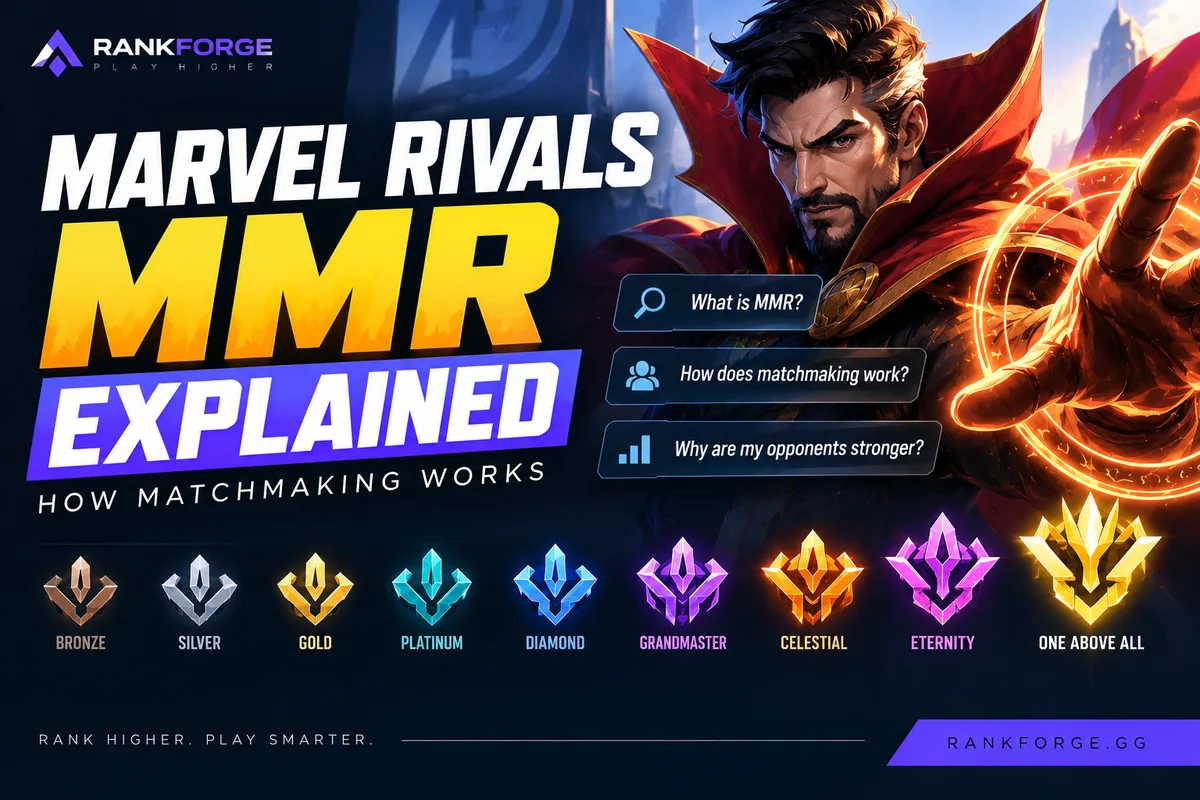
Marvel Rivals uses ranks including:
- Bronze
- Silver
- Gold
- Platinum
- Diamond
- Grandmaster
- Celestial
- Eternity
- One Above All
Your rank is the visible representation of your competitive progression.
MMR
MMR is the term used to describe the hidden matchmaking skill measurement players associate with matchmaking.
Unlike your rank, you don't receive a publicly displayed MMR number.
This means you cannot open your profile and see something like:
MMR: 2,347
Marvel Rivals does not provide that kind of public value.
How Marvel Rivals Matchmaking Works
The exact matchmaking algorithm is not publicly documented.
However, the official competitive rules provide several important clues.
During placement matches, Marvel Rivals creates a predicted rank for the player.
That predicted rank is used for matchmaking and team formation while placements are being completed. :contentReference[oaicite:2]{index=2}
This means your placement games are not simply random matches against completely unrelated players.
The system has an estimate of where you belong and uses that information when creating the games.
Predicted Rank During Placements
Marvel Rivals introduced a placement system where your first 10 ranked matches of the relevant placement process are used to determine your starting competitive position.
During these games, you receive a predicted rank.
The important distinction is:
Predicted rank ≠ final rank.
The predicted rank is used during the placement process for matchmaking and team formation.
After completing the required placement matches, your actual rank is assigned based on the placement system. :contentReference[oaicite:3]{index=3}
This helps explain why your matchmaking can feel different while you are completing placements.
Does Your Rank Affect Matchmaking?
Yes, competitive rank is clearly relevant to matchmaking.
Marvel Rivals' official placement rules specifically describe predicted rank being used for matchmaking.
The game has also implemented different team-size restrictions depending on rank.
For example, earlier official competitive rules allowed Bronze through Grandmaster players to queue in larger parties, while Celestial, Eternity and One Above All were restricted to solo or duo queue. :contentReference[oaicite:4]{index=4}
These rules can change between seasons, but they demonstrate that rank is an important part of the competitive matchmaking environment.
Does Individual Performance Affect Marvel Rivals Ranked Progress?
Yes.
Marvel Rivals has explicitly stated that individual performance can influence competitive scoring.
Earlier competitive updates increased the weight of individual performance when determining how many points players gain from victories and lose from defeats. :contentReference[oaicite:5]{index=5}
The system was later changed again.
In Season 7, Marvel Rivals introduced a new placement system where every placement match tracks individual performance independently from teammates. After ten placement matches, the player's rank can be adjusted by between -100 and +100 competitive points based on personal results and tier. :contentReference[oaicite:6]{index=6}
This is important because ranked progression is not necessarily determined by a simple win/loss counter.
Does Getting More Kills Increase Your MMR?
There is no publicly confirmed formula saying:
More kills = X amount of MMR
Marvel Rivals has confirmed that individual performance can influence competitive scoring, but the developers have not published a complete formula showing exactly how every statistic translates into hidden matchmaking value.
Therefore, you should not assume that chasing eliminations is the best way to improve matchmaking.
Winning matches and consistently contributing to your team's success remain much more important than farming statistics.
Why Am I Playing Against Higher-Ranked Players?
There are several possible reasons.
1. Rank and matchmaking evaluation aren't identical
A player's visible rank does not necessarily tell you everything about their matchmaking history or current skill evaluation.
2. Placement games can mix different visible ranks
During placements, the game uses predicted rank to create matches.
The predicted rank is specifically used for matchmaking during the placement process. :contentReference[oaicite:7]{index=7}
3. Party matchmaking changes the equation
When players queue together, the system needs to account for the skill and rank of multiple players.
Marvel Rivals' placement rules state that when a team contains a player in placements, the highest-ranked player in the team can be used as the matchmaking search anchor. :contentReference[oaicite:8]{index=8}
4. High-level matchmaking has additional restrictions
Higher-ranked players face stricter party restrictions.
This reduces the ability of very high-ranked players to create large coordinated parties and can change the matchmaking environment at the top of the ladder. :contentReference[oaicite:9]{index=9}
Why Do My Matches Suddenly Feel Harder?
A sudden increase in difficulty doesn't necessarily mean that the game has "changed your MMR" after one match.
Competitive matchmaking can feel very different from game to game because of:
- Player skill differences
- Party compositions
- Hero pools
- Team coordination
- Individual performance
- Rank distribution in the current queue
- Placement status
- Queue population
A single difficult match is not enough evidence that your hidden matchmaking rating has dramatically changed.
Look at your performance over a larger number of games instead.
Can You See Your Marvel Rivals MMR?
No public numerical MMR value is currently provided.
You can see your visible competitive rank and related competitive progression, but there is no official profile number that displays your hidden matchmaking rating.
This means websites or players claiming that they know your exact Marvel Rivals MMR should be treated carefully unless they have a reliable official source.
Can You Improve Your MMR?
Because Marvel Rivals does not publish a complete MMR formula, nobody can provide a guaranteed method for increasing a specific hidden number.
However, the best approach is to improve the factors that consistently contribute to winning competitive games.
Play a Small Hero Pool
Mastering a few heroes is usually better than constantly switching between characters you barely understand.
Know:
- Your abilities
- Your cooldowns
- Your strongest matchups
- Your weaknesses
- Your ultimate timing
- Your positioning
Focus on Objectives
Marvel Rivals is an objective-based team game.
A large elimination count doesn't automatically win a match.
Learn when to:
- Contest
- Retreat
- Push
- Hold space
- Protect teammates
- Commit ultimates
Reduce Unnecessary Deaths
Dying at the wrong time can give the enemy team a huge advantage.
Before taking a fight, ask whether the potential reward is worth the risk.
Improve Your Positioning
Good positioning allows you to deal damage, support teammates or create pressure without constantly giving the enemy free eliminations.
Communicate
Even simple communication can improve team coordination.
Call out:
- Low-health enemies
- Enemy ultimates
- Flankers
- Objective timing
- Important cooldowns
- Team regrouping
Avoid Tilt
A losing streak can quickly become worse if you continue playing while frustrated.
If you're making increasingly emotional decisions, take a break.
Can Losing Lower Your MMR?
If a matchmaking system uses a hidden skill rating, losses can influence how the system evaluates your competitive level.
However, Marvel Rivals does not publicly disclose a numerical MMR formula.
Therefore, there is no official number showing exactly how much hidden matchmaking rating you lose from one defeat.
What is publicly documented is that ranked results and individual performance can affect competitive progression.
Does Winning Increase Your MMR?
Winning competitive games is obviously an important signal of successful performance.
However, it would be inaccurate to claim that every victory increases a hidden MMR number by a specific amount.
Marvel Rivals has not published such a formula.
Instead, focus on the practical result:
Consistently winning competitive matches is the best way to demonstrate that you can perform at a higher level.
Does Your Team Affect Your Matchmaking?
Yes, your team composition and party structure can influence the matchmaking environment.
This becomes particularly important when playing with friends.
Marvel Rivals has specific party restrictions at different competitive levels.
At the highest ranks, the game has restricted players to smaller parties. Official rules have included solo or duo queue restrictions for Celestial, Eternity and One Above All. :contentReference[oaicite:10]{index=10}
These restrictions are designed to maintain a more competitive environment at the highest levels.
Marvel Rivals Matchmaking and Solo Queue
Solo queue can feel unpredictable because you have less control over the players placed on your team.
That makes individual consistency extremely important.
When playing solo:
- Pick heroes you can reliably perform on
- Adapt to your team
- Avoid unnecessary arguments
- Play around objectives
- Communicate useful information
- Don't chase teammates' mistakes
- Focus on the next fight
You cannot control four teammates.
You can control your own decisions.
Marvel Rivals Matchmaking and Duo Queue
Duo queue gives you more control over one part of your team.
A good duo can coordinate:
- Ultimate combinations
- Target focus
- Defensive plays
- Objective pushes
- Hero swaps
However, duo queue does not guarantee easier games.
You still need to perform well against the opposing team.
At the highest competitive tiers, party restrictions also limit how many players can queue together. :contentReference[oaicite:11]{index=11}
How to Escape a Losing Streak
If your matchmaking experience suddenly feels terrible, don't immediately assume your hidden MMR is broken.
Try this process:
Step 1: Stop Queueing While Tilted
Take a short break.
Step 2: Review Your Last Games
Look for repeated mistakes rather than focusing on individual teammates.
Step 3: Narrow Your Hero Pool
Choose two or three reliable heroes.
Step 4: Improve One Weakness
For example:
- Positioning
- Aim
- Ultimate timing
- Objective awareness
- Target selection
Step 5: Return With a Clear Goal
Don't simply queue to recover lost points.
Queue with a specific improvement goal.
Can RankForge Help You Climb Faster?
If you're struggling with ranked matchmaking and want to reach a specific competitive tier, improving your fundamentals is the best long-term solution.
For players who want a faster path to their target rank, you can also check the Marvel Rivals Rank Boost service from RankForge.
The important thing is to understand what your goal is:
Improve your skill → climb naturally
or
Reach your target rank faster → use a rank progression service
Final Thoughts
The biggest misunderstanding about Marvel Rivals MMR is assuming that there is a publicly visible number or a simple formula that explains every matchmaking decision.
There isn't.
Marvel Rivals does not currently publish a complete numerical MMR formula.
What the official competitive systems do confirm is that matchmaking uses competitive information such as predicted rank during placements, while individual performance and ranked results can influence competitive progression. :contentReference[oaicite:12]{index=12}
The best way to improve your matchmaking experience is therefore not to obsess over an invisible number.
Instead:
- Win more consistently
- Improve your hero pool
- Reduce unnecessary deaths
- Play objectives
- Communicate with your team
- Adapt to enemy compositions
- Avoid tilt
- Review your mistakes
- Focus on long-term improvement
If you consistently perform better, your competitive results will eventually reflect that improvement.