Rina Sato
Marvel Rivals Ranked System Explained | Ranks, Points & Competitive Guide (2026)
Learn how the Marvel Rivals ranked system works in 2026. This guide explains every competitive rank, ranked points, placements, rank progression, matchmaking.
Marvel Rivals Ranked System Explained | Ranks, Points & Competitive Guide (2026)
If you want to climb seriously in Marvel Rivals, understanding the ranked system is just as important as learning your heroes.
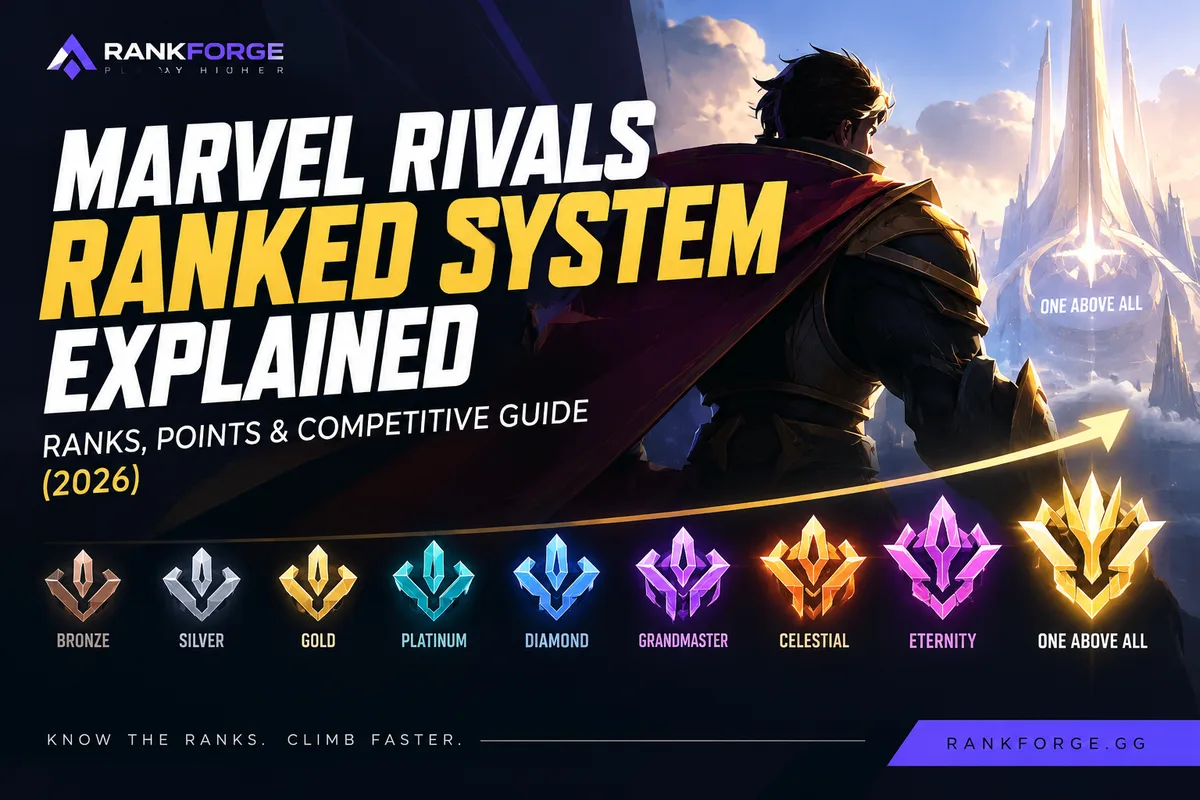
Marvel Rivals uses a competitive rank ladder that progresses from Bronze through Silver, Gold, Platinum, Diamond, Grandmaster, Celestial and Eternity before reaching the highest rank, One Above All.
Your rank is affected by your competitive results, and the game has introduced several changes to how placements and competitive progression work over time.
In this guide, we'll explain how the Marvel Rivals ranked system works, what every rank means, how competitive points work, how placements work and what you can do to climb more efficiently.
Marvel Rivals Rank Order
The Marvel Rivals competitive ladder consists of the following ranks:
1. Bronze
2. Silver
3. Gold
4. Platinum
5. Diamond
6. Grandmaster
7. Celestial
8. Eternity
9. One Above All
Most ranks below the highest tiers are divided into multiple divisions. As you progress through the divisions, you eventually move into the next major rank tier.
The goal is to continuously accumulate enough competitive progress to move upward through the ladder.
Marvel Rivals Rank Tiers Explained
Bronze
Bronze is the entry point for the competitive ladder.
Players at this level are generally still developing their fundamentals, including positioning, hero abilities, target selection and objective awareness.
If you're struggling in Bronze, focus on learning one or two heroes rather than constantly changing your picks.
Silver
Silver players generally have a better understanding of the basic game but can still lose matches through positioning mistakes, unnecessary fights and poor ultimate usage.
Improving consistency is usually more important than trying to make complicated plays.
Gold
Gold is an important milestone because it represents a more competitive level of play.
Players begin to punish obvious mistakes more consistently, making team coordination and objective control increasingly important.
Gold has also been associated with seasonal ranked rewards in Marvel Rivals.
Platinum
Platinum is where individual mistakes can become much more expensive.
Players should begin thinking more carefully about team composition, hero counters, ultimate economy and when to contest objectives.
Diamond
Diamond is a significant step above the lower ranks.
At this point, mechanical skill alone is usually not enough to climb consistently. Good positioning, communication and understanding of win conditions become increasingly important.
Grandmaster
Grandmaster represents a high level of competitive play.
Players at this level generally have strong hero knowledge and understand how to convert advantages into objectives and wins.
Celestial
Celestial is one of the game's highest competitive tiers.
At this level, small mistakes can decide fights, and players need a strong understanding of both their own hero and the overall team strategy.
Eternity
Eternity sits near the top of the competitive ladder.
Reaching this rank requires consistent performance against highly competitive players and a strong understanding of how to win difficult matches.
One Above All
One Above All is the highest rank in Marvel Rivals.
It represents the top end of the competitive ladder and is the ultimate goal for players trying to reach the highest possible rank.
How Marvel Rivals Ranked Points Work
Competitive progress is based on your performance in ranked matches.
Winning matches generally moves you upward, while losing matches can reduce your competitive progress.
Marvel Rivals has also used individual performance as part of competitive scoring. Official patch notes have specifically stated that competitive scoring considers both the match result and individual performance, with later changes increasing the weight of individual performance. :contentReference[oaicite:1]{index=1}
That means simply looking at the final score of a match doesn't always tell the entire story of your ranked progression.
Your performance inside the match can matter as well.
How to Rank Up in Marvel Rivals
The basic ranked progression loop is simple:
Win competitive matches → gain competitive progress → reach the next division → continue climbing
However, consistently ranking up requires more than simply playing a large number of games.
Focus on:
- Winning more team fights
- Playing heroes you understand
- Staying alive during important objectives
- Using ultimates efficiently
- Avoiding unnecessary deaths
- Adapting your hero choice to the enemy team
- Playing around your team's win condition
- Communicating important information
- Maintaining consistent performance
A player who focuses only on eliminations can still lose games if they ignore objectives and team fights.
Marvel Rivals Placement Matches
Placement matches determine your starting position when the game's placement system applies.
Marvel Rivals introduced a major placement change in Season 5.
From Season 5 onward, the first 10 ranked matches of the relevant placement process are placement matches. The game uses these matches to estimate your starting competitive tier. :contentReference[oaicite:2]{index=2}
The system distinguishes between a predicted rank during placements and the actual rank assigned after completing the required placement matches.
This means your placement games can have a significant impact on where you begin your climb.
Placement Tips
Before starting placements:
- Use your strongest heroes
- Avoid experimenting with unfamiliar characters
- Play when you can concentrate
- Avoid unnecessary queue dodges or disconnects
- Communicate with teammates
- Prioritize winning objectives
- Don't tilt after a single bad game
Ten placement matches can give you a very different starting point depending on your results and performance.
Individual Performance Matters
Marvel Rivals has adjusted its competitive system to put more emphasis on individual performance.
In Season 7, NetEase introduced a new placement system where every placement match tracked individual performance rather than tying the result entirely to teammates.
After the ten placement matches, the player's rank could be adjusted between -100 and +100 competitive points based on personal results and tier. :contentReference[oaicite:3]{index=3}
This is important because ranked progression isn't simply a matter of counting wins and losses.
Your contribution during competitive matches can influence how the system evaluates your performance.
Ranked Matchmaking and Team Sizes
Competitive matchmaking also has restrictions at higher ranks.
The rules have changed between seasons, but higher-ranked players have had increasingly restrictive party-size rules.
For example, official Marvel Rivals rules have limited players in the highest ranks to smaller parties, with Eternity and One Above All restricted to solo or duo queue in the cited competitive rules. :contentReference[oaicite:4]{index=4}
These restrictions are designed to prevent large coordinated groups from creating an unfair advantage at the highest levels of the ladder.
Always check the current in-game competitive rules when queueing with friends because these restrictions can change with future seasons.
Marvel Rivals Ranked Rewards
Competitive ranks aren't only about the badge next to your name.
Marvel Rivals regularly provides seasonal rewards tied to ranked progression.
Gold has repeatedly been used as an important reward threshold, with different seasons offering exclusive costumes for reaching Gold or higher. Higher ranks can also be associated with additional recognition such as Crests of Honor and Nameplate Frames. :contentReference[oaicite:5]{index=5}
Rewards can change from season to season, so players should check the current season's reward information in-game.
Rank Resets and New Seasons
Marvel Rivals periodically resets or recalibrates competitive progression when a new full season begins.
The exact reset rules have changed over the game's lifetime.
For example, earlier seasons used direct division demotions, while later seasons introduced placement-based systems. Season 5 introduced the 10-match placement structure, making it important to distinguish older ranked guides from the current system. :contentReference[oaicite:6]{index=6}
If you're reading an old Marvel Rivals ranked guide, always check whether it was written before the placement system was introduced.
How to Climb Faster in Marvel Rivals
If your goal is to climb as efficiently as possible, don't try to win every game through mechanical skill alone.
1. Master a Small Hero Pool
Choose a few reliable heroes rather than trying to play the entire roster.
A small hero pool makes it easier to understand matchups, abilities and team-fight situations.
2. Play Around Objectives
Eliminations are useful, but they don't automatically win the match.
Prioritize objectives, especially when your team has already gained an advantage.
3. Avoid Unnecessary Deaths
Every unnecessary death removes you from the fight and gives the enemy team time to take space or secure an objective.
Surviving can be more valuable than chasing one additional elimination.
4. Use Your Ultimate With a Plan
Don't automatically use an ultimate just because it is available.
Think about whether it can secure an elimination, win a team fight or create an important objective advantage.
5. Adapt to the Enemy Team
If your current hero isn't working, don't stubbornly continue playing the same strategy.
Good ranked players recognize when the situation requires a different approach.
6. Don't Tilt Queue
A losing streak can quickly turn into a much larger losing streak if you continue playing while frustrated.
Take a break and return when you're focused.
7. Review Your Mistakes
After a loss, ask:
- Why did our team lose the important fight?
- Did I die first?
- Did I use my ultimate effectively?
- Was I positioned correctly?
- Did I ignore an objective?
- Could I have changed heroes earlier?
This is much more useful than simply blaming teammates.
Common Marvel Rivals Ranked Mistakes
Playing Too Many Heroes
Constantly switching between unfamiliar heroes makes it harder to develop consistency.
Chasing Eliminations
A high elimination count doesn't guarantee a win.
Objectives and team fights should remain the priority.
Ignoring Team Composition
A team made up of individually strong heroes can still struggle if it lacks the tools needed for the enemy lineup.
Fighting Without Your Team
Going into fights alone is one of the easiest ways to throw an advantage.
Continuing Through Tilt
If you're angry after several losses, your decision-making usually gets worse.
Focusing Only on Your Rank
Your rank is the result of many matches.
Instead of obsessing over every single point, focus on improving the decisions that influence your win rate.
Is Marvel Rivals Ranked Worth Playing?
Absolutely.
Competitive mode provides a much more structured environment for players who want to improve than casual modes.
The ranked ladder gives you a clear progression path from Bronze to One Above All and provides a way to measure your improvement over time.
If you're serious about climbing, understanding the ranked system is only the first step.
Your hero pool, positioning, mechanics, objective awareness and team coordination all become increasingly important as you move higher.
Final Thoughts
The Marvel Rivals ranked system is built around competitive progression through multiple tiers, from Bronze all the way to One Above All.
The most important things to remember are:
- Learn the current placement rules
- Build a reliable hero pool
- Focus on objectives
- Improve your individual performance
- Adapt to enemy team compositions
- Avoid unnecessary deaths
- Don't play through tilt
- Check the current season's reward and matchmaking rules
Ranked systems can change between seasons, so always verify the latest competitive rules before relying on an older guide.
If you're struggling to climb, improving your fundamentals should be the first priority. For players who want structured help, RankForge also offers competitive gaming services designed around rank progression.