 Diego Alvarez
Overwatch 2 Competitive Ranks Explained: All Ranks and Divisions
Learn all Overwatch Competitive ranks in order, how divisions work, how rank progression changes, and what it takes to climb the ladder.
Overwatch 2 Competitive Ranks Explained: All Ranks and Divisions
Climbing the Competitive ladder in Overwatch 2 is one of the biggest challenges for players who want to improve. Whether you're starting your ranked journey or trying to reach a higher tier, understanding the ranking system is an important first step.
Overwatch uses a system of skill tiers and divisions to represent your Competitive rank. Your rank reflects your progress, while matchmaking also considers your underlying skill rating to create competitive matches.
In this guide, we'll explain the Overwatch ranks in order, how divisions work, how rank progression is displayed, and what you can do to climb more consistently.
All Overwatch Ranks in Order
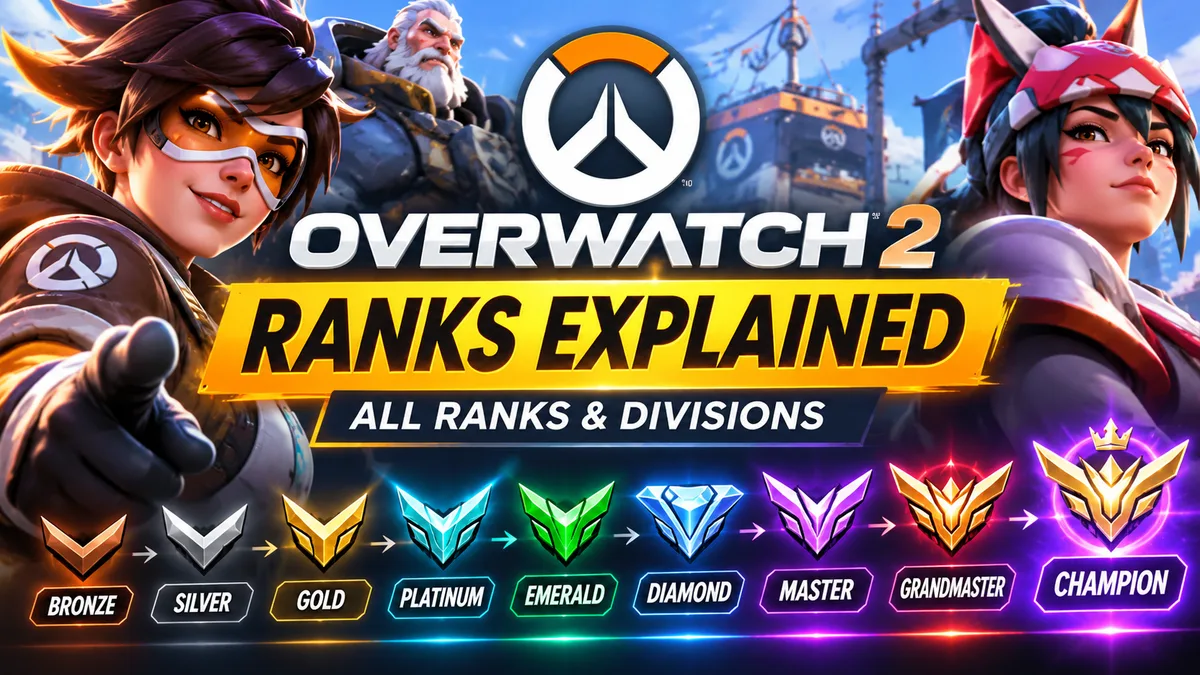
Overwatch Competitive ranks are arranged from the lowest skill tier to the highest.
The current rank ladder includes:
1. Bronze
2. Silver
3. Gold
4. Platinum
5. Emerald
6. Diamond
7. Master
8. Grandmaster
9. Champion
Each skill tier contains five divisions, numbered from 5 to 1.
Division 5 is the lowest division within a tier, while Division 1 is the highest.
For example, the progression within Gold is:
- Gold 5
- Gold 4
- Gold 3
- Gold 2
- Gold 1
After Gold 1, you progress into Platinum 5.
The same structure applies throughout the ranked ladder.
How Overwatch Rank Divisions Work
Divisions provide a more detailed view of your progress within a skill tier.
Instead of simply displaying Gold or Diamond, the system shows your current division. This helps you understand how close you are to reaching the next tier.
For example:
- Gold 5 means you are at the lower end of Gold.
- Gold 3 means you have progressed further through Gold.
- Gold 1 means you are close to reaching Platinum.
Your division can change after Competitive matches as you gain or lose rank progression.
The exact amount of progress depends on the match and the system's evaluation of your competitive rating.
What Is the Highest Rank in Overwatch?
Champion is the highest regular Competitive skill tier in Overwatch.
Champion sits above Grandmaster and is intended for the most skilled players in the Competitive ladder.
Like the other tiers, Champion contains five divisions:
- Champion 5
- Champion 4
- Champion 3
- Champion 2
- Champion 1
Champion 1 represents the highest regular division.
The Top 500 leaderboard is a separate competitive distinction. It is not simply another standard skill tier above Champion.
How Does Overwatch Competitive Rank Progression Work?
Your rank changes as you play Competitive matches.
After a match, the Competitive progression screen shows how your rank has moved. You can gain or lose progress depending on the result and other matchmaking factors.
Several factors can influence the amount of progress:
Match Outcome
Winning generally moves your rank progression upward, while losing generally moves it downward.
However, not every win or loss results in the same amount of progression.
Matchmaking Expectations
The matchmaking system considers the relative strength of the teams.
A win against a team that was expected to be stronger may provide a different progression result than a win against a team that was expected to be weaker.
Rank Calibration and Modifiers
Overwatch can display modifiers that help explain why your progression changed.
These may relate to calibration, streaks, or the expected outcome of the match.
The important point is that your rank progression is not always a fixed amount per win or loss.
For more information about matchmaking, see the official Overwatch Competitive system explanation.
What Is the Difference Between Rank and MMR?
Rank and Matchmaking Rating (MMR) are related, but they are not exactly the same concept.
Your visible rank is the skill tier and division displayed in Competitive.
MMR is an internal matchmaking value used to estimate your skill and help create balanced matches.
Blizzard has explained that matchmaking uses MMR when forming games. Your visible rank can move toward your underlying rating as you continue playing.
This helps explain why two players with the same displayed rank may not always have identical matchmaking experiences.
You can read more about the system in Blizzard's matchmaking developer blog.
Does Overwatch Have Separate Ranks for Different Modes?
Competitive progression can differ between queues and modes.
For example, Role Queue and Open Queue are separate Competitive experiences. Your rank in one should not be treated as your rank in the other.
Role Queue also allows players to compete and progress based on their selected role.
This means a player can have different ranks across different Competitive queues.
When reviewing your progress, make sure you're looking at the correct mode and role.
How to Rank Up in Overwatch
Understanding the rank system is useful, but improving your gameplay is what helps you climb.
Here are several practical ways to become more consistent in Competitive.
1. Focus on One or Two Roles
Trying to master every role at the same time can make improvement difficult.
Choose the roles you enjoy most and build a reliable hero pool for each.
This allows you to develop better positioning, matchup knowledge, and decision-making.
2. Improve Your Positioning
Positioning is one of the most important skills in Overwatch.
Avoid standing in exposed areas without a clear reason. Use cover, understand sightlines, and consider where your teammates can support you.
A small positioning improvement can prevent unnecessary deaths and help your team win more fights.
3. Understand Your Role in Team Fights
Every role contributes differently.
Tanks create space and control important areas. Damage heroes pressure opponents and secure eliminations. Supports help sustain their team and enable important plays.
Understanding your responsibility helps you make better decisions during fights.
4. Review Your Mistakes
After a difficult match, think about what went wrong.
Ask yourself:
- Did I use an important ability too early?
- Was I positioned too aggressively?
- Did I lose track of an enemy flank?
- Did I engage without my teammates?
- Could I have used an ultimate more effectively?
Identifying recurring mistakes is one of the best ways to improve.
5. Play Consistently
Improvement takes time.
Instead of focusing only on your current rank, focus on developing habits that help you perform better in every match.
Review your gameplay, practice your mechanics, and work on one improvement goal at a time.
Overwatch Rank Boosting: An Alternative for Players Who Want to Reach Their Goal
Some players want to reach a specific Competitive rank but do not have the time to grind through the ladder.
RankForge offers Overwatch boosting services for players looking to reach their desired rank.
You can explore the available options on our Overwatch boosting page.
Whether you're aiming for a new rank or simply want to understand the Competitive ladder better, knowing how the ranking system works can help you make more informed decisions.
Frequently Asked Questions
What are all the Overwatch ranks in order?
The Overwatch Competitive ranks are Bronze, Silver, Gold, Platinum, Emerald, Diamond, Master, Grandmaster, and Champion, from lowest to highest.
How many divisions are in each Overwatch rank?
Each regular skill tier contains five divisions, numbered from 5 to 1. Division 5 is the lowest and Division 1 is the highest.
What is the highest rank in Overwatch?
Champion 1 is the highest regular Competitive division. Top 500 is a separate leaderboard distinction.
Does winning always increase your Overwatch rank?
Winning generally increases rank progression, but the amount can vary depending on matchmaking factors and modifiers. A win does not always result in the same amount of progress.
Can I have different ranks in Role Queue and Open Queue?
Yes. Role Queue and Open Queue are separate Competitive experiences, and your rank can differ between them.
Final Thoughts
The Overwatch Competitive ranking system gives players a way to measure their progress and compete against others of similar skill.
Understanding the rank tiers, divisions, and progression system can help you set realistic goals and better understand your results.
If your goal is to climb, focus on consistent gameplay, better positioning, and learning from your mistakes.
And if you're looking for help reaching your desired rank, you can explore RankForge Overwatch Boosting.
Learn the ladder. Improve your gameplay. Climb toward your next rank.


