Marcus Webb
TFT Set 18 Enchanted Wilds Guide | New Mechanics, Traits & Changes
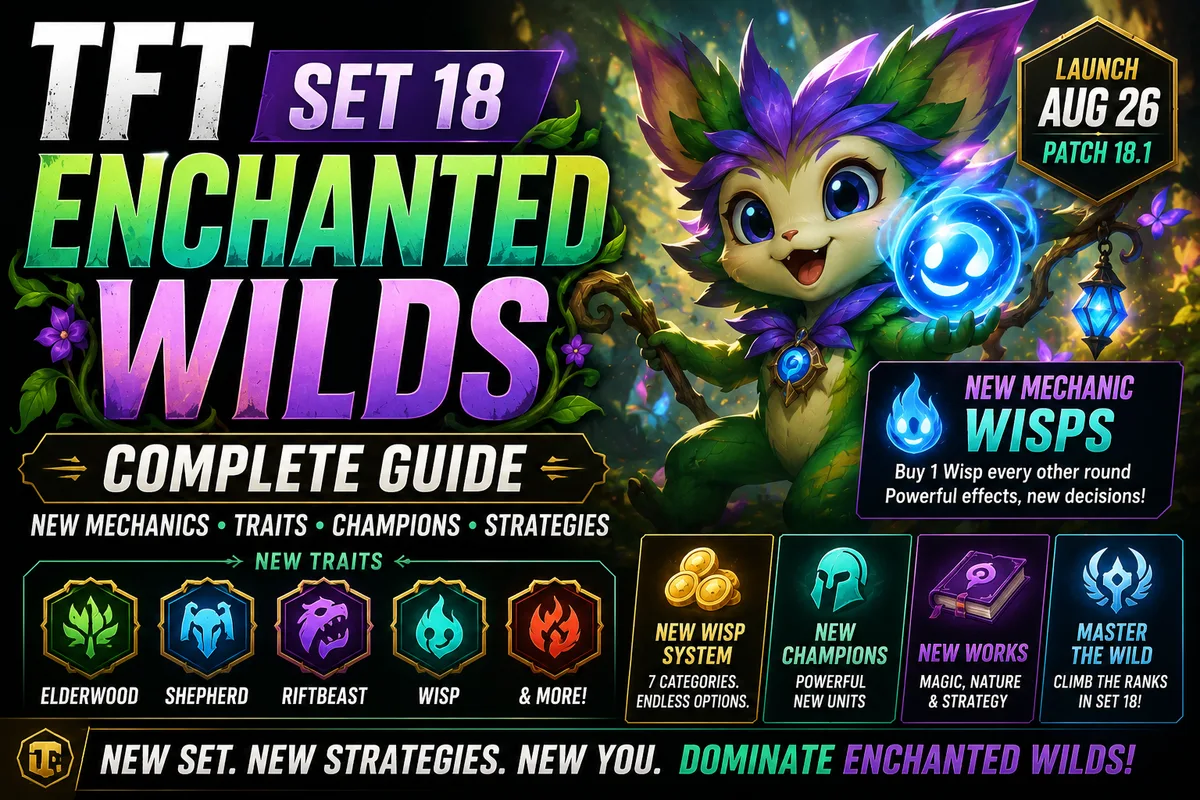
TFT Set 18 Enchanted Wilds is here. Learn about Wisps, new traits, champions, the Unreal engine update and what to expect when climbing the new set.
TFT Set 18 Enchanted Wilds Guide | New Mechanics, Traits & Changes
A new TFT set means a completely new game to learn.
TFT Set 18, Enchanted Wilds, launches on August 26, 2026 with Patch 18.1 and takes players into a forest filled with new champions, traits and a brand-new mechanic called Wisps.
This set is also an important technical milestone for Teamfight Tactics because Riot is moving TFT from its previous Hextech engine to Unreal with the launch of Set 18.
If you're returning to TFT after Set 17, or you're starting the new set from scratch, there is a lot to learn.
This guide covers the most important changes in Enchanted Wilds, explains Wisps, looks at the new trait structure, and gives you a practical approach for starting your Set 18 ranked climb.
Important: Set 18 is launching today, so the meta is not settled yet. This guide focuses on the confirmed set mechanics, systems and launch changes rather than pretending there is already a permanent "best comp."
What Is TFT Set 18: Enchanted Wilds?
Enchanted Wilds is the 18th major TFT set.
The theme moves away from the space-focused Space Gods set and into a magical forest filled with:
- Riftbeasts
- Elderwood
- Wisps
- New champions
- New traits
- New team compositions
- New items and interactions
- New strategic possibilities
Riot officially describes the set as being built around the life and magic of the Enchanted Wilds.
The set goes live with Patch 18.1 on August 26, 2026. :contentReference[oaicite:2]{index=2}
TFT Set 18 Release Date
TFT Set 18 launches on:
August 26, 2026
The set arrives with Patch 18.1.
That means today is effectively a reset for the TFT meta.
Players who understand the new mechanics early can have an advantage while everyone else is still learning the set.
This is especially important during the first few days of a new set.
Don't assume a Set 17 strategy will automatically work in Set 18.
The traits, units, economy decisions and strongest transitions are all different.
The Biggest New Set 18 Mechanic: Wisps
Wisps are the defining mechanic of Enchanted Wilds.
They are an updated version of the Charms system that previously appeared in Magic N' Mayhem.
However, Riot made several changes to make the mechanic easier to understand and use.
Wisps appear directly in your shop as temporary sources of power.
You can purchase one Wisp per round.
They appear in every other shop and always occupy the rightmost shop slot.
Most Wisps last for only one round.
As the game progresses, Wisps become more powerful, but their costs can also increase. :contentReference[oaicite:3]{index=3}
How Do Wisps Work?
The easiest way to understand Wisps is to think of them as a temporary additional decision in your shop.
You are not simply choosing which champion to buy.
You may also have an opportunity to purchase a Wisp that provides an additional benefit.
That benefit can affect:
- Combat
- Gold
- XP
- Items
- Champions
- Shop manipulation
- Risk/reward decisions
This creates another layer of decision-making during the game.
Wisp Categories
Riot divided Wisps into seven categories:
1. Champion
2. Combat
3. Misc
4. Shop
5. Gold/XP
6. Risky
7. Item
Each category has its own visual identity.
This is important because it allows you to understand the general purpose of a Wisp much faster while scouting your shop.
:contentReference[oaicite:4]{index=4}
When Can You Buy a Wisp?
Wisps can only be purchased during the planning phase.
Once the planning phase ends, the Wisp disappears.
The important part is what happens afterward.
The champion underneath the Wisp becomes visible.
That means you don't lose the information from that shop slot simply because you decided not to purchase the Wisp.
This is a major quality-of-life improvement.
For example, you may see a Wisp that isn't useful for your current board.
Instead of feeling forced to buy it, you can simply let it disappear and see the champion underneath.
:contentReference[oaicite:5]{index=5}
Should You Always Buy Wisps?
No.
This is probably one of the most important lessons for new Set 18 players.
A Wisp isn't automatically good just because it is available.
You should compare its value against your current board and economy.
Ask:
Does this help me win my next fight?
Does it improve my economy?
Does it help me reach an important level?
Does it support my current composition?
Is the cost worth the effect?
A Wisp that gives you a powerful combat advantage can be worth buying immediately.
A Wisp that costs valuable gold while doing very little for your current board may not be.
Wisps and Economy
Economy management becomes even more interesting in Set 18 because some Wisps can directly interact with gold or XP.
This creates an additional decision:
Do I spend resources now for a temporary advantage, or preserve my economy for later?
That decision depends heavily on your game state.
If you're one loss away from dying, spending extra resources for immediate board strength can make sense.
If you're healthy and building toward a level or roll-down timing, saving may be more valuable.
Wisps and Risky Choices
The Risky Wisp category adds another layer to the mechanic.
These options can offer stronger rewards while introducing some form of risk.
That means experienced players will need to evaluate not only:
"How much value does this give me?"
but also:
"Can I afford the downside?"
This is particularly important when you're already low on health.
A risky decision that might be acceptable at 80 HP can be disastrous at 10 HP.
TFT Set 18 Traits
Enchanted Wilds introduces a large collection of new traits.
The set's theme revolves heavily around nature, magical creatures and summoned units.
Some of the major trait concepts highlighted by Riot include:
- Elderwood
- Shepherd
- Riftbeasts
- Wisp-related mechanics
- Additional forest-themed verticals
The exact strength of each trait will change as players discover optimal item combinations and positioning.
That's why the first few days of Set 18 should be treated as an exploration period.
Elderwood
Elderwood is one of the central themes of Enchanted Wilds.
The trait is built around the set's forest identity and gives players a composition path centered around its associated units.
The important thing when learning Elderwood isn't simply memorizing the trait bonus.
You want to understand:
- Which units can carry
- Which units provide frontline
- Which items fit the composition
- Which units can hold items temporarily
- When you should transition into the trait
A trait can look powerful on paper but still perform poorly if you force it from a weak opening.
Shepherd
Shepherd is another important Set 18 trait.
Riot specifically adjusted Shepherd before launch to make its summons more impactful.
The final 17.9 changes included:
- Lower Shepherd mana requirements
- Adjusted AP scaling
- Shorter summon shield duration
- Increased damage on certain Shepherd effects
These changes were intended to make the summons cast more frequently and scale more effectively throughout fights. :contentReference[oaicite:6]{index=6}
That makes Shepherd an interesting trait to watch during the first days of Set 18.
Set 18 Champions
Enchanted Wilds introduces a completely new roster environment.
That means your knowledge from Set 17 doesn't automatically transfer.
You'll need to relearn:
- 1-cost carries
- 2-cost carries
- 3-cost carries
- 4-cost carries
- 5-cost late-game units
- Frontline options
- Utility units
- Trait transitions
This is one reason the first week of a new set can feel chaotic.
Players are still discovering which units are genuinely strong and which only look good on paper.
Twisted Fate in Set 18
Twisted Fate received a significant adjustment in the final patch before launch.
His ability now has a much larger high-roll and lower low-roll outcome.
If he rolls a 9, he always grants gold regardless of star level.
If he rolls a 1, he takes true damage based on his maximum health.
His damage ranges were also heavily adjusted. :contentReference[oaicite:7]{index=7}
This creates a very different risk/reward pattern from a standard ability.
If you use Twisted Fate, pay attention to how his ability interacts with your economy and board state.
Gwen in Set 18
Gwen also received changes before the set launch.
Her Groove threshold was increased, while her primary target damage was buffed.
This suggests Riot wanted to keep her competitive without allowing the champion to dominate the early Set 18 environment. :contentReference[oaicite:8]{index=8}
As always, actual ranked performance will depend on items, traits and the wider meta.
Why You Shouldn't Force One Set 18 Comp Yet
One of the biggest mistakes players make at the beginning of a new TFT set is immediately searching for one "best comp" and forcing it every game.
That approach can work temporarily.
But the Set 18 meta is going to change rapidly.
Players are still learning:
- Which carries are strongest
- Which traits are worth forcing
- Which items are flexible
- Which openers are strongest
- Which transitions are reliable
- Which augments work with which boards
Instead of forcing one composition, learn the logic behind your board.
How to Approach Your First Set 18 Games
Your first games should be about learning.
Don't worry if you lose some LP.
Focus on discovering:
Stage 2
Which early units are strong?
Which pairs can carry fights?
Which items are flexible?
Stage 3
Which traits are actually worth investing into?
When should you level?
Which units are worth holding?
Stage 4
Which carries can realistically take you into the late game?
Which frontline units survive?
When should you roll?
Stage 5+
Which compositions actually scale?
Which 4-cost and 5-cost units stabilize boards?
Which items should move onto your final carries?
This information will be more valuable than blindly copying a tier list during the first few hours.
Set 18 Economy Strategy
The fundamentals of TFT economy still matter.
You need to balance:
Gold
Health
Experience
Board strength
Future potential
Set 18's Wisps add another decision on top of that.
You now have to evaluate whether the Wisp's value is worth the resource cost.
That means greedy players may sometimes need to spend earlier than usual.
Likewise, players who are already strong may be able to use Wisps to accelerate an advantage.
When Should You Level?
There isn't one universal leveling pattern for every Set 18 game.
Your leveling decision should depend on:
- Current health
- Board strength
- Gold
- Win/loss streak
- Available units
- Lobby strength
- Your intended composition
If you're winning comfortably, maintaining your economy can be more valuable.
If you're losing heavily, spending gold to stabilize can prevent a much larger health loss.
The new set doesn't remove the fundamentals of TFT.
It adds more decisions around them.
Don't Ignore Your Lobby
Set 18 will reward players who scout.
Look at what other players are building.
If three players are heavily contesting the same units, your odds of finding those units drop.
That doesn't automatically mean you must abandon the composition.
But it should affect your decision.
Similarly, if nobody else is playing a particular trait, that can create an opportunity.
Scouting becomes even more important during the early weeks of a set because the meta is still changing.
Positioning in Set 18
Don't use one fixed board every game.
Your positioning should react to:
- Enemy carries
- Assassins or dive threats
- AOE abilities
- Hooks
- Frontline patterns
- Enemy targeting
- Your own carry range
A composition can be theoretically strong and still lose because the carry is positioned incorrectly.
When you scout, don't only look at what the enemy is playing.
Look at where they are putting it.
TFT Set 18 and the Unreal Engine
Set 18 isn't only a gameplay update.
It is also a major technical change for TFT.
Starting with Enchanted Wilds, TFT is moving from the Hextech engine to Unreal.
Riot says this isn't a new version of TFT.
The game remains the same TFT experience, but the underlying technology is changing. :contentReference[oaicite:9]{index=9}
What Does the Unreal Migration Mean?
The migration is intended to give TFT more room for future development.
Riot says the move should provide a stronger foundation for future tools and innovation.
However, there are some immediate differences players should know about.
The initial Set 18 download is larger than normal.
Mobile players will automatically receive the updated TFT app using Unreal.
And some settings will reset during the migration.
:contentReference[oaicite:10]{index=10}
Will You Need a New TFT Account?
No.
Your existing Riot account remains your TFT account.
The engine migration does not require you to create a new account. :contentReference[oaicite:11]{index=11}
What Happens to TFT Settings?
One thing players should check after installing Set 18 is their settings.
Riot says preferred settings will be reset during the engine migration.
Cosmetic loadout settings can also be reset to their base state.
So after launching Set 18 for the first time, spend a few minutes checking:
- Graphics
- Resolution
- Audio
- Interface settings
- Controls
- Favorite cosmetics
:contentReference[oaicite:12]{index=12}
Will TFT Have Bugs at Launch?
Riot has been very open about expecting more bugs than usual during the initial Unreal migration.
The team extended the PBE testing period because this is the first set running on the new engine.
That means players should expect the possibility of unusual issues during the launch period.
If you encounter a genuine bug, reporting it helps the team identify problems faster.
:contentReference[oaicite:13]{index=13}
What Should You Do Before Playing Ranked?
Before jumping directly into ranked Set 18, take some time to familiarize yourself with the new set.
A good approach is:
1. Play a normal game.
Learn the new units.
2. Read the Wisp options.
Understand what the categories do.
3. Test different openers.
Don't force one composition.
4. Scout other players.
See which traits appear contested.
5. Learn item holders.
Understand which early units can hold items for your eventual carry.
6. Then start climbing.
Once the mechanics become familiar, ranked games become much easier to understand.
How to Climb in TFT Set 18
If your goal is climbing, focus on fundamentals rather than chasing every new meta discovery.
Play Your Strongest Board
Don't hold a perfect late-game composition while your current board loses every round.
Preserve Health
Health is a resource.
A strong early board can give you more time to find your final composition.
Scout
Know what the lobby is playing.
Learn Flexible Items
Don't slam items that only work for one very specific composition unless you have a clear reason.
Understand When to Roll
Rolling too early can destroy your economy.
Rolling too late can cost too much health.
Don't Tilt
A bad game doesn't mean your entire Set 18 strategy is wrong.
The Biggest Set 18 Beginner Mistakes
Forcing One Trait
Don't force the same trait every game.
Ignoring Wisps
Wisps are a major part of the set mechanic.
Learn to evaluate them.
Spending Too Much Gold
A strong board today isn't always worth destroying your economy.
Refusing to Spend Gold
The opposite is also true.
If you're about to die, saving 30 gold doesn't matter.
Ignoring the Lobby
Contested units are harder to find.
Copying PBE Meta Forever
PBE is useful for learning the set, but live data and player adaptation can change the meta quickly.
Is Set 18 Good for Climbing?
Yes.
Every new set creates a fresh learning curve.
Players who learn the new mechanics quickly can gain an advantage over players who continue playing as if the previous set were still live.
Set 18 is especially interesting because Wisps create additional decisions every few rounds.
The players who learn when to buy them—and when to ignore them—will have a better understanding of the set.
What Should You Learn First?
If you are starting Set 18 today, don't try to memorize everything.
Learn these five things first:
1. The Wisp mechanic
Understand what the seven categories do.
2. The strongest early units
Learn which champions can stabilize your board.
3. Flexible items
Know which carries can use your early components.
4. Economy timings
Don't destroy your economy without a reason.
5. Scouting
Learn what the rest of the lobby is building.
Once these fundamentals are comfortable, start learning individual compositions.
Final Thoughts
TFT Set 18: Enchanted Wilds is one of the biggest changes TFT has received in 2026.
The new set introduces:
- A completely new champion and trait pool
- The Wisp mechanic
- New forest-themed compositions
- New carry and frontline options
- A new ranked environment
- The Unreal engine migration
The most important new gameplay system is clearly Wisps.
They add another decision to your shop and can provide combat power, economy, items, champions and risk/reward opportunities.
But don't treat every Wisp as an automatic purchase.
Good TFT players evaluate opportunity cost.
The same principle applies to the entire set.
Don't blindly force the first composition you see online.
Scout your lobby.
Play your strongest board.
Protect your economy when possible.
Spend when necessary.
And learn how the new set actually works.
The first few days of Enchanted Wilds are about experimentation.
The players who adapt fastest will have the best chance of climbing once the meta starts to settle.
If you're interested in improving your TFT rank, keep an eye on our upcoming Set 18 comps, trait guides, augment guides and climbing guides as the live meta develops.
You can also explore our TFT Rank Boost service if you want professional help reaching a higher rank.