Marcus Webb
TFT Set 18 Leveling Guide | When to Level, Roll & Fast 8
Learn when to level in TFT Set 18, when to save gold, when to roll, and when Fast 8 or Fast 9 makes sense. Enchanted Wilds leveling guide explains level timings
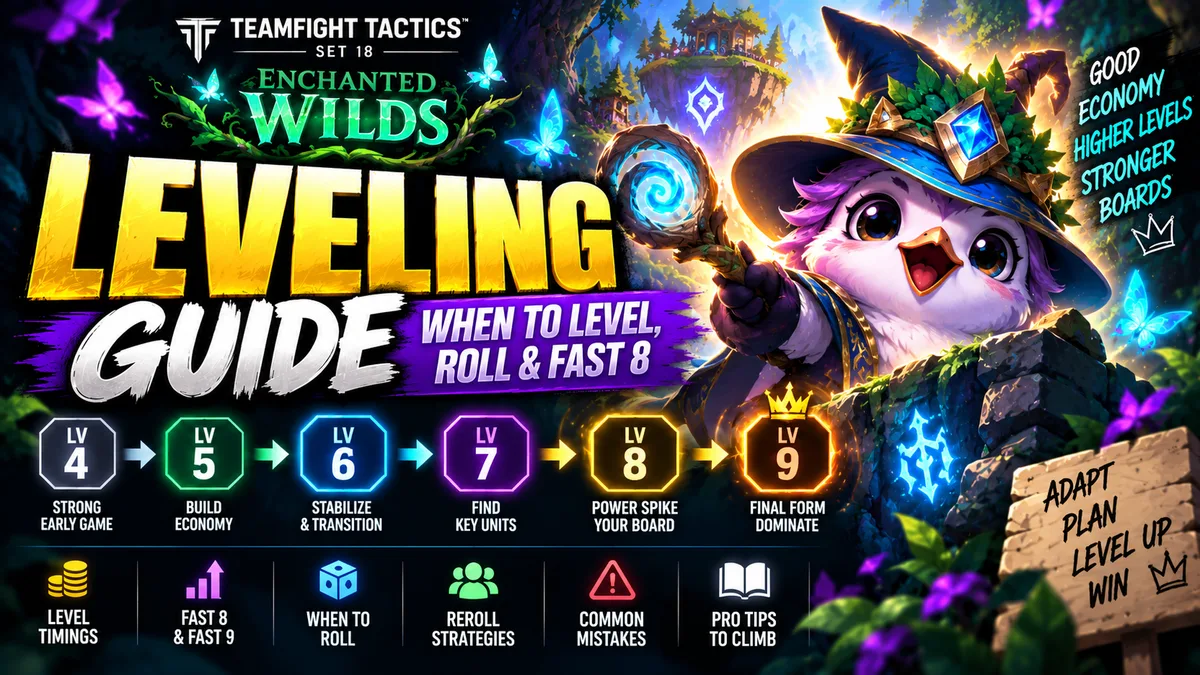
TFT Set 18 Leveling Guide | When to Level, Roll & Fast 8
Knowing when to level is one of the most important skills in Teamfight Tactics.
Two players can have almost the same amount of gold, the same items and similar boards, yet one can finish first while the other finishes seventh simply because they spent their resources at different times.
TFT Set 18: Enchanted Wilds does not change that fundamental rule.
The strongest players understand when to:
- Buy experience
- Save for interest
- Roll for upgrades
- Protect their health
- Push a level
- Stabilize at Level 7 or 8
- Continue toward Level 9
- Abandon a greedy leveling plan
This guide explains how leveling works strategically in TFT Set 18, including common level timings, Fast 8, Fast 9, reroll strategies and the mistakes that cause players to lose games while trying to reach their final board.
For an overview of the new set and its mechanics, see our TFT Set 18 Enchanted Wilds Guide.
Why Leveling Matters in TFT
Every level changes the options available to you.
Higher levels generally give you:
- A larger board
- Access to stronger units
- Different shop odds
- More trait combinations
- More room for utility units
- Stronger late-game boards
But leveling costs resources.
Every piece of gold spent on experience is gold you cannot immediately use for:
- Shop refreshes
- Champion purchases
- Maintaining interest
- A future roll-down
- Other economic decisions
That means leveling is always a trade-off.
The goal isn't to level as quickly as possible.
The goal is to reach the right level at the right time.
TFT Leveling Basics
Your level affects both your board size and the champions you can realistically find in the shop.
Early in the game, lower-cost champions make up a much larger part of the shop.
As you level, the game gives you better access to more expensive units.
This creates two broad strategic paths.
Level-focused
Spend resources on experience and move toward stronger late-game units.
Reroll-focused
Stay at a useful level and spend more gold searching for upgrades to lower-cost champions.
Neither approach is automatically better.
Your units, items, health and economy determine which one makes sense.
The Most Important Leveling Rule
Before buying experience, ask:
"What does this level actually give me?"
A level is valuable when it gives you something meaningful.
For example:
- An additional board slot
- Better access to your desired carry
- A stronger trait combination
- A valuable utility unit
- A transition into your final composition
If leveling only adds a random unit with no meaningful synergy, saving the gold may be better.
Common TFT Leveling Timings
There is no single leveling schedule that should be followed every game.
However, many standard TFT games naturally develop around a familiar progression through the early, mid and late game.
A common framework is:
- Early Level 4
- Level 5 during Stage 2
- Level 6 around Stage 3
- Level 7 around Stage 4
- Level 8 during Stage 4 or later
- Level 9 in the late game
These are guidelines, not rules.
Your actual timing should react to:
- HP
- Gold
- Streak
- Board strength
- Composition
- Augments
- Items
- Lobby strength
- Contested units
If your board is weak, leveling earlier can save your game.
If your board is already winning, delaying a level can produce a much stronger economy.
When Should You Level Early?
Early leveling is usually about tempo.
You spend gold now because the additional unit or improved shop access can help you win rounds.
Consider leveling early when:
- Your board is already strong
- One extra unit significantly improves your traits
- You can protect a valuable win streak
- Your next level gives access to important units
- You have enough economy to recover afterward
The important word is significantly.
Don't spend a large amount of gold for a tiny improvement.
Leveling to Protect a Win Streak
A win streak is an economic advantage.
Winning gives you additional income while also preserving HP.
That means spending some gold to maintain a strong streak can be correct.
For example:
You are winning comfortably.
You are one unit away from a much stronger board.
You have enough gold to buy the level without destroying your economy.
In that situation, leveling can create additional value because the level helps you continue winning.
The gold isn't simply buying XP.
It is helping protect the entire streak.
When Should You Delay Leveling?
Delaying a level can be correct when:
- Your board is already strong
- You need to reach an interest threshold
- You are intentionally loss streaking
- Your composition wants a reroll level
- Your next level doesn't improve the board much
- You need gold for a future roll-down
This is where economy and leveling become closely connected.
Sometimes the strongest play is doing nothing.
Leveling vs. Rolling
One of the most important decisions in TFT is deciding whether your next gold should go toward XP or shop refreshes.
Level When:
- You need another board slot
- Your composition benefits from higher-cost units
- You want access to a stronger champion pool
- Your board is already stable
- You are preparing for a late-game transition
Roll When:
- Your current units are close to upgrades
- Your composition is built around lower-cost champions
- You are losing too much HP
- Your carry is missing
- The board needs immediate stabilization
The mistake is treating leveling and rolling as completely separate strategies.
They are competing uses of the same resource.
Reroll Compositions and Leveling
Reroll compositions are built around finding multiple copies of specific lower-cost champions.
Because of that, leveling too quickly can actually hurt your plan.
If you leave the level where your desired champions have favorable shop odds, you can spend your economy searching for upgrades instead of constantly pushing toward the next level.
This is why reroll players often have a very different leveling pattern from Fast 8 players.
When to Stay at a Reroll Level
Consider staying at your current level when:
- Your carry is a lower-cost champion
- You already have several copies
- The units are relatively uncontested
- Your items fit the carry
- Your composition becomes significantly stronger through upgrades
The goal is to maximize the value of your gold at the level that best supports your composition.
Slow Rolling
Slow rolling means maintaining enough gold to preserve your economy while spending excess resources on shop refreshes.
This is useful when you need repeated opportunities to find your key units.
The basic idea is:
Maintain economy → spend excess gold → find upgrades → maintain economy → repeat.
Slow rolling is especially attractive when your composition needs several copies rather than one expensive late-game unit.
When to Stop Slow Rolling
Don't slow roll forever.
Once your important units are upgraded, you need to decide what the next power spike is.
That might be:
- Leveling
- A stronger trait
- A higher-cost carry
- Additional utility
- Better positioning
A common mistake is continuing to roll simply because rolling has become the habit.
Once your board is strong enough, the next gold should often go toward the next level.
Fast 8 Explained
Fast 8 is a leveling strategy built around reaching Level 8 relatively quickly and using the stronger unit pool to construct a late-game board.
It is particularly attractive when your composition relies on higher-cost champions.
The general idea is:
Strong economy → preserve enough HP → level aggressively → stabilize with stronger units.
The strategy sounds simple, but the difficult part is surviving the journey.
When Should You Fast 8?
Fast 8 becomes more attractive when:
- Your economy is strong
- Your HP is healthy
- Your early board is stable
- Your composition wants expensive units
- You have strong temporary item holders
- Your lobby is not forcing you to stabilize immediately
You want enough resources to reach Level 8 without arriving with a completely broken board.
When Should You NOT Fast 8?
Avoid forcing Fast 8 when:
- You are losing huge amounts of HP
- Your economy is weak
- Your board has no upgrades
- Your intended composition is heavily contested
- You have no realistic late-game carry plan
- You need immediate stabilization
Fast 8 is a strategy, not a requirement.
If your game is falling apart, stabilize first.
Fast 8 Is Not "Never Roll"
One of the biggest misunderstandings about Fast 8 is that you should save every piece of gold until you reach Level 8.
That's not always correct.
If your board becomes dangerously weak, a small roll-down can preserve enough HP to complete your leveling plan.
A good Fast 8 player is willing to spend when necessary.
The goal is to reach Level 8 with enough resources and health to actually use the advantage.
What to Do at Level 8
Reaching Level 8 is not the end of the strategy.
Now you need to decide:
Do I stabilize, or do I keep leveling?
If your board is weak:
Roll.
If your board is already strong:
Consider saving.
If your composition needs Level 9:
Continue building economy.
This decision should be based on the lobby.
Look at the strength of the other players.
If everyone else is one fight away from dying, you may not need to greed for Level 9.
If several players already have strong Level 8 boards, you may need a stronger late-game plan.
Fast 9 Explained
Fast 9 is the greedier version of a level-focused strategy.
Instead of investing heavily into stabilizing at Level 8, you try to reach Level 9 and unlock an even stronger late-game board.
The reward is significant.
But so is the risk.
When Fast 9 Makes Sense
Consider Fast 9 when:
- You have a strong economy
- You have plenty of HP
- Your board is already stable
- Your composition benefits from additional expensive units
- You have a strong late-game plan
- You are not under immediate pressure
Fast 9 should usually be treated as a luxury.
You earn the right to greed toward it by building a strong enough game beforehand.
When Fast 9 Is a Mistake
Fast 9 is dangerous when:
- You are below comfortable HP
- You are losing every round
- Your Level 8 board isn't stable
- The lobby is accelerating
- You need a carry immediately
- You have no clear benefit from the additional level
Don't chase Level 9 simply because it sounds powerful.
A stable Level 8 board can easily finish higher than a Level 9 board that arrives too late.
Level 7: The Important Midgame Decision
Level 7 is often an important transition point.
This is where you should ask:
- Is my board strong enough to continue saving?
- Do I need a four-cost carry?
- Am I rerolling?
- How much HP do I have?
- What is the lobby doing?
- What is my final composition?
If you are healthy and your economy is strong, continuing toward Level 8 can be correct.
If you are weak, Level 7 can become a stabilization point.
Level 8: Stabilize or Greed?
This is one of the biggest decisions in a TFT game.
You finally reach Level 8.
Now you have two options.
Stabilize
Spend gold to find upgrades and create a strong board.
Greed
Continue saving toward Level 9.
Choose stabilization when:
- Your board is weak
- You are low HP
- Other players are stronger
- Your carry is missing
- You need immediate upgrades
Choose greed when:
- Your board is already strong
- Your HP is healthy
- Your economy is excellent
- The lobby gives you time
- Level 9 significantly improves your final board
Leveling and HP
HP is one of the best indicators of whether you can afford to greed.
High HP
You have more freedom.
Medium HP
Make calculated decisions.
Low HP
Convert your economy into board strength.
Critical HP
Stop greeding.
This is one of the simplest rules in TFT, yet it is ignored constantly.
Leveling and Win Streaks
Win streaks can justify earlier investment.
If you are already winning, an additional level can help you maintain the streak.
But don't spend so much that you destroy your future economy.
Think of it as protecting an investment.
If spending 8 gold preserves several future wins, the cost can be worthwhile.
Leveling and Loss Streaks
Loss streaks require more patience.
If you intentionally lose early, you usually want to preserve your economy while controlling your HP loss.
That means you shouldn't randomly level just because you have gold.
Your goal is to reach the point where your planned power spike becomes strong enough to reverse the game.
The danger is waiting too long.
A controlled loss streak is strategic.
An uncontrolled losing streak is simply losing.
Leveling With Strong Items
Items can influence your leveling decision.
If your temporary carry is extremely strong, you may be able to save longer.
If your items have no good holder, your board may collapse before your late-game carry arrives.
This is another reason item flexibility matters.
For more itemization advice, see our TFT Set 18 Enchanted Wilds Guide.
Leveling With Augments
Augments can change the value of leveling.
An economy-focused augment can make reaching higher levels easier.
A combat augment can allow you to stabilize without spending as much gold.
A composition-specific augment can change which level is most valuable.
Always reconsider your leveling plan after receiving a major augment.
Leveling With Wisps
Wisps add another decision layer to Set 18.
Riot designed Wisps to appear in every other shop and include categories such as Gold/XP, Champions, Combat, Items, Shop and Risky options.
That means a Wisp can sometimes accelerate a level-focused strategy or provide enough immediate power to delay spending elsewhere. :contentReference[oaicite:1]{index=1}
But don't buy a Gold/XP Wisp simply because it says XP.
Compare the reward with what your next level actually accomplishes.
If you're one round away from a meaningful level and the Wisp accelerates it, the value can be excellent.
If the level does almost nothing for your board, keeping the resources may be better.
Scouting Before You Level
Scouting should influence your leveling decisions.
Look at:
- Other players' levels
- Their board strength
- Their carries
- Contested champions
- Their HP
- Their economy
- Their likely transition
If several players are already reaching Level 8 and your board is weak, you may need to accelerate.
If the entire lobby is weak, you may have more time to greed.
The Lobby Determines Your Pace
TFT is not a single-player game.
Your leveling pace should react to the other seven players.
If the lobby is extremely aggressive, slow economic strategies become more dangerous.
If the lobby is weak, greed becomes more attractive.
This is why blindly copying a Fast 8 timing from a guide can produce bad results.
The timing that works in one lobby may be completely wrong in another.
Common Leveling Mistakes
1. Leveling on Autopilot
Don't buy XP simply because you normally do it on a certain round.
Ask what the level accomplishes.
2. Fast 8 With No HP
Reaching Level 8 with almost no health is not automatically a success.
3. Greeding Level 9 While Weak
Level 9 doesn't help if you die before using it.
4. Leveling Instead of Upgrading
Sometimes a two-star upgrade is worth more than another level.
5. Ignoring Your Composition
Reroll and Fast 8 compositions need completely different resource plans.
6. Forgetting Interest Thresholds
Spending just enough gold to fall below an important threshold can have an economic cost.
7. Never Rolling
Some players become so focused on leveling that they refuse to stabilize.
8. Rolling Too Much
The opposite is equally bad.
If your board is already stable, constantly rolling can prevent your next level.
A Simple Leveling Decision Tree
When you're unsure what to do, ask these questions in order.
Question 1: Am I about to die?
If yes, stabilize.
Question 2: Is my board already strong?
If yes, consider saving.
Question 3: Does the next level significantly improve my board?
If yes, consider leveling.
Question 4: Am I playing reroll?
If yes, check whether staying at your current level is more valuable.
Question 5: What is the lobby doing?
If everyone is stronger, you may need to accelerate.
Question 6: What is my next power spike?
Choose the resource investment that gets you there most efficiently.
Leveling Cheat Sheet
| Situation | Better Direction |
| --- | --- |
| Strong board + high HP | Save or level toward next spike |
| Strong win streak | Consider leveling to protect tempo |
| Weak board + high HP | Stabilize without destroying economy |
| Weak board + low HP | Roll and stabilize |
| Reroll composition | Stay at the appropriate level longer |
| 4-cost carry composition | Prioritize reaching the level that improves access |
| Healthy Level 8 board | Consider saving toward Level 9 |
| Weak Level 8 board | Roll before greeding |
| Strong economy + strong HP | Fast 8/9 becomes more attractive |
| Low HP + weak board | Stop greeding |
| Contested carry | Reconsider your planned leveling route |
| Strong temporary carry | Saving can be more valuable |
| Level adds a key trait | Leveling becomes more valuable |
How to Improve Your Leveling Decisions
You don't need to memorize dozens of round-by-round rules.
Instead, focus on three concepts.
Tempo
How strong does your board need to be right now?
Economy
How much future value are you sacrificing?
Win Condition
What does your final board actually need?
When those three answers align, your leveling decision becomes much easier.
Final Thoughts
Good TFT leveling isn't about reaching Level 8 or Level 9 as quickly as possible.
It's about reaching the right level at the right moment.
Sometimes you should level early to protect a win streak.
Sometimes you should stay at a lower level and reroll.
Sometimes you should stabilize at Level 8.
Sometimes you can afford to greed toward Level 9.
The correct decision depends on:
- HP
- Gold
- Items
- Augments
- Wisps
- Composition
- Streak
- Lobby strength
- Your next power spike
The best players constantly reevaluate those factors instead of following a fixed leveling script.
If you're learning the fundamentals of Enchanted Wilds, start with our TFT Set 18 Enchanted Wilds Guide.
For more TFT strategy and Set 18 guides, visit the RankForge TFT Blog.
If you want professional help with your TFT climb, you can also explore our TFT boosting and coaching options.