Rina Sato
Valorant Anti-Smurf Changes 2026 | Rank Manipulation Explained
Riot is cracking down on Valorant smurfing and rank manipulation. Learn what changed in 2026, what behavior can be punished, and how penalties affect RR and MMR.
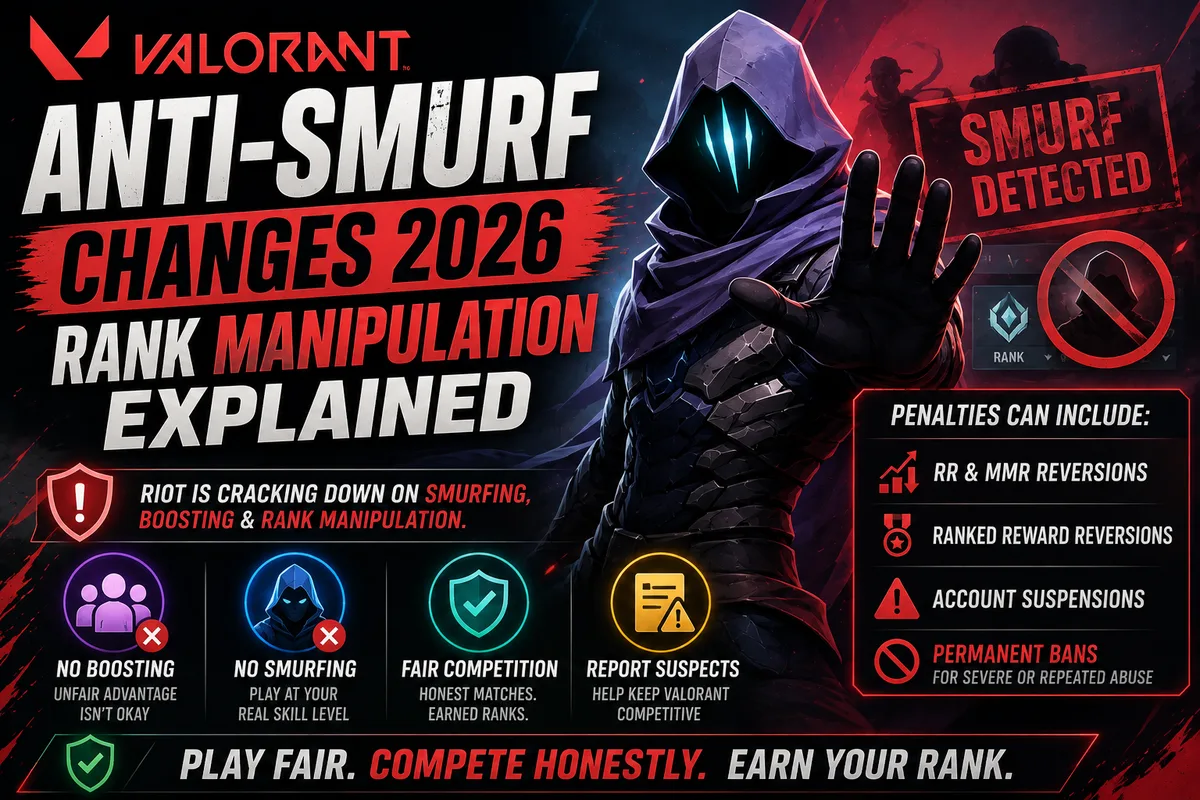
Valorant Anti-Smurf Changes 2026 | Rank Manipulation Explained
Smurfing has been one of the most frustrating problems in competitive Valorant for years.
A player enters a lower-ranked lobby, performs far above the expected skill level, and makes the game feel completely unfair.
But Riot's definition of the problem is broader than simply "a good player on a different account."
In 2026, Riot significantly strengthened its systems for detecting and penalizing behavior that manipulates Ranked.
Patch 13.01 introduced updated detection tools specifically targeting rank manipulation, boosting, win-trading and stream-sniping. Riot also confirmed that penalties can include rank and MMR reversions, reward reversions, account suspensions and permanent bans for severe or repeated abuse.
This guide explains what changed, what Riot considers rank manipulation, what is still allowed, and what players should know before using another account in Valorant.
What Is Smurfing in Valorant?
Smurfing generally refers to an experienced player using an account that is significantly lower ranked than their actual skill level.
However, not every alternate account is automatically considered abusive.
Riot specifically distinguishes normal alternate-account use from behavior intended to manipulate Ranked.
The important difference is intent and behavior.
Playing normally on an alternate account that you created and leveled yourself is allowed.
Intentionally manipulating your rank, using someone else's account, or participating in a setup designed to inflate another player's rank is not.
What Changed With Valorant Anti-Smurfing in 2026?
Riot announced stronger anti-smurf and rank-manipulation measures with Patch 13.01.
The updated systems are designed to identify patterns associated with:
- Boosting
- Rank manipulation
- Win-trading
- Stream-sniping
- Account sharing
- Other coordinated behavior that undermines Ranked integrity
Riot says it is starting with high-confidence cases and the most serious offenders before expanding the technology further.
This is important because Riot isn't simply trying to detect players who have one unusually good game.
The system is designed to identify suspicious patterns.
Does Having an Alt Account Get You Banned?
No.
Having an alternate account is not automatically a violation.
Riot explicitly says that playing on an alternate account you created and leveled yourself is allowed.
Likewise, playing with friends of different ranks is not automatically considered smurfing.
For example, Riot says five-stacking with friends, even when players have different ranks, remains allowed.
The problem begins when an account is used to intentionally manipulate the Ranked environment.
What Is Rank Manipulation?
Rank manipulation means deliberately interfering with the Ranked system so that a player's visible rank or matchmaking rating no longer represents their legitimate competitive performance.
Examples can include:
- Intentionally losing games
- Artificially lowering your rank
- Boosting another account
- Coordinating wins or losses
- Using another person's account
- Participating in organized rank manipulation
The key concept is that the player's competitive progress is no longer being earned normally.
What Is Valorant Boosting?
Riot defines boosting as a form of smurfing where a higher-skilled player uses a lower-ranked account to artificially increase that account's rank or the rank of players in their party.
Riot identifies several roles that can be involved.
The Booster
The higher-skilled player providing the unfair rank increase.
The Boostee
The account receiving the unfair rank increase.
The Hitchhiker
A player who queues alongside the boosted account and benefits from the manipulated games.
This last category is particularly important because Riot says penalties can also affect players who benefit from rank manipulation without being the primary boosted account.
Can Boosted Players Lose Their Rank?
Yes.
Riot says confirmed rank manipulation can result in RR and MMR being returned to their pre-boost status.
That means reaching a higher rank through manipulated games doesn't necessarily protect the account from later consequences.
If Riot confirms the manipulation, the competitive progress associated with it can be reversed.
Can Rank Rewards Be Removed?
Yes.
Riot specifically says ranked rewards connected to manipulated progress can be reverted.
That means gaining a reward through an illegitimate rank does not necessarily make the reward permanent.
The system is designed to keep competitive progression connected to legitimate gameplay.
Can You Get Permanently Banned for Smurfing?
Potentially.
Riot says penalties depend on the severity and repetition of the behavior.
Possible consequences include:
- Account suspension
- RR reversal
- MMR reversal
- Ranked reward reversal
- Permanent ban for repeated or severe abuse
Not every suspected case automatically receives the same penalty.
Riot says it looks for repeated patterns and strong evidence before taking action.
Does One Bad Game Make You Look Like a Smurf?
No.
This is an important distinction.
You can have an incredible game.
You can top-frag several matches in a row.
You can improve rapidly.
You can even perform much better than your normal rank for a period of time.
That alone does not mean you're violating the rules.
Riot explicitly says that having a bad game, having a bad Act, or going on a streak of excellent matches can all be normal parts of competitive gaming.
The important factor is whether there is evidence of intentional manipulation.
What About Players Who Improve Quickly?
Improvement is not cheating.
Suppose you're Gold and spend several weeks practicing aim, game sense and movement.
You suddenly start performing at a much higher level.
Your statistics may look unusual.
That doesn't mean you're manipulating your rank.
You're simply getting better.
Riot's detection systems are intended to identify abusive patterns rather than punish legitimate improvement.
What About Five-Stacking With Friends?
Five-stacking with friends of different ranks is allowed.
Riot explicitly lists five-stacking with friends, even when players have different ranks, as normal play.
This is important because players sometimes confuse a large rank difference with automatic smurfing.
A high-ranked player playing with lower-ranked friends isn't automatically breaking the rules.
The surrounding behavior matters.
What About Helping a New Player?
Helping a newer friend learn Valorant is also allowed.
You can teach:
- Aim
- Movement
- Utility
- Map knowledge
- Economy
- Communication
- Strategy
The problem is not teaching somebody.
The problem is deliberately manipulating their competitive progress.
Teaching your friend how to improve is fundamentally different from intentionally manipulating their Ranked games.
Is Playing on an Alternate Account Allowed?
Yes, provided the account is your own and you're not intentionally manipulating your rank.
Riot specifically lists playing on an alternate account that you created and leveled yourself as allowed behavior.
The safest approach is simple:
Use your own account.
Don't borrow somebody else's account.
Don't share accounts.
Don't intentionally lose games to create easier matches.
Is Account Sharing Allowed?
No.
Riot's current policy explicitly lists account sharing as prohibited.
That means you shouldn't give your login information to another player or play on somebody else's account.
This is important for both competitive integrity and account security.
If another person has access to your account, you are also exposing yourself to potential security problems.
Are Purchased Valorant Accounts Allowed?
Riot explicitly lists purchasing an account among the behaviors that are not allowed.
The same applies to borrowing, stealing or otherwise obtaining access to another person's account.
Players should therefore understand that buying an account isn't simply an alternative way of starting at a higher rank.
It can create both competitive and account-security risks.
What About Win-Trading?
Win-trading is another behavior Riot is targeting.
Win-trading occurs when players coordinate match outcomes instead of genuinely competing.
For example, players might agree that one side will intentionally lose one game and the other side will intentionally lose another game.
The objective is to manipulate:
- RR
- Rank
- Leaderboards
- Rewards
- Competitive status
Riot says its updated tools are designed to identify this behavior with higher confidence.
What Is Stream Sniping?
Stream sniping is another form of competitive abuse targeted by Riot.
It involves using someone's live broadcast to gain unfair information about their game.
For example, someone could watch a player's live stream specifically to discover:
- Their location
- Their rotation
- Their team's strategy
- Their planned attack
- Their defensive setup
Riot says it has updated its tools to better validate these behaviors and will penalize confirmed abuse.
How Does Riot Detect Rank Manipulation?
Riot has not published every detail of its detection system.
That is intentional.
If every detection rule were publicly documented, players attempting to manipulate Ranked could simply adjust their behavior to avoid specific checks.
What Riot has confirmed is that its detection technology looks for patterns associated with abusive behavior.
The system has also been expanded using technology Riot previously deployed successfully in League of Legends.
This means players shouldn't assume that avoiding one obvious behavior makes an account completely safe.
Can Riot Detect Boosting After It Happens?
Players should not assume that finishing a boost means the account is permanently safe.
Riot says confirmed cases can result in rank and MMR reversions.
That means enforcement can affect competitive progress after the manipulated games have already occurred.
The practical lesson is simple:
Don't assume that temporary success means the behavior won't be detected later.
What Happens to the Booster?
The booster can be penalized.
Riot specifically says penalties may apply to boosters, boostees and hitchhikers.
Depending on severity, consequences can include account suspensions and permanent bans.
The booster therefore isn't protected simply because the account owner gave permission.
Permission from another player does not turn prohibited account behavior into legitimate Ranked play.
What Happens to the Boostee?
The account receiving the unfair benefit can also be penalized.
Possible consequences include:
- Rank reversal
- MMR reversal
- Reward reversal
- Account suspension
- More serious penalties in severe or repeated cases
This is why players should think carefully before giving account access to another person.
What Happens to a Hitchhiker?
A hitchhiker is someone who queues with a player involved in rank manipulation and benefits from the manipulated games.
Riot specifically says hitchhikers can have their rank reverted for rating gained by queuing with a player engaged in rank manipulation.
So simply saying:
"I wasn't the person playing the account"
doesn't necessarily eliminate the risk.
How Can Players Report a Smurf?
Riot has added a dedicated Rank Manipulation reporting category.
If you believe a player is intentionally manipulating Ranked, use the appropriate reporting option after the match.
Don't report somebody simply because they had a good game.
Instead, report behavior that appears genuinely suspicious.
For example:
- Repeatedly obvious rank manipulation
- Intentional losses
- Coordinated win-trading
- Account sharing
- Suspicious boosting behavior
Riot says reports also provide useful data for its detection systems.
What Should You Do If You Think Someone Is Smurfing?
Don't start a fight with the player.
Don't threaten them.
Don't attempt to sabotage the match.
Instead:
1. Finish the game normally.
2. Collect any relevant information available through the match.
3. Report the player using the appropriate category.
4. Move on to the next game.
Riot's systems can investigate patterns that individual players cannot see.
What Should You NOT Do?
If you want to keep your account safe, avoid:
- Buying accounts
- Selling accounts
- Sharing accounts
- Borrowing accounts
- Intentionally losing games
- Win-trading
- Queue manipulation
- Participating in boosting
- Using another player's account
- Giving someone access to your login
Riot's current policy specifically identifies several of these behaviors as prohibited.
Can You Play With Higher-Ranked Friends?
Yes.
Playing with friends is not automatically a violation.
You can play together as long as you're actually playing normally.
The distinction is between:
Playing with friends
and
Manipulating Ranked for a specific result.
Riot wants players to be able to enjoy Valorant together without treating every rank difference as suspicious.
Why Is Riot Increasing Anti-Smurf Enforcement?
The main reason is competitive integrity.
Ranked systems only work when players believe that their opponents are competing honestly.
If players constantly encounter manipulated games, the focus changes from:
"How can I improve?"
to:
"Was this lobby even fair?"
Riot says its objective is to make competitive progress reflect genuine performance.
Does Anti-Smurf Detection Affect Normal Players?
Normal players should not need to change how they play.
If you:
- Play on your own account
- Try to win
- Queue normally
- Play with friends
- Improve naturally
- Occasionally have great or terrible games
you are doing what Riot describes as normal play.
The updated systems are aimed at abusive behavior rather than ordinary competitive variance.
What Does This Mean for Ranked in 2026?
The biggest change isn't that Riot suddenly made every alternate account illegal.
It didn't.
The major change is that Riot has significantly improved its ability to identify and penalize coordinated rank manipulation.
That means players involved in organized boosting, account sharing, win-trading or similar behavior should expect greater enforcement.
How Does This Affect Your RR and MMR?
If Riot confirms that your rank was obtained through manipulation, your RR and MMR can be reverted.
This is important because visible rank isn't necessarily permanent proof of legitimate progression.
Riot can restore an account's rating to its pre-manipulation state.
This also helps protect players who legitimately earned their rank from having the leaderboard distorted by manipulated accounts.
What About Rank Manipulation and the Valorant Leaderboard?
The leaderboard is supposed to represent competitive achievement.
Win-trading and other manipulation can artificially move players up the ladder.
By reversing manipulated rank and rewards, Riot can reduce the long-term impact of these actions.
This is especially important at high ranks, where relatively small changes in competitive rating can significantly affect leaderboard position.
The Difference Between Smurfing and Alt Accounts
These terms are often used interchangeably, but they aren't necessarily the same thing.
Alt Account
Your own additional account that you created and play normally.
Smurfing
Often used to describe a skilled player intentionally playing below their true level, particularly when this involves manipulating matchmaking.
Boosting
Using a higher-skilled player to artificially raise another account's rank.
Rank Manipulation
The broader category of behavior designed to distort Ranked progression.
Understanding these differences makes it easier to understand Riot's current policy.
Is Valorant's Anti-Smurf System Perfect?
No system can guarantee that every abusive account will be identified immediately.
Riot itself describes the current rollout as an ongoing expansion of its detection technology.
The company says it is starting with high-confidence cases and plans to expand the technology from there.
That means anti-smurfing should be viewed as an ongoing system rather than a single feature that solves every problem instantly.
What Should You Do If You Want to Improve Your Rank?
The safest long-term strategy is still the simplest:
Play on your own account and improve your own gameplay.
Work on:
- Aim
- Crosshair placement
- Movement
- Game sense
- Utility usage
- Communication
- Map knowledge
- Economy
- Decision-making
Our Valorant Aim Training Guide covers a practical 20-minute routine for improving mechanics.
You can also read our Valorant Game Sense Guide if your biggest weakness is decision-making rather than aim.
How to Stay Safe From False Smurfing Concerns
If you're worried about being mistaken for a smurf, don't change your gameplay artificially.
You don't need to intentionally play badly.
You don't need to avoid playing with friends.
You don't need to stop using an alternate account that you legitimately created.
Instead, simply follow Riot's rules.
Play on your own account.
Don't intentionally tank your rank.
Don't share your account.
Don't participate in coordinated rank manipulation.
And play to win.
Final Thoughts
Valorant's anti-smurf systems have become significantly more serious in 2026.
Patch 13.01 introduced stronger detection for rank manipulation, while Riot's accompanying policy update clarified exactly what behavior it is targeting.
The most important points are:
- Your own alternate account is allowed.
- Playing with friends of different ranks is allowed.
- Helping a new player learn the game is allowed.
- Account sharing is not allowed.
- Buying or borrowing accounts is not allowed.
- Artificially lowering your rank is not allowed.
- Boosting is targeted by Riot.
- Win-trading is targeted.
- Stream-sniping is targeted.
- Confirmed cases can lose RR and MMR.
- Ranked rewards can be reverted.
- Serious or repeated abuse can result in permanent bans.
The easiest way to avoid problems is also the most straightforward:
Play on your own account, play to win, and let your rank reflect your actual performance.
If you're trying to improve rather than manipulate your rank, start with our Valorant Aim Training Guide, Valorant Game Sense Guide, Valorant Summit Map Guide, and How to Rank Up Fast in Valorant.