Rina Sato
Valorant Peeking Guide 2026 | Wide Peek, Jiggle Peek & Shoulder Peek
Learn how to peek in Valorant with wide peeks, jiggle peeks, shoulder peeks and counter-strafing techniques to win more gunfights.
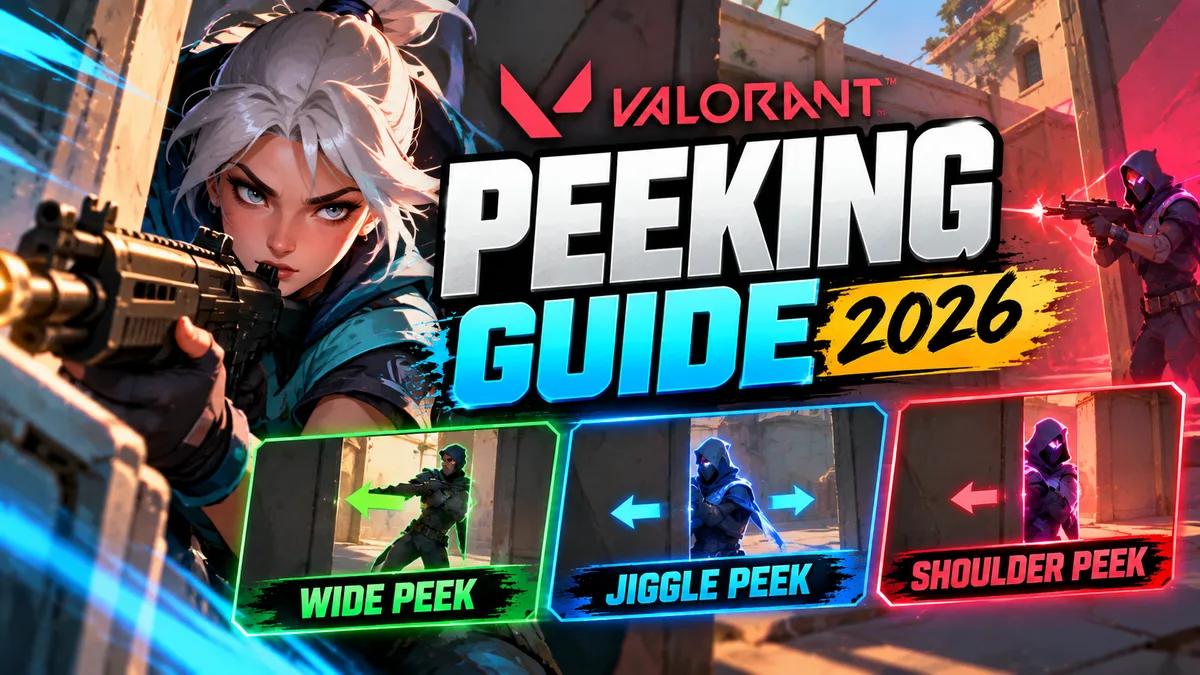
Valorant Peeking Guide 2026: Wide Peek, Jiggle Peek & Shoulder Peek
Peeking is one of the most important mechanical skills in Valorant.
You can have excellent aim and still lose gunfights if you expose yourself incorrectly, swing at the wrong time, or give an enemy an easy angle to hold.
Good peeking is about more than simply moving around a corner.
You need to understand:
- When to wide peek
- When to jiggle peek
- When to shoulder peek
- How to use movement
- How to clear angles
- How to play around enemy utility
- When to take the fight and when to disengage
In this guide, we'll break down the most important Valorant peeking techniques and explain when to use each one in ranked games.
What Is Peeking in Valorant?
Peeking means exposing yourself from behind cover to gain information or engage an enemy.
For example, if an opponent is holding an angle from behind a box, you can peek the corner to:
- Take a gunfight
- Gather information
- Force the enemy to reveal their position
- Bait a shot
- Create space for your team
The problem is that different peeks create different advantages and risks.
A slow peek can give the enemy an easy target.
A poorly timed wide swing can expose you to multiple players.
A good peek should have a purpose.
The 4 Main Peeking Techniques
The most useful peeking techniques to understand are:
1. Wide peeking
2. Jiggle peeking
3. Shoulder peeking
4. Close-angle clearing
Each has a different purpose.
What Is a Wide Peek?
A wide peek means moving far enough away from the corner that you swing past the angle the enemy is holding.
Instead of exposing only a small part of your body, you move quickly across the enemy's expected crosshair position.
When Should You Wide Peek?
Wide peeking can be useful when:
- You expect the enemy to hold a tight angle
- You want to surprise an Operator player
- You have a movement advantage
- You have information about the enemy's position
- You are taking an isolated duel
- You have teammate support
The important part is timing.
A wide peek is much stronger when the enemy does not expect it.
Wide Peek vs Holding a Tight Angle
Imagine an enemy is holding the edge of a doorway.
If you slowly move into the doorway, your head may appear directly where their crosshair is already positioned.
You are essentially walking into their shot.
A wider swing can force them to move their crosshair farther.
That can make the duel more difficult for them.
However, wide peeking is not automatically better.
If multiple enemies are holding the same area, a wide swing can expose you to several players at once.
What Is a Jiggle Peek?
A jiggle peek is a very short movement out from cover followed by an immediate return.
The goal is usually to gather information or bait an enemy shot rather than commit to a full gunfight.
A good jiggle peek can help you discover:
- Whether an enemy is holding the angle
- Whether an Operator is present
- Whether an enemy has used utility
- Where an opponent is positioned
- Whether the angle is safe to challenge
How to Jiggle Peek Correctly
Start behind cover.
Move just far enough to expose yourself.
Immediately return to safety.
Don't stay exposed longer than necessary.
The purpose is information.
You are not trying to win the entire round with one jiggle peek.
Example
You suspect an Operator is holding A Main.
Instead of walking directly into the angle, you can jiggle peek first.
If the Operator fires:
- You now know the position.
- The enemy has fired their shot.
- Your team has more information.
- You can decide whether to re-peek, use utility or rotate.
That's much better than blindly walking into the Operator's crosshair.
What Is a Shoulder Peek?
A shoulder peek is similar to a jiggle peek, but the goal is often to briefly expose enough of your character model to make the enemy react.
You can use it to:
- Bait an Operator shot
- Force an enemy to reveal their position
- Make an opponent waste utility
- Gather information
The key is that you don't commit to the fight.
You show just enough information to make the enemy respond.
Jiggle Peek vs Shoulder Peek
These terms are sometimes used interchangeably, but the practical difference is intent.
Jiggle Peek
Usually focused on quickly checking an angle or gathering information.
Shoulder Peek
Often focused on deliberately baiting a shot or reaction.
Both techniques require the same fundamental skill:
Get information without unnecessarily giving up your life.
When Should You Wide Peek?
Wide peeking is especially useful when you have a reason to believe the enemy is holding a predictable angle.
Examples include:
Operator Holding an Angle
A wide swing can make the Operator player's adjustment more difficult.
Enemy Is Alone
If you know only one player is holding the position, you can commit more confidently.
You Have a Flash
A flashed enemy has less ability to react to your movement.
You Are Being Supported
If a teammate can trade you, the risk of the peek is reduced.
You Need to Take Space
Sometimes you need to stop playing passively and claim an area.
When Should You Jiggle Peek?
Jiggle peeking is usually better when information is more important than immediately winning the duel.
Use it when:
- You don't know where the enemy is
- You suspect an Operator
- You're checking a common angle
- You want to bait a shot
- Your team needs information
- You don't want to commit yet
Information has value.
You don't need to kill the enemy every time you peek.
When Should You Shoulder Peek?
Shoulder peeking is particularly useful when you suspect an enemy is holding a powerful angle.
For example:
You know an Operator could be watching Mid.
Instead of giving the enemy a free kill, you can briefly expose yourself and force a reaction.
If the enemy shoots, you've gained information.
If they don't, you may have learned that the angle is not being held in the expected way.
How to Peek an Operator
Operator players punish predictable peeks.
If you repeatedly swing the same angle at the same speed, you're making their job easy.
Instead:
- Jiggle first
- Bait the shot
- Use utility
- Change your timing
- Change your position
- Wide swing when appropriate
- Ask for a flash
- Double peek with a teammate
Never assume the same peek will work twice.
Double Peeking in Valorant
A double peek means two teammates expose themselves around the same time.
The purpose is to create a trade opportunity and force the defender to deal with multiple targets.
For example:
Player A swings first.
Player B follows immediately.
If Player A dies, Player B can trade the kill.
This is much stronger than two players peeking separately several seconds apart.
Why Trading Makes Peeking Safer
Imagine you peek alone.
You lose the duel.
Your team loses a player.
Now imagine you peek with a teammate behind you.
You lose the duel.
Your teammate immediately trades the kill.
The result is completely different.
Trading turns individual gunfights into team fights.
When attacking a site, don't only ask:
Can I kill this player?
Ask:
If I die, can my teammate trade me?
That question alone can improve your ranked decision-making.
For more decision-making fundamentals, see our Valorant Game Sense Guide.
Counter-Strafing and Peeking
Movement is directly connected to peeking.
If you're moving while shooting, your accuracy becomes worse.
A common technique is to release your movement key and quickly press the opposite direction to stop your character before firing.
This is commonly called counter-strafing.
The important principle is simple:
Move → stop → shoot.
Don't panic and hold movement while trying to win a duel.
Wide Swinging With a Teammate
Wide swings become much more dangerous for the defender when two players attack together.
For example:
Player A wide swings.
Player B follows.
The defender now has to choose between two targets.
Even if the defender gets the first kill, the second player can often trade.
This is one reason coordinated attacks are so powerful.
Don't Wide Peek Everything
One of the biggest mistakes newer players make is learning one technique and using it constantly.
You shouldn't wide peek every angle.
Sometimes the correct play is:
- Jiggle peek
- Shoulder peek
- Use utility
- Ask for a flash
- Let a teammate clear
- Hold the angle
- Rotate
The correct peek depends on the information available.
Peeking Common Angles
When clearing an angle, don't expose yourself to every possible enemy position simultaneously.
Clear dangerous angles systematically.
For example:
1. Clear the closest angle.
2. Clear the next position.
3. Move your crosshair toward the next likely enemy.
4. Continue through the area.
This reduces the number of positions you need to worry about at once.
Crosshair Placement While Peeking
Your movement can be perfect and you can still lose the fight if your crosshair is in the wrong position.
Keep your crosshair around head level before exposing yourself.
The less your mouse needs to move after the enemy appears, the easier the shot becomes.
For more mechanical practice, see our Valorant Aim Training Guide.
You can also use our Best Valorant Crosshair Settings guide to build a consistent setup.
Peeking With Utility
Don't treat peeking and utility as separate concepts.
Good utility can completely change the risk of a peek.
Examples:
Flash
Reduces the enemy's ability to take the duel normally.
Smoke
Blocks other angles and reduces the number of threats you need to consider.
Recon
Provides information before you expose yourself.
Molly or Area Damage
Can force an enemy out of a strong position.
Wall
Can isolate sections of the map.
The strongest peeks are often created by utility rather than raw mechanics.
How to Peek When Attacking
Attackers usually want to gain space.
Your first objective isn't necessarily getting a kill.
It can be:
Take space without losing a player.
Use utility.
Clear dangerous angles.
Trade teammates.
Force defenders away from strong positions.
Then continue advancing.
A kill is valuable, but the space created by a good peek can be equally important.
How to Peek When Defending
Defenders have different priorities.
You don't always need to push the enemy.
Sometimes the best defensive play is simply holding an angle and forcing attackers to use utility.
If you do peek:
- Have an escape route
- Know where your teammate is
- Avoid predictable timing
- Don't re-peek automatically
- Consider the enemy's utility
Defensive aggression should have a purpose.
Stop Re-Peeking the Same Angle
One of the easiest mistakes to punish is predictable re-peeking.
You peek.
The enemy hits you for 70 damage.
You retreat.
Then you peek from exactly the same position.
The enemy is already ready.
Instead, change something:
- Change your position
- Change your timing
- Use utility
- Ask for a teammate
- Give up the angle
If the enemy already knows where you are, don't make their job easier.
Peeking Low HP Enemies
A low-health enemy doesn't automatically mean you should swing.
Ask:
- How many enemies are nearby?
- Do I have teammate support?
- Do I have enough health?
- Do I have utility?
- Can the enemy escape?
- What happens if I lose?
A 20 HP enemy can still kill you with one bullet.
Don't turn a winning situation into a losing one because you became impatient.
Common Peeking Mistakes
1. Slow Peeking Every Angle
Slow movement can make you an easy target.
2. Wide Peeking Multiple Enemies
A wide swing is much riskier when several enemies can see you.
3. Re-Peeking Immediately
The enemy already knows your position.
4. Peeking Without Information
You don't always need to fight.
5. Ignoring Utility
Utility can make difficult angles much easier.
6. Fighting Without a Trade
If nobody can help you, dying first can lose the round.
7. Shooting While Moving
Your accuracy suffers when you haven't properly stopped.
8. Poor Crosshair Placement
Good movement cannot compensate for a crosshair aimed at the floor.
9. Chasing Low HP Players
Low HP does not mean harmless.
10. Using the Same Peek Every Round
Good opponents adapt quickly.
A Simple Peeking Decision Tree
Before peeking, ask:
Do I know where the enemy is?
Yes: Choose the peek based on their position.
No: Consider jiggle peeking or using utility first.
Is an Operator likely?
Use information gathering or bait the shot before committing.
Do I have teammate support?
If yes, a coordinated peek can be stronger.
Are multiple enemies holding?
Avoid exposing yourself to several players simultaneously.
Do I actually need to fight?
If not, you may be better off holding your position.
How to Practice Peeking
You don't need a complicated training routine.
Use the Range and Deathmatch to practice:
- Head-level crosshair placement
- Stopping before shooting
- Wide swings
- Short jiggle movements
- Angle clearing
- Target transitions
Then transfer those skills into real matches.
Your goal isn't to perform perfect peeks in a training environment.
Your goal is to make better decisions during real rounds.
Peeking and Rank Progression
Better peeking can directly improve your ranked performance because it helps you take more favorable gunfights.
However, peeking is only one part of climbing.
You also need:
- Aim
- Crosshair placement
- Movement
- Utility usage
- Communication
- Economy management
- Map knowledge
- Game sense
If you're working on your overall climb, read our How to Rank Up Fast in Valorant guide.
Understanding Valorant MMR can also help explain why your RR gains and losses may change as your results improve.
Final Thoughts
Good peeking isn't about using the most aggressive technique possible.
It's about choosing the right peek for the situation.
Use:
Wide peeks to challenge or surprise predictable angles.
Jiggle peeks to gather information and bait shots.
Shoulder peeks to force reactions without committing.
Double peeks to create trade opportunities.
Utility-assisted peeks to reduce the risk of difficult fights.
Most importantly, don't peek automatically.
Think about what you're trying to accomplish before exposing yourself.
Sometimes the best peek is the one that gives your team information without costing you a death.
Once you've got this down, the climb is the next step, and if you want a hand with it, our Valorant rank boost puts an experienced high-rank booster on the climb for you.