Rina Sato
VALORANT Retake Mode Guide | 3v3 Rules, Best Agents & Tips (2026)
Learn how VALORANT Retake Mode works in 2026, including the 3v3 rules, pre-planted Spike, loadouts, maps, best agents and practical strategies for winning more rounds.
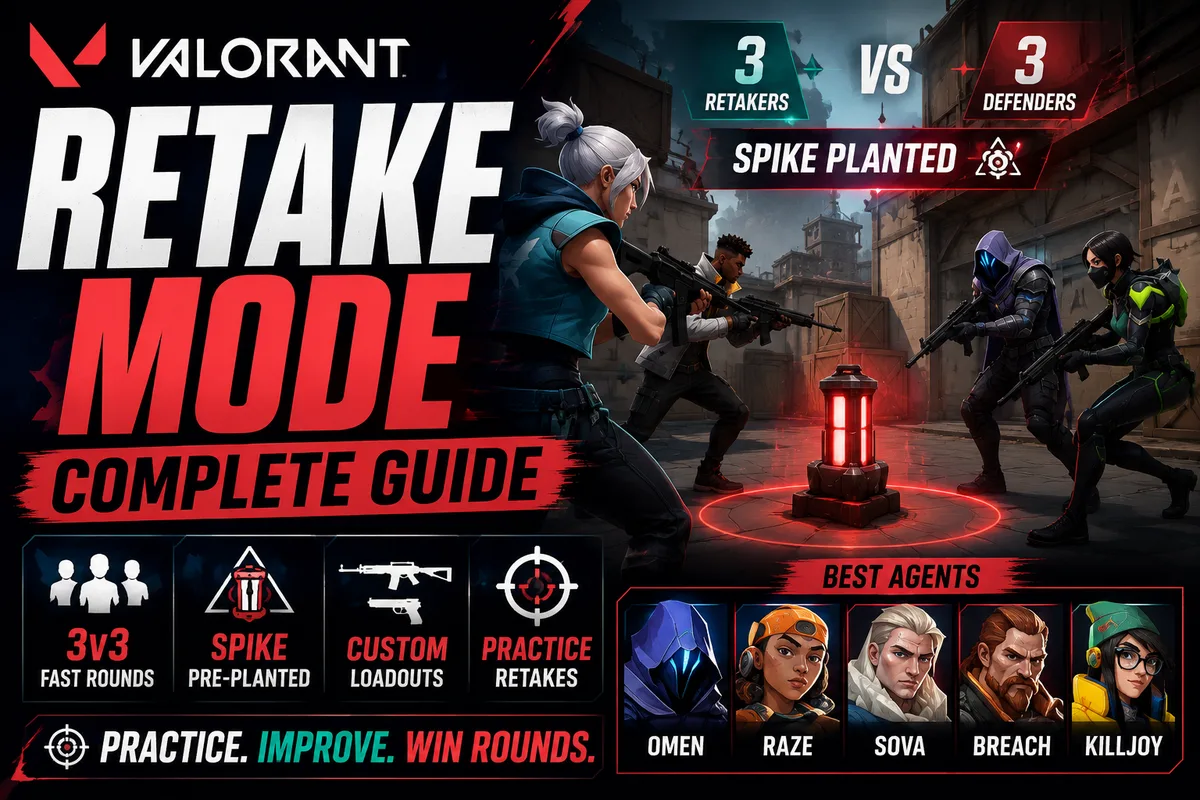
VALORANT Retake Mode Guide | 3v3 Rules, Best Agents & Tips (2026)
VALORANT Retake is one of the fastest ways to practice the part of the game that usually decides close rounds: the post-plant.
Instead of spending the first half of a normal VALORANT round looking for space, Retake starts with the Spike already being planted. One team has to defend the site while the other team has to coordinate a retake before the Spike detonates.
The result is a fast 3v3 mode built almost entirely around utility usage, positioning, gunfights and post-plant decision-making.
Riot introduced Retake as a limited-time mode in Act 4, with each round taking place on a single site and teams swapping sides every round. The mode also uses a special loadout system instead of the normal VALORANT economy.
If you want to improve your retakes, post-plant positioning or close-range decision-making, Retake is worth understanding.
What Is VALORANT Retake Mode?
Retake is a 3v3 Spike mode where the Spike is automatically planted shortly after the round begins.
One team becomes the defenders of the planted Spike.
The other team becomes the retakers.
The goal is simple:
Defenders: protect the Spike until it detonates.
Retakers: eliminate the defenders or defuse the Spike before it detonates.
There is no normal attack-side site execute.
You are immediately dealing with a post-plant situation.
That makes Retake much faster than standard Competitive.
VALORANT Retake Mode Rules
The basic rules are straightforward.
3v3 Matches
Each round features three players on each team.
Because there are fewer players, individual mistakes matter significantly more.
Losing the first player can immediately turn a 3v3 into a difficult 2v3.
The Spike Is Already Planted
The Spike automatically plants a few seconds into the round.
The plant position is selected from a curated group of possible locations on the site.
This means players need to understand multiple post-plant setups rather than memorizing one universal position.
Teams Switch Sides Every Round
The teams alternate between defending the Spike and attempting the retake.
This gives both sides an opportunity to play the same site from different perspectives.
First to 5 Rounds Wins
A match ends when one team reaches five round wins.
Rounds can end through:
- Team elimination
- Spike defuse
- Spike detonation
There is no traditional 13-round VALORANT structure.
The shorter format keeps matches fast and focused.
How the Retake Loadout System Works
Retake doesn't use the standard VALORANT economy.
Instead, players select from two cards each round.
These cards provide combinations of:
- Weapons
- Armor
- Ability charges
The available options change as the match progresses.
This means you don't have to worry about saving credits for the next round.
Instead, your focus should be on choosing the loadout that best fits the situation.
Which Weapon Should You Pick?
There isn't one weapon that is always correct.
Your choice should depend on the map, site and how you expect the round to play out.
Rifles
Rifles are generally the safest choice when you expect medium-range fights.
They give you enough flexibility to contest different areas of the site.
Shotguns
Shotguns can become extremely dangerous on compact sites and around tight corners.
They are particularly effective when the enemy has to clear close-range positions.
SMGs
SMGs can be useful when you expect aggressive close-range fights.
Their mobility and fire rate can make them effective during chaotic retakes.
Snipers
Snipers can provide huge value when the site has long sightlines.
However, they become much harder to use once enemies close the distance.
The important thing is to choose your weapon around the fight you expect rather than automatically selecting the most expensive-looking option.
Best Agents for Retake Mode
Agent value changes significantly in Retake because there is no traditional attack or defense phase.
You don't need an agent who can slowly build site control.
You need an agent who can immediately create value in a fight.
1. Omen
Omen is an excellent Retake agent because he combines several useful tools.
His strengths include:
- Smokes
- Paranoia
- Teleportation
- Flexible positioning
- Ability to create unexpected angles
A well-placed smoke can isolate defenders and make the retake much easier.
Paranoia can also create an opening for your team to push together.
2. Raze
Raze is particularly effective when enemies are hiding behind predictable cover.
Her utility can force defenders away from strong positions before your team commits.
She is especially dangerous on smaller sites where explosive utility can affect multiple players.
3. Breach
Breach is extremely useful when the enemy is holding a site from fortified positions.
His crowd control can force defenders out of cover and create opportunities for teammates to swing.
The key is coordination.
A Breach ability is much stronger when your teammate is ready to capitalize immediately.
4. Sova
Sova provides valuable information.
Knowing where defenders are positioned is one of the most important parts of a successful retake.
Recon abilities can reduce the number of angles your team has to clear blindly.
His utility also becomes valuable when defenders are playing from predictable post-plant positions.
5. Killjoy
Killjoy can provide excellent defensive value when your team is the side holding the Spike.
Her utility can force retakers to spend time clearing positions while the Spike timer continues.
She can also make certain approaches much more difficult.
6. Cypher
Cypher is another strong defensive option.
His traps can provide information and punish players attempting to enter through predictable routes.
On the retake side, his information tools can help your team understand where defenders are positioned.
Best Agents for Defending the Spike
When you're holding the planted Spike, your priorities change.
You don't need to chase kills.
You need to waste the enemy's time.
Strong defensive choices include:
- Killjoy
- Cypher
- Viper
- Omen
- Brimstone
The ideal defender creates uncertainty.
Make the retaking team spend utility.
Force them to clear angles.
Move after contact.
Avoid giving them free one-on-one fights.
Every second they waste is valuable.
Best Agents for Retaking
Retakers generally benefit from information, flashes and area-clearing utility.
Strong choices include:
- Sova
- Breach
- Omen
- Raze
- KAY/O
- Fade
The exact choice depends on the site.
A retake agent should ideally help your team answer one of three questions:
Where are they?
How do we remove them?
How do we enter safely?
If your abilities don't help answer one of those questions, you're probably not getting enough value from them.
How to Retake a Site Properly
The biggest mistake in Retake is entering one player at a time.
Don't do this.
A 3v3 retake should usually be coordinated around information and timing.
Step 1: Identify the Spike
Before running onto the site, confirm where the Spike is planted.
The plant location determines which angles you need to prioritize.
Step 2: Find the Defenders
Use information abilities whenever possible.
You don't want to clear every possible corner blindly.
Step 3: Clear Dangerous Utility
Remove traps, mollies and other abilities that could prevent your team from entering.
Don't waste your entire utility supply before you actually reach the fight.
Step 4: Choose an Entry
Decide which route your team is taking.
Avoid having three players enter through completely different positions.
Step 5: Trade
If the first player takes a fight, the second player should be close enough to trade.
This is especially important in a 3v3 environment.
One isolated death can make the entire retake collapse.
Step 6: Defuse
Once the defenders are eliminated or forced away from the Spike, immediately convert your advantage into a defuse.
Don't chase unnecessary kills.
The objective is the Spike.
How to Defend the Spike
Defending isn't simply about standing next to the Spike.
You want to make the retake difficult.
Don't Give Away Free Kills
If you are alone against three players, taking an unnecessary fight can end the round instantly.
Play for time.
Use Crossfires
Two players holding the same angle can often create stronger defensive positions than three players standing separately.
Force Utility
Make the retaking team spend flashes, smokes and other abilities before they can reach the Spike.
Change Positions
Once the enemy knows where you are, don't always remain there.
A small reposition can create a completely different angle.
Play the Timer
Remember that the Spike is your win condition.
You don't have to eliminate every enemy.
If the timer reaches zero, the defending team wins.
The Most Common Retake Mistakes
Retake is simple to understand but easy to play badly.
1. Peeking Alone
This is probably the most common mistake.
If you are retaking 3v3, there is rarely a good reason to fight three separate 1v1s.
Play together.
2. Using Everything Before Entering
If you use every ability from outside the site, you may have nothing left once you actually reach the defenders.
Keep something for the final fight.
3. Ignoring the Spike Timer
The timer changes the value of every decision.
If there are only a few seconds left, you cannot play the same way you would at the beginning of the round.
4. Chasing Kills
The Spike is the objective.
If two defenders run away and the Spike is available for a defuse, don't automatically chase them.
5. Refusing to Give Up Space
Sometimes the best defensive play is to give up part of the site and play for the timer.
You don't always need to fight at the first possible position.
6. Not Trading
A player who enters alone and dies without being traded has effectively thrown away one-third of the team's available firepower.
7. Ignoring Utility
Retake is one of the best environments for learning that utility is not simply something you throw before a gunfight.
Every ability should solve a problem.
Retake Is Excellent Aim Practice
One of the biggest benefits of the mode is the number of actual gunfights you get.
Instead of spending a long time walking around a normal round before reaching combat, Retake puts you into fighting situations almost immediately.
That makes it useful for practicing:
- Crosshair placement
- First-shot accuracy
- Flicks
- Close-range fights
- Trading
- Movement
- Peeking
- Holding post-plant angles
However, don't treat Retake as a pure aim trainer.
The best players still use utility and positioning.
If you constantly take raw aim duels, you're missing one of the main lessons the mode provides.
Retake Is Also Good for Learning Post-Plants
Post-plant situations are one of the most important parts of Competitive VALORANT.
Retake gives you repeated opportunities to practice:
- Spike positioning
- Defuse timing
- Post-plant angles
- Retake routes
- Utility usage
- Crossfires
- Trading
- Clutch situations
You can make mistakes repeatedly without waiting through a full 30-minute match to get another similar situation.
That makes the mode particularly useful for players who struggle with late-round decision-making.
Retake Maps
The mode originally launched with sites from:
- Ascent
- Bind
- Haven
- Summit
- Sunset
Riot later expanded the Retake map pool in Patch 13.02 by adding:
- Split
- Corrode
- Lotus
Because each match is played on a single randomly selected site, learning the important angles on several maps is worthwhile.
Don't just learn where the Spike can be planted.
Learn:
- Common defender positions
- Retake entrances
- Strong crossfires
- Common utility locations
- Safe defuse positions
- Dangerous post-plant angles
How to Improve at Retake Mode
If you want to use Retake to improve your Competitive gameplay, focus on one skill at a time.
Session 1: Gunfights
Focus on crosshair placement and taking clean fights.
Session 2: Trading
Stay close to teammates and look for trade opportunities.
Session 3: Utility
Try to use every ability with a specific purpose.
Session 4: Post-Plants
Focus on Spike positioning, timing and defensive angles.
Session 5: Communication
Call enemy positions and tell teammates when you're ready to swing.
This creates a much more useful practice routine than simply playing the mode without thinking about what you're trying to improve.
Retake vs Competitive
Retake isn't a replacement for Competitive.
The two modes train different things.
| Retake | Competitive |
|---|---|
| Fast 3v3 fights | Full 5v5 rounds |
| Spike already planted | Full attack and defense |
| No normal economy | Standard economy |
| Heavy post-plant focus | Complete tactical game |
| Short matches | Longer matches |
| Repeated gunfights | More varied situations |
Retake is best viewed as a focused training environment and a fast game mode rather than a complete replacement for ranked play.
Can Retake Help You Rank Up?
Yes, but indirectly.
Retake can help you improve specific skills that transfer into Competitive.
For example:
- Better crosshair placement
- Better trading
- Faster decision-making
- Stronger post-plant awareness
- Better utility timing
- More confident retakes
But you still need to practice the rest of VALORANT.
If you never work on economy, rotations, map control, attacking defaults or full-round strategy, Retake alone won't turn you into a high-ranked player.
For a broader approach, combine Retake practice with our How to Improve Aim in Valorant guide and How to Improve Game Sense in Valorant guide.
Final Thoughts
VALORANT Retake is much more than a quick 3v3 mode.
It gives players a concentrated environment for practicing some of the most important situations in the game.
You repeatedly get to practice:
- Gunfights
- Trading
- Utility usage
- Post-plants
- Retakes
- Defensive positioning
- Communication
- Time management
The biggest lesson is simple:
Don't take three separate fights when you can create one coordinated fight.
Use information first.
Clear dangerous utility.
Enter together.
Trade kills.
Then play the Spike.
If you're trying to climb Competitive, Retake can be a useful addition to your practice routine, especially when you want to sharpen your mechanics and late-round decision-making without committing to another full ranked match.