Marcus Webb
Wild Rift Dragon Guide 2026 | Objectives, Dragon Soul & When to Fight
Learn how Dragons and Dragon Soul work in Wild Rift, when to contest objectives, how to prepare for fights and how better Dragon control can help you climb ranked games.
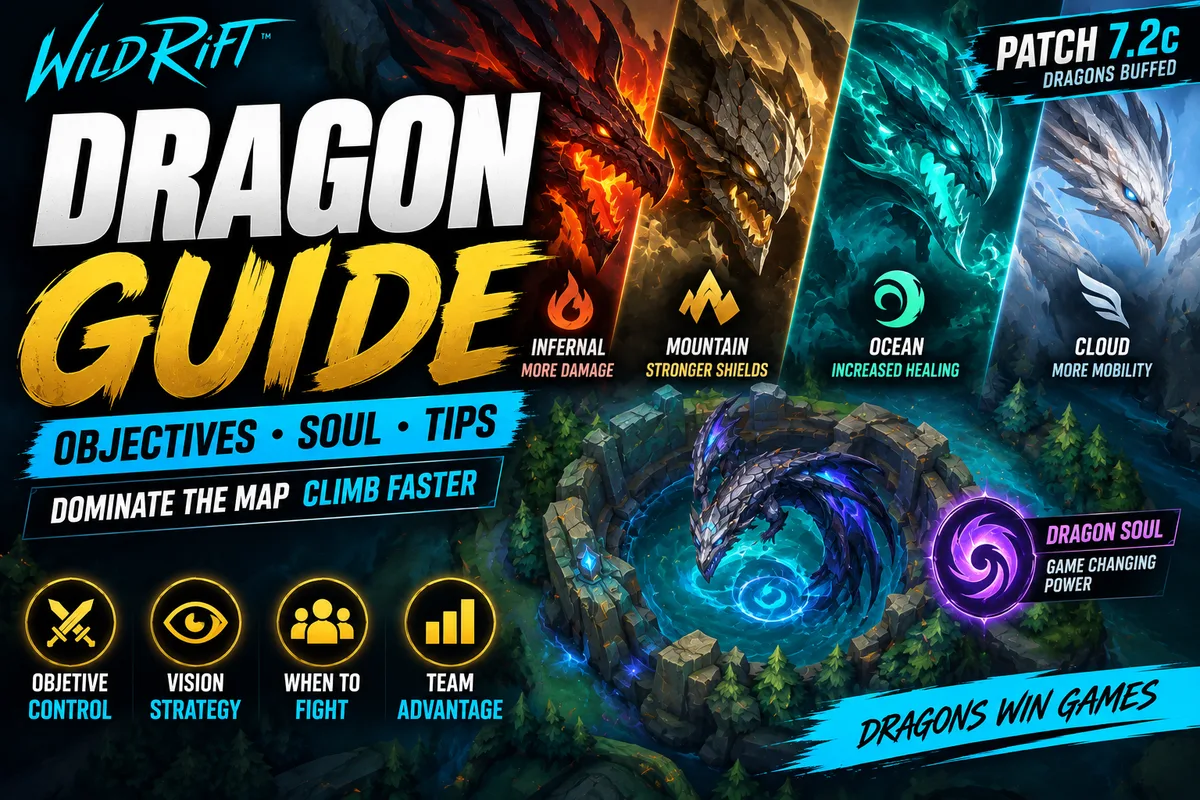
Wild Rift Dragon Guide 2026 | Objectives, Dragon Soul & When to Fight
Dragons are some of the most important objectives in Wild Rift.
A team that consistently controls Dragons can build powerful permanent advantages while also creating pressure around the bottom side of the map.
But simply taking every Dragon whenever it spawns is not good macro.
You need to know when to contest, when to trade, how to prepare vision and when giving up the objective is actually the correct decision.
This became even more important after Patch 7.2c, when Riot increased the impact of Elemental Dragons and Dragon Soul to make them more meaningful strategic objectives.
If you want to improve your macro and climb more consistently, understanding Dragon control is essential.
Why Dragons Matter in Wild Rift
Dragons provide permanent advantages to the team that secures them.
The exact value depends on which Elemental Dragon is taken, but the important concept is the same:
Dragon control gives your team long-term power.
Unlike a normal wave or jungle camp, the value of a Dragon continues affecting the game after the fight is finished.
That means teams should start preparing for an upcoming Dragon before it actually spawns.
Good Dragon control involves:
- Wave management
- Vision
- Jungle tracking
- Recall timing
- Team positioning
- Objective setup
- Smite management
- Knowing when to fight
Elemental Dragons Explained
Wild Rift has several Elemental Dragons, each providing a different type of advantage.
The main Dragon types are:
- Infernal Dragon
- Mountain Dragon
- Ocean Dragon
- Cloud Dragon
Each Dragon provides its own team benefit.
The value of a Dragon also depends on your team's composition.
For example, a team that wants to take extended fights may value a different Dragon benefit than a composition focused on burst damage or mobility.
This is why Dragon control should be viewed as part of your overall game plan rather than a simple checklist.
Dragon Soul
Dragon Soul is one of the biggest rewards your team can work toward.
After your team has secured enough Elemental Dragons, you can eventually gain the Dragon Soul associated with the Elemental Rift.
The Soul provides a powerful permanent combat effect and can dramatically change how your team approaches fights.
Patch 7.2c increased the impact of several Dragon Soul effects.
For example, Infernal Dragon Soul received higher adaptive damage, Mountain Dragon Soul received a larger shield and Ocean Dragon Soul received stronger healing.
That makes the later Dragon contest even more important.
Why Dragon Soul Changes the Game
A normal Dragon gives your team an advantage.
Dragon Soul can become a major win condition.
Once the enemy team is approaching Soul point, they are forced to think about the next Dragon very differently.
If they give it up, your team gets an enormous long-term advantage.
If they contest it, they may have to take a difficult teamfight around a heavily prepared objective.
This is why the Dragon before Soul point can be one of the most important fights of the match.
When Should You Fight for Dragon?
The biggest mistake is treating every Dragon as mandatory.
Sometimes the correct decision is to fight.
Sometimes the correct decision is to trade it for something else.
Before starting Dragon, ask:
- Where is the enemy jungler?
- Are my teammates alive?
- Do we have lane priority?
- Do we have vision?
- Are our ultimates available?
- Are our recalls finished?
- Is the enemy team stronger right now?
- Do we have Smite?
- Is the Dragon Soul at stake?
If your team has priority, vision and numbers, contesting becomes much safer.
If your bot lane has just recalled and your jungler is dead, starting Dragon may be a terrible decision.
Dragon Preparation Starts Before Spawn
Don't wait until the Dragon appears to think about the objective.
The best teams prepare in advance.
Push the Nearby Waves
If your lanes are pushed, your opponents have to spend time clearing minions.
That gives your team more freedom around the objective.
Recall Before the Fight
Spending all your gold and returning to the map with full resources is usually better than arriving at Dragon with thousands of unspent gold.
Establish Vision
Remove enemy wards and place your own vision around the approaches to the objective.
Track the Enemy Jungler
Knowing where the enemy jungler is can determine whether your team can safely start Dragon.
Save Smite
If you are the jungler, your Smite is one of the most important tools around the objective.
Don't waste it immediately before a major Dragon contest unless there is a specific reason.
Dragon Vision Control
Vision is one of the biggest differences between a clean Dragon setup and a coin-flip objective.
You want to know:
Where can the enemy enter from?
Don't only place one ward inside the Dragon pit.
Control the surrounding routes.
Look for:
- River entrances
- Jungle paths
- Bushes around the objective
- Nearby lane approaches
- Enemy wards
Clearing vision is equally important.
If the enemy can see your team starting Dragon, they can prepare their engage or attempt a steal.
Don't Start Dragon Blindly
Starting Dragon without knowing where the enemy jungler is can be extremely dangerous.
The enemy doesn't need to win a full teamfight.
They may simply enter the pit at the right moment and steal the objective.
Before starting, check the map.
If the enemy jungler is missing, ask where they could be.
Sometimes the correct play is to wait.
Other times you can use the threat of starting Dragon to force the enemy team into a bad position.
The Dragon Bait
You don't always have to immediately attack the Dragon.
Sometimes your team can use the objective as bait.
Start damaging it.
Force the enemy to respond.
Then stop attacking and turn onto the enemy team.
This can be particularly effective when your team has strong engage.
The enemy thinks they are walking into the Dragon pit.
Instead, they walk into five opponents prepared to fight.
When Should You Give Up Dragon?
Giving up an objective is not automatically a mistake.
If your jungler is dead and the enemy team has five players around Dragon, forcing the fight can turn one lost objective into multiple deaths.
Instead, look for a trade.
Depending on the game state, you might be able to take:
- Turret plates
- A tower
- Enemy jungle camps
- Rift pressure
- A kill on the opposite side
- Vision
- Another major objective
The goal is to make the enemy's Dragon advantage as expensive as possible.
Trading Dragon for Something Else
Good macro players understand that objectives have opportunity cost.
Imagine the enemy team starts Dragon while your Baron Lane champion is pushing the opposite side.
You might not be able to contest Dragon.
But you may be able to take a tower.
That is much better than running blindly toward Dragon after the enemy has already secured it.
Always ask:
What can we gain while they are taking this objective?
Dragon and Lane Priority
Lane priority is extremely important.
If your Dragon is spawning and both nearby lanes are pushed underneath your towers, your team has a problem.
The enemy can arrive first.
They can establish vision.
They can control the river.
Your team then has to enter through an area controlled by the opponent.
Instead, prepare the waves before the objective.
Push the lane.
Then move toward Dragon.
This creates a much safer setup.
The Jungler's Role Around Dragon
The jungler has several responsibilities.
Track the Enemy Jungler
You need to know whether the enemy Smite user is nearby.
Secure the Objective
Save your Smite for the final objective burst whenever possible.
Control Vision
Help remove enemy wards and protect your own vision.
Coordinate the Fight
Don't automatically jump into the Dragon pit.
Sometimes your job is to zone the enemy jungler away from the objective.
Don't Tunnel Vision
If the enemy team starts a fight outside the pit, don't forget that the Dragon is still the objective.
Your job is to make the correct decision for the team rather than simply chase kills.
The Support's Role Around Dragon
Supports also play a huge role in objective control.
Before Dragon:
- Clear vision
- Establish wards
- Protect the jungler
- Control entrances
- Help push the nearby lane
During the fight:
- Protect your carries
- Deny enemy entry
- Start fights when appropriate
- Watch for enemy flanks
A support doesn't need to get kills to win a Dragon fight.
Good vision and positioning can be more valuable.
Don't Fight Before Your Team Is Ready
A common mistake is starting the Dragon fight before everyone has arrived.
You might have four players ready while your strongest damage dealer is still clearing a wave.
Wait.
Check your minimap.
Make sure your team is actually prepared.
A few seconds of patience can turn a bad fight into an easy objective.
Dragon Fights Are About Positioning
The Dragon pit can create awkward fights because it limits movement.
This is especially dangerous for squishy champions.
Don't automatically walk into the pit.
Depending on your champion, it can be better to fight around the entrance and use the terrain to your advantage.
Your team should know:
- Who enters first
- Who protects the backline
- Who zones the enemy jungler
- Who secures the Dragon
- Who watches for flanks
Without a plan, the objective quickly becomes chaotic.
Don't Chase Kills After Winning Dragon
You secured the Dragon.
The objective is complete.
Now ask what happens next.
If the enemy team is retreating, chasing them halfway across the map may not be worth it.
Instead, consider:
- Resetting
- Taking nearby camps
- Pushing a lane
- Preparing the next objective
- Setting up vision
A successful objective should create another advantage.
Don't throw that advantage away chasing one extra kill.
Dragon Soul Strategy
Once your team is close to Dragon Soul, the game changes.
The enemy knows they cannot afford to give you another Dragon.
You should use that pressure.
Push lanes.
Clear vision.
Control entrances.
Force the enemy to walk into dangerous areas.
The Dragon itself becomes a threat that forces the enemy to respond.
You don't always need to immediately start it.
Sometimes simply controlling the area around Dragon is enough to create opportunities.
How to Play When the Enemy Has Soul Point
The opposite situation requires patience.
If the enemy is one Dragon away from Soul, you cannot casually give them the objective.
Start preparing early.
Push waves.
Recall.
Buy items.
Set vision.
Track the enemy jungler.
Then arrive before the objective becomes contested.
Do not wait until the Dragon is already at low health.
By then, you have surrendered control of the fight.
Common Dragon Mistakes
1. Starting Dragon Without Lane Priority
Your teammates are stuck under their towers while you start an objective.
The enemy arrives first.
2. Fighting Without Your Jungler
If the enemy jungler is alive and yours is dead, securing Dragon becomes much harder.
3. Ignoring Vision
Walking into a dark river is an invitation to get engaged.
4. Fighting 4v5
Wait for your missing teammate when possible.
5. Chasing Instead of Taking the Objective
Kills are not always more valuable than the objective.
6. Forgetting the Next Objective
After taking Dragon, think about what your team should do next.
7. Contesting Every Dragon
Not every objective is worth risking the entire game.
How Dragon Control Helps You Climb
Players often focus too heavily on KDA when reviewing their games.
Macro is just as important.
After a lost Dragon fight, ask:
- Did we arrive late?
- Did we have lane priority?
- Did we clear vision?
- Was our jungler alive?
- Did we recall beforehand?
- Did we start the objective too early?
- Did we fight in a bad position?
- Did we know where the enemy jungler was?
If you repeatedly lose Dragons for the same reason, fixing that one mistake can have a huge impact on your win rate.
Dragon Control for Different Roles
Baron Lane
Push your wave before moving toward Dragon when possible.
Don't abandon a huge wave for an unnecessary fight.
Jungle
Track both junglers and manage Smite carefully.
Your positioning around the objective can determine the entire fight.
Mid Lane
Mid priority is extremely valuable because you can reach the river quickly.
Push the wave and move first when possible.
Dragon Lane
Prepare the lane before the objective and avoid recalling at the worst possible moment.
Support
Control vision and protect your team's approach.
Your wards can determine whether the enemy gets an uncontested engage.
Final Thoughts
Dragon control is one of the clearest examples of why Wild Rift is more than individual mechanics.
You can have the best player on the team and still lose an objective because your waves were pushed incorrectly, your vision was missing or your jungler arrived late.
Good Dragon macro follows a simple process:
Push → Recall → Vision → Position → Fight or Trade → Secure → Reset
Don't blindly fight every Dragon.
Don't give away every Dragon either.
Learn to evaluate the game state and understand what your team can realistically accomplish.
Patch 7.2c has made Dragons and Dragon Soul more impactful, which makes objective control even more valuable for teams trying to climb.
If you consistently prepare your team for Dragon fights instead of reacting when the objective is already being attacked, you'll create more favorable fights and give yourself a much better chance of winning ranked games.
If you'd rather spend your time playing than grinding ranked, our Wild Rift rank boost puts an experienced high-rank booster on the climb for you.