What Is the Average Rank in LoL? 2026 Rank Distribution
What is the average rank in LoL? See the 2026 rank distribution, player percentages, top 10%, top 5%, top 1%, and where Gold, Emerald and Diamond stand.
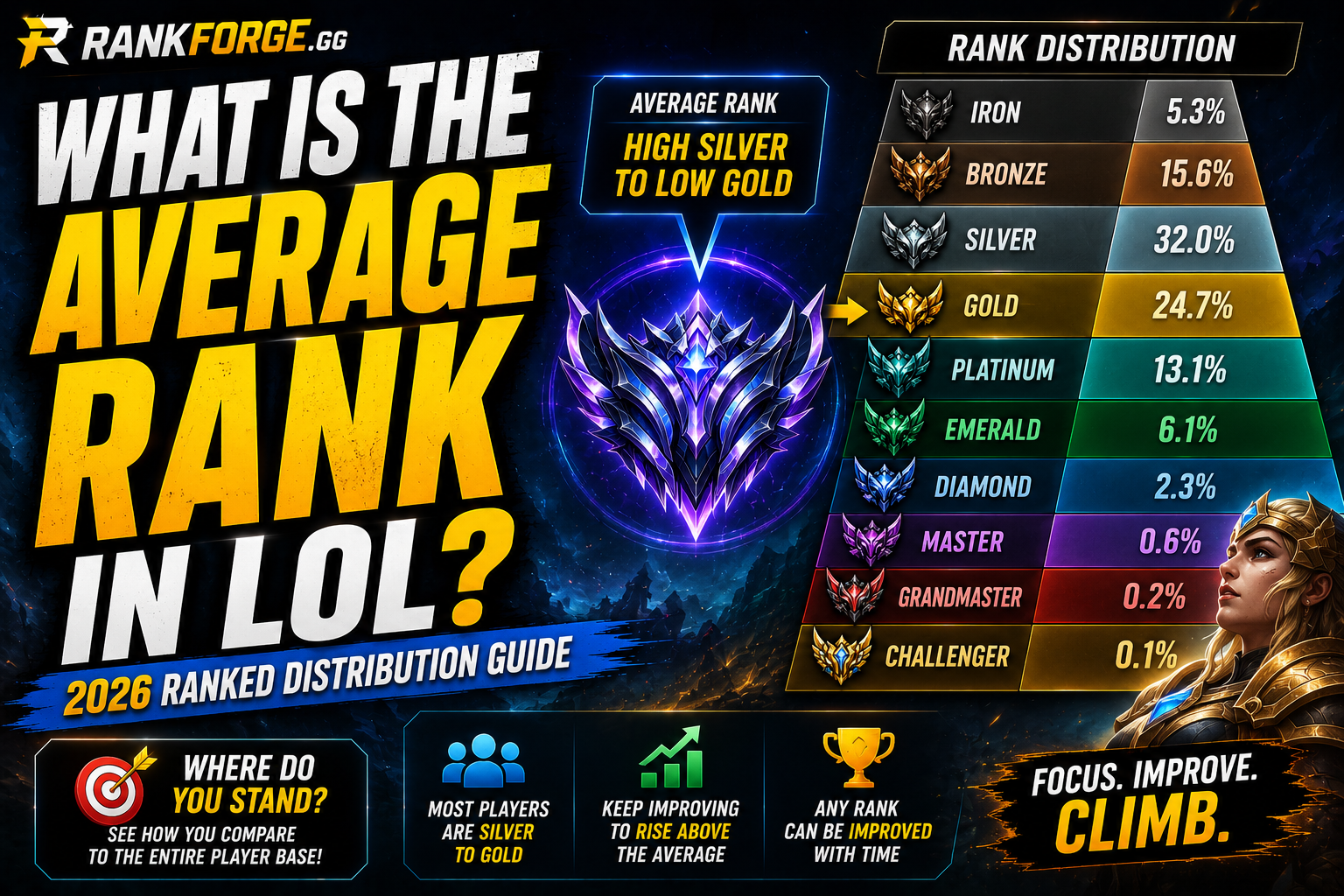
What Is the Average Rank in League of Legends? 2026 Rank Distribution
Wondering what the average rank is in League of Legends?
The current ranked Solo/Duo distribution puts the median player around Gold III. Gold is also the largest individual tier, containing about 23.4% of ranked players.
That means the answer is no longer simply "Silver or Gold." The current ladder has a much clearer middle, with Gold III sitting around the 50th percentile.
This guide breaks down the current LoL rank distribution, explains what percentage of players are in each tier, and shows what rank you need to reach the top 50%, 25%, 10%, 5%, and 1%.
Data note: Rank distributions change continuously as players climb, decay, and enter the ranked ladder. The figures in this guide are a September 2026 snapshot of ranked Solo/Duo players and should be treated as current estimates rather than permanent percentages.
For official information about the League ranked system, see the Riot Games Ranked Support.
What Is the Average Rank in LoL?
The median ranked Solo/Duo player is currently around Gold III.
The median is useful because it represents the player in the middle of the ranked population. Roughly half of ranked players are below that point and roughly half are above it.
Gold is also the largest tier overall, accounting for approximately 23.4% of ranked Solo/Duo players.
So if you are currently around Gold, you are close to the center of the ranked ladder.
If you are Platinum or higher, you are already above a large majority of the ranked population.
League of Legends Rank Distribution 2026
The current Solo/Duo distribution looks approximately like this:
| Rank | Share of Players | Approx. Percentile |
|---|---:|---:|
| Iron | 3.6% | Bottom 3.6% |
| Bronze | 15.7% | Top 96.4% |
| Silver | 20.8% | Top 80.7% |
| Gold | 23.4% | Top 59.8% |
| Platinum | 18.4% | Top 36.4% |
| Emerald | 13.3% | Top 17.9% |
| Diamond | 3.9% | Top 4.7% |
| Master | 0.68% | Top 0.74% |
| Grandmaster | 0.042% | Top 0.060% |
| Challenger | 0.018% | Top 0.018% |
These percentages are based on a current September 2026 Solo/Duo player distribution snapshot. Exact numbers change as the ranked population changes.
For the latest available distribution data, see LoL Rank Distribution.
What Percentage of Players Are in Each LoL Rank?
Iron
Iron represents approximately 3.6% of ranked Solo/Duo players.
It is the lowest tier and contains players at the beginning of the ranked ladder.
Bronze
Bronze accounts for approximately 15.7% of ranked players.
A player reaching Bronze is already above the very bottom portion of the ladder, although a large percentage of the population remains above Bronze.
Silver
Silver contains approximately 20.8% of ranked players.
Silver is one of the largest sections of the ladder and includes a significant portion of the overall ranked population.
Gold
Gold is the largest individual tier at approximately 23.4%.
Gold IV is the lowest Gold division, while Gold I is the highest.
The current distribution puts Gold III around the median, making it one of the most useful reference points when discussing the "average" LoL player.
Platinum
Platinum represents approximately 18.4% of ranked Solo/Duo players.
Platinum IV or higher is around the top 36% of the ranked population.
That means Platinum is clearly above the middle of the ladder.
Emerald
Emerald contains approximately 13.3% of ranked players.
Emerald IV or higher is around the top 18%.
Emerald therefore represents a significant step above the average ranked player.
Diamond
Diamond represents approximately 3.9% of ranked Solo/Duo players.
Diamond IV or higher places a player around the top 4.7% of the ranked population.
That makes Diamond a relatively uncommon rank compared with the large Silver, Gold and Platinum populations.
Master
Master contains approximately 0.68% of the ranked population.
Master or higher is around the top 0.74%.
At this point, the ranked population becomes extremely concentrated compared with the lower tiers.
Grandmaster
Grandmaster represents approximately 0.042% of players.
Grandmaster or higher is around the top 0.060%.
Challenger
Challenger represents approximately 0.018% of ranked Solo/Duo players.
It is the highest rank on the standard League ranked ladder.
What Rank Is Top 50% in League of Legends?
The exact cutoff moves over time, but current data puts Gold II or higher around the top 50% of ranked Solo/Duo players.
Gold III sits around the median.
This distinction is important:
- Gold III is approximately the middle of the population.
- Gold II is around the top 50% threshold.
- Gold IV is below the median threshold.
So if you're asking "what rank is average in League?", Gold III is currently a useful answer.
What Rank Is Top 25% in LoL?
Current September 2026 data puts Platinum II or higher around the top 25%.
That means reaching Platinum II places a player ahead of roughly three quarters of the ranked Solo/Duo population.
The exact percentile can change during the season, so treat this as a current snapshot rather than a permanent cutoff.
What Rank Is Top 10% in League?
The current top 10% threshold is approximately Emerald II.
In other words, reaching Emerald II or higher places you around the top 10% of ranked Solo/Duo players.
The current distribution puts Emerald II or higher at approximately the top 9.9%.
What Rank Is Top 5% in League?
Diamond IV is currently around the top 5% threshold.
The current distribution places Diamond IV or higher at approximately the top 4.7% of ranked Solo/Duo players.
So reaching Diamond is a much rarer achievement than reaching Gold or Platinum.
What Rank Is Top 1% in League?
The current top 1% threshold is approximately Master.
Master or higher represents around the top 0.74% of ranked Solo/Duo players.
That puts Master firmly inside the top 1% of the current ranked population.
What Rank Is Considered Above Average in LoL?
There is no official Riot definition of an "above-average" rank.
However, statistically, anything above the median is above the middle of the ranked population.
Using the current distribution as a reference:
- Gold III: around the median
- Gold II+: roughly top 50%
- Platinum II+: roughly top 25%
- Emerald II+: roughly top 10%
- Diamond IV+: roughly top 5%
- Master+: roughly top 1%
These thresholds change as the ranked population changes.
Is Gold a Good Rank in League of Legends?
Gold is close to the center of the current ranked distribution.
Because Gold is the largest tier, reaching Gold does not put a player into a small elite group. However, it does mean the player has progressed beyond the lower tiers of the ranked ladder.
Gold III is particularly useful as a reference because it is around the current median.
If your goal is simply to be above the average ranked player, reaching the upper part of Gold is a reasonable milestone.
Is Platinum Above Average?
Yes, based on the current distribution.
Platinum IV or higher is around the top 36% of ranked Solo/Duo players.
Platinum II or higher is around the top 25%.
That means Platinum is clearly above the middle of the current ranked population.
Is Emerald a High Rank?
Emerald is considerably less populated than Gold or Platinum.
Emerald IV or higher is around the top 18% of ranked players, while Emerald II or higher is around the top 10%.
This makes Emerald a useful milestone for players who want to reach the upper portion of the ranked ladder without entering the extremely small Diamond-and-above population.
How Rare Is Diamond in LoL?
Diamond IV or higher represents approximately the top 4.7% of ranked Solo/Duo players.
The individual Diamond divisions are much smaller than Gold, Silver or Platinum.
This is why Diamond can feel significantly more competitive than the middle ranks.
Players in Diamond are also exposed to a much smaller pool of opponents compared with the broad populations found in Silver, Gold and Platinum.
How Rare Is Master in League of Legends?
Master or higher represents approximately the top 0.74% of ranked Solo/Duo players.
That means fewer than one in every 100 ranked players is currently at Master or above.
Grandmaster and Challenger are substantially rarer still.
Current estimates put:
- Master+: top 0.74%
- Grandmaster+: top 0.060%
- Challenger: top 0.018%
Average Rank vs Most Common Rank
"Average rank" can mean several different things.
Median Rank
The median is the player in the middle of the ranked population.
Currently, that is around Gold III.
Most Common Division
The most populated individual division is currently Gold IV.
Largest Tier
Gold is the largest tier overall, with approximately 23.4% of ranked players.
These three measurements are different, which is why different websites can sometimes give different answers when discussing the "average rank."
Why Does LoL Rank Distribution Change?
Rank distribution is not static.
It changes throughout the season because:
- New players complete placements.
- Existing players climb.
- Players stop playing ranked.
- High-ranked players can decay.
- Players move between divisions and tiers.
- Regional populations have different distributions.
Because of this, a rank that represents the top 10% today may represent a slightly different percentile later in the season.
For that reason, rank distribution guides should always include a date or season reference.
Does Rank Distribution Include Flex Queue?
This guide focuses on Ranked Solo/Duo.
Solo/Duo and Flex are separate ranked queues and have different player populations.
Mixing the two queues can produce a misleading picture of where the average ranked player sits.
Average Rank vs MMR
Your visible rank and your hidden matchmaking rating are related, but they are not exactly the same thing.
Rank determines your visible position on the ranked ladder.
MMR is used by the matchmaking system to help determine the skill level of opponents and teammates you are matched with.
This means two players at the same visible rank can have different matchmaking histories and different MMR.
Your LP gains and losses can also be affected by the relationship between your current rank and your matchmaking rating.
For a deeper explanation, see our LoL MMR Explained.
How to Improve Your League Rank
If you're currently around the middle of the ladder, improving does not require mastering every champion or playing hundreds of games at once.
Focus on a small number of repeatable fundamentals.
Play a Small Champion Pool
Using fewer champions makes it easier to build consistent mechanics, matchup knowledge and decision-making.
Improve CS
Consistent farming gives you more gold and experience without requiring risky fights.
Review Your Deaths
Instead of only looking at whether you won or lost, identify why you died.
Repeated unnecessary deaths can have a larger impact on your climb than a single mechanical mistake.
Improve Objective Control
Track dragons, towers, Rift Herald and Baron instead of treating kills as the only path to victory.
Avoid Tilt Queueing
If your decision-making becomes noticeably worse after several losses, taking a break can be more productive than immediately starting another game.
For more detailed climbing advice, see our Fastest Way to Rank Up in LoL.
If you're still completing your placements, see our LoL Placement Matches Guide.
For an explanation of the complete ranked ladder, see our LoL Ranked System Explained.
LoL Rank Distribution at a Glance
If you only want the key numbers, use these current benchmarks:
| Goal | Approximate Rank |
|---|---|
| Median player | Gold III |
| Top 50% | Gold II+ |
| Top 25% | Platinum II+ |
| Top 20% | Emerald IV+ |
| Top 10% | Emerald II+ |
| Top 5% | Diamond IV+ |
| Top 1% | Master+ |
| Top 0.1% | Grandmaster+ |
These are September 2026 Solo/Duo estimates and will move over time.
Final Thoughts
The current answer to "What is the average rank in League of Legends?" is approximately Gold III for the median ranked Solo/Duo player.
Gold is the largest tier, but the distribution becomes much narrower as you move toward Emerald, Diamond and the Master+ ranks.
A useful way to view the current ladder is:
Gold III → around the middle
Platinum II → top 25%
Emerald II → top 10%
Diamond IV → top 5%
Master → top 1%
Remember that these percentages are snapshots rather than permanent values. The ranked population changes throughout the season, and different regions can have different distributions.
If your goal is to climb beyond the middle of the ladder, focus on consistent improvement rather than comparing yourself with professional players or streamers.